
Argentina files criminal complaints after UK issues Falklands business guidance
Coveragetap to expand ▾Spectrum: Center Only🌍Asia: 1 · LatAm: 1
- Argentina's foreign ministry rejected the United Kingdom's guidance for companies in the Falklands (per en.mercopress.com).
- Argentina said it will apply Argentine law against firms conducting hydrocarbons in the Falklands area without Argentine authorization (per en.mercopress.com).
- The dispute as reported centers on companies engaged in hydrocarbons activity in and around the Falklands, which Argentina treats as requiring Argentine authorization (per en.mercopress.com).
Argentina escalated a legal confrontation with Britain over hydrocarbons activity in the Falklands after the United Kingdom issued guidance asserting London’s sovereignty and saying Argentine law does not apply.
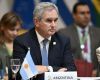
Buenos Aires’ foreign ministry publicly rejected the UK guidance and moved to enforce its domestic legal claims: Foreign Minister Pablo Quirno filed three criminal complaints targeting ten companies and their directors for conducting hydrocarbons operations in waters Argentina considers subject to its law (per en.mercopress.com).
The filings signal Argentina will use criminal law rather than purely diplomatic channels to contest private-sector activity tied to the islands.
London’s guidance — aimed at companies operating near the Falklands — frames those operators as subject to UK authority; Argentina’s formal complaints present the opposite legal claim and elevate the dispute from policy rhetoric to potential prosecutions (per en.mercopress.com).
Argentina framed its action around the need to protect its sovereign jurisdiction over hydrocarbon resources, while the UK guidance stresses British sovereignty and legal certainty for firms; the Mercopress report records both positions but does not include statements from the targeted companies or from UK officials (per en.mercopress.com).
The immediate consequence is legal exposure for the ten named companies and their directors under Argentine law, which could complicate investment decisions and contractual operations in the contested area even as diplomatic exchanges continue (per en.mercopress.com).
Observers should expect further filings or enforcement steps from Buenos Aires and legal responses or clarifying guidance from London, but Mercopress does not report
- Argentine citizens involved in coastal provinces and energy-sector workers face legal and economic disruption because Argentina is pursuing criminal complaints against ten companies and their directors for hydrocarbons activity (per en.mercopress.com). 2) The ten targeted companies bear immediate legal risk and potential operational costs because Argentina said it will apply Argentine law to hydrocarbons activity in the area (per en.mercopress.com). 3) The United Kingdom benefits from offering legal certainty to firms operating under British guidance, preserving investment flows in the Falklands area as framed by London (per en.mercopress.com).
Whether Foreign Minister Pablo Quirno pursues prosecutions or seeks court injunctions against the ten named companies within the Argentine judicial system. 2) Whether the United Kingdom issues a formal diplomatic protest or legal clarification rebutting Argentina's criminal complaints at the level of UK foreign authorities. 3) Whether any of the ten companies named in the complaints suspend or alter hydrocarbons operations in the contested area in response to Argentine filings.
- Only en.mercopress.com is available in this pack; it frames Argentina as rejecting UK guidance and filing complaints while noting the UK guidance affirms British sovereignty (per en.mercopress.com).
- No source in this pack disputes facts reported by Mercopress; absence of other outlets means competing accounts or denials (for example from the UK or the named companies) are not present.
- No source in this pack quotes any of the ten companies or provides the companies' names or the specific allegations in the criminal complaints.
- No source in this pack cites any UK government response, legal analysis of the applicability of Argentine law, or whether prior regulatory steps preceded the UK guidance.
- Only one figure appears: Mercopress reports 'three criminal complaints' and 'ten companies' (per en.mercopress.com).
- Mercopress presents the sequence as: the UK published guidance asserting sovereignty → Argentina rejected the guidance and filed criminal complaints; no additional triggering actions are reported (per en.mercopress.com).
- Mercopress attributes the filing of the complaints to Foreign Minister Pablo Quirno and attributes the UK guidance's assertion of sovereignty to the United Kingdom (per en.mercopress.com).