
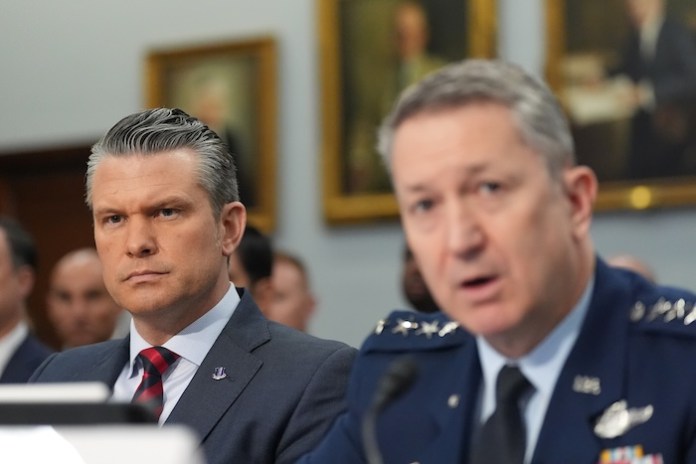
Hegseth Asserts US Maintains Strong Stance on Iran Amid Ongoing Tensions
Coveragetap to expand ▾Spectrum: Mostly Right🌍US: 2 · ME: 1
- US Defense Secretary Pete Hegseth stated that the US has not capitulated on its demands from Iran (per aljazeera.com).
- The US and Israel launched coordinated military strikes against Iran in early March 2026 (context).
- Iranian military actions are responses to the US and Israeli military campaign (context).
In a recent Pentagon briefing, US Defense Secretary Pete Hegseth firmly stated that the United States has not yielded to Iran regarding its demands, asserting that the US retains the 'upper hand' in the ongoing geopolitical tensions. This declaration comes in the wake of coordinated military strikes by the US and Israel against Iran, which began in early March 2026.
These strikes have led to a series of retaliatory actions from Iran, further escalating the situation in the region. Hegseth's comments underscore the US administration's stance of maintaining a strong position against Iran, despite the complexities of the current conflict.
The US's military engagement with Iran is part of a broader strategy to counter perceived threats and assert its influence in the Middle East. The ongoing conflict has seen significant military exchanges, with both sides experiencing casualties and damage.
The US's approach to Iran has been characterized by a combination of military pressure and diplomatic efforts, aiming to curb Iran's influence and nuclear ambitions. However, the situation remains tense, with potential for further escalation as both sides continue to engage in military actions.
Hegseth's assertion of the US's upper hand is likely intended to reassure allies and deter adversaries, signaling that the US will not back down from its strategic objectives. This stance is consistent with the US's historical approach to dealing with Iran, which has often involved a mix of sanctions, diplomatic isolation, and military readiness.
The broader implications of this conflict are significant, affecting not only regional stability but also global energy markets and international diplomatic relations. As the situation develops, many governments will be closely monitoring the actions of both the US and Iran, as well as the responses from other key players in the region.
While Hegseth's remarks project confidence, the reality on the ground remains complex and fluid, with both sides preparing for potential further confrontations. The outcome of this ongoing conflict will have lasting impacts on the geopolitical landscape of the Middle East and beyond.
- The ongoing conflict between the US and Iran affects regional populations, particularly in Iran, where military actions have led to civilian casualties and infrastructure damage.
- The US's military and diplomatic stance impacts global energy markets, as tensions in the Middle East can lead to fluctuations in oil prices, affecting economies worldwide.
- US allies in the region, such as Israel, benefit from the US's strong stance against Iran, as it aligns with their security interests and regional strategies.
- Whether the US will engage in further military actions against Iran in the coming weeks.
- Iran's potential retaliatory measures in response to US and Israeli military actions.
- Diplomatic efforts by other nations to mediate or influence the conflict's trajectory.
Left- and right-leaning outlets are covering this story differently — in which facts to emphasize, which context to include, and how to frame causes and consequences.
7 specific areas where coverage diverges — see below.
- No significant framing differences noted as only one source was provided.
- No disputed or unclear facts noted as only one source was provided.
- No source mentions the specific civilian impact of the US and Israeli strikes on Iran.
- No differing figures noted as only one source was provided.
- No causality disagreements noted as only one source was provided.
- No differing attributions noted as only one source was provided.