
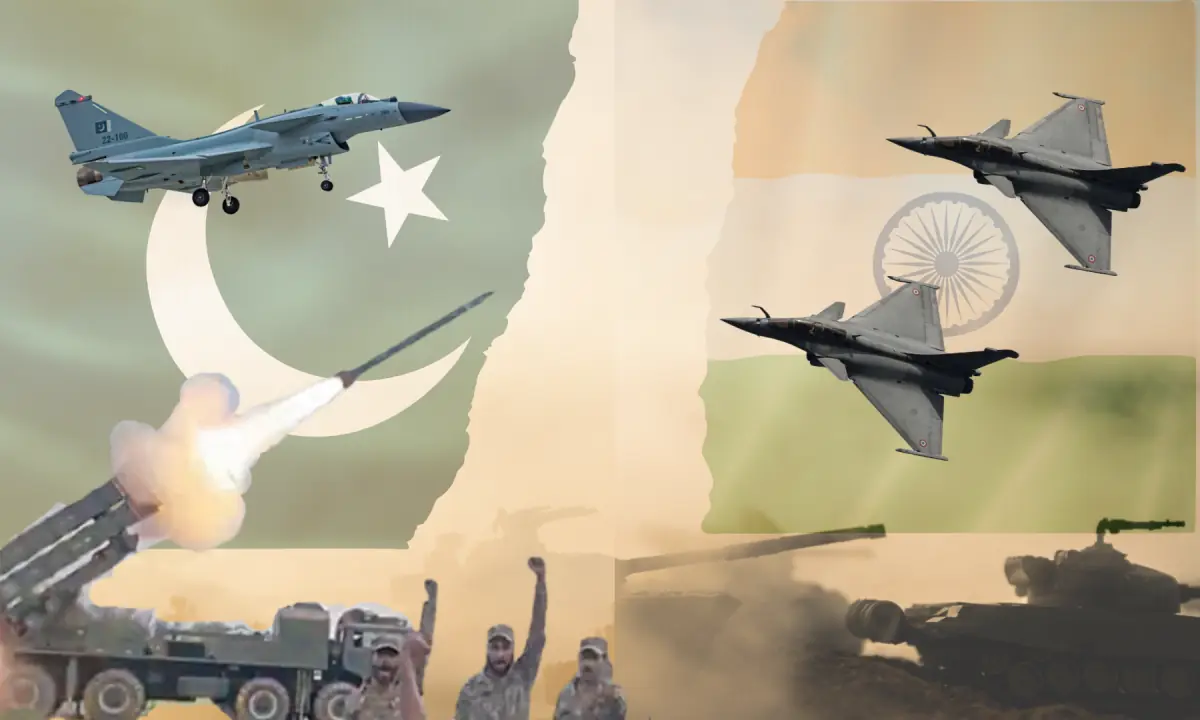
Pakistan Downs Indian Jets Amid Intense Border Conflict
Coveragetap to expand ▾Spectrum: Center Only🌍ME: 1
- The 2025 conflict between Pakistan and India began with exchanges of fire on the Line of Control starting April 26 (per dawn.com).
- From May 6 to May 10, Pakistan and India engaged in a military conflict involving missile exchanges (per dawn.com).
- The conflict resulted in the deaths of at least 31 Pakistani civilians (per dawn.com).
The 2025 military conflict between Pakistan and India marked a significant escalation in tensions between the two nuclear-armed neighbors. The conflict began with exchanges of fire on the Line of Control on April 26, which heightened tensions and led to a full-scale military engagement from May 6 to May 10.
During this period, both nations exchanged missiles, raising global concerns about the potential for further escalation. In response to the rising tensions, Pakistan's Prime Minister Shehbaz Sharif visited the Inter-Services Intelligence headquarters on May 6, signaling the country's readiness for potential conflict.
Defence Minister Khawaja Asif echoed this sentiment, warning that clashes with India could occur at any moment. The conflict resulted in significant casualties, with at least 31 Pakistani civilians killed.
In a notable military achievement, Pakistan managed to shoot down at least seven Indian jets, a move that was internationally recognized as a clear setback for India. many governments closely monitored the situation, given the potential for the conflict to escalate into a broader regional crisis.
Both nations have a history of military confrontations, but the involvement of nuclear capabilities added a layer of complexity and danger to the situation. While the immediate conflict has subsided, the underlying tensions between Pakistan and India remain unresolved.
The events of 2025 serve as a reminder of the fragile peace in the region and the potential for future conflicts if diplomatic solutions are not pursued. The conflict has also highlighted the need for international mediation to prevent further escalation and to address the root causes of the tensions between the two countries.
As both nations continue to rebuild and recover from the conflict, many governments's role in facilitating dialogue and promoting peace will be crucial.
- Pakistani civilians bear the concrete costs, with at least 31 killed during the conflict (per dawn.com).
- The conflict underscores the ongoing risk of military escalation between nuclear-armed neighbors, affecting regional stability.
- Pakistan's military actions, such as shooting down Indian jets, demonstrate its defense capabilities and strategic responses.
- The international community's recognition of India's setback highlights the geopolitical implications of the conflict.
- Whether Pakistan and India engage in diplomatic talks to address the underlying tensions.
- Monitoring any further military engagements or exchanges of fire along the Line of Control.
- International mediation efforts to prevent future conflicts and promote peace in the region.
- No source mentions the specific economic interests or trade impacts resulting from the conflict.
- The role of international diplomatic efforts in de-escalating the conflict is not detailed.
- The historical context of previous conflicts between India and Pakistan is not fully explored.