
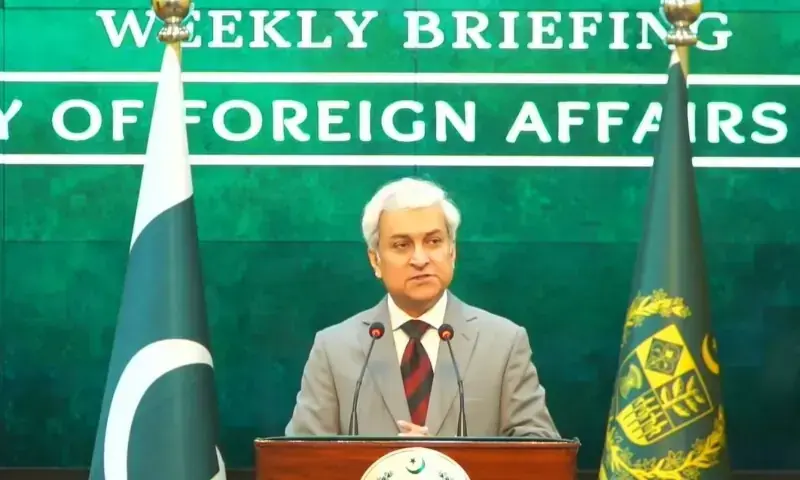
“If an agreement is reached in Pakistan, it would be an honour for us,” he said.
Coveragetap to expand ▾Spectrum: Center Only🌍ME: 1
- Pakistan has expressed interest in hosting peace talks between the United States and Iran (per dawn.com).
- Foreign Office spokesperson Tahir Andrabi stated that reaching an agreement in Pakistan would be an honor (per dawn.com).
- Pakistan is hopeful for a settlement between the US and Iran, regardless of the location (per dawn.com).
- The Pakistani Prime Minister has expressed hope that current diplomatic efforts will lead to lasting peace and stability (per dawn.com).
Pakistan has expressed its willingness to play a mediating role in the ongoing diplomatic efforts between the United States and Iran. During a recent briefing, Foreign Office spokesperson Tahir Andrabi highlighted Pakistan's hope that an agreement could be reached on its soil, which would be considered an honor for the country.
Andrabi's remarks come amid reports that Iran is evaluating a new proposal from the US, following the suspension of 'Project Freedom,' an initiative aimed at opening the Strait of Hormuz.
The Pakistani government has shown optimism about the potential for a settlement between the US and Iran, emphasizing that the location of such an agreement is secondary to the achievement of peace itself. Andrabi reiterated that Pakistan would welcome a resolution wherever it may occur, underscoring the country's commitment to fostering regional stability.
The Prime Minister of Pakistan has also expressed hope that the current diplomatic momentum will lead to a durable agreement, securing peace and stability for the region and beyond. This sentiment reflects Pakistan's strategic interest in maintaining stability in its neighborhood, particularly given the geopolitical tensions involving major powers.
The backdrop to these developments includes the US's recent suspension of 'Project Freedom,' which was designed to ensure the free passage of oil through the Strait of Hormuz, a critical chokepoint in global energy supply. The proposal under review by Tehran is seen as a potential step towards de-escalating tensions that have simmered in the region.
Pakistan's offer to host talks is part of its broader diplomatic strategy to position itself as a key player in regional peace efforts. By facilitating dialogue between the US and Iran, Pakistan aims to enhance its international standing and contribute to a peaceful resolution of conflicts that have far-reaching implications.
As the situation evolves, many governments will be watching closely to see if Pakistan's aspirations to mediate will materialize into concrete diplomatic engagements. The outcome of these efforts could significantly impact the geopolitical landscape of the Middle East and South Asia.
- The people of Pakistan could benefit from increased international prestige and influence if the country successfully hosts US-Iran peace talks.
- The Iranian and American populations bear the costs of ongoing tensions, which affect regional security and economic stability.
- Pakistan's involvement in mediation efforts could enhance its diplomatic relations with both the US and Iran, potentially leading to economic and strategic benefits.
- Whether Iran accepts the new US proposal under review.
- Any official announcement from Pakistan regarding hosting the US-Iran talks.
- Developments in 'Project Freedom' and its impact on the Strait of Hormuz.
- No source mentions the specific contents of the US proposal under review by Iran.
- The potential economic impacts on Pakistan if it hosts the talks are not discussed.
- The historical context of US-Iran tensions and previous diplomatic efforts is not detailed.
- Tahir Andrabi: 'If an agreement is reached in Pakistan, it would be an honour for us.'