
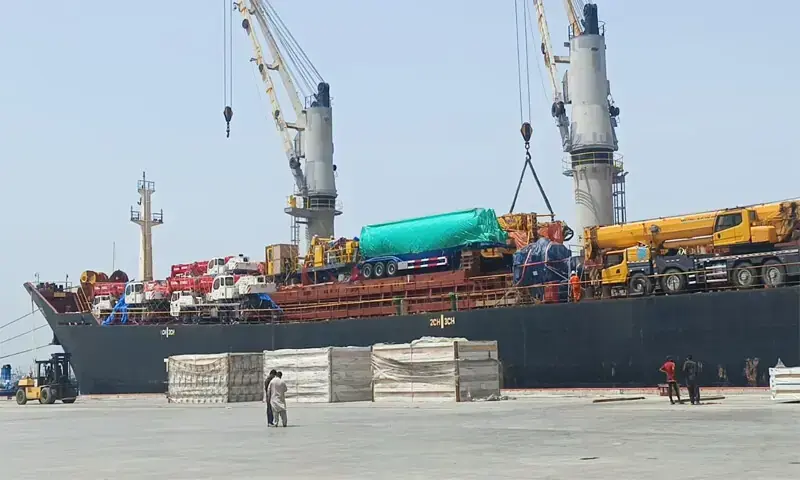
He added that port charges on transit container cargo have also been reduced by up to 31pc.
Coveragetap to expand ▾Spectrum: Center Only🌍ME: 1 · Asia: 1
- Govt reduces tariffs at Gwadar Port in bid to boost global traffic He added that port charges on transit container cargo have also been reduced by up to 31pc.
- Federal Minister for Maritime Affairs Junaid Anwar Chaudhry on Monday announced a major reduction in tariffs at Gwadar Port aimed at boosting global transit traffic, according to an official statement.
- According to the statement, the minister said that berthing fees for container ships have been reduced by 25 per cent, while port charges on international transshipment containers have been cut by 40pc.
- Further, a one-month free storage facility has been introduced for general cargo, compared to the standard five-day allowance at other national ports, the minister added.
- “Ships bringing transit and transshipment cargo have been given major relief,” Chaudhry was quoted as saying.
In a bid to enhance its position as a key transit hub, the Federal government of Pakistan has announced significant reductions in tariffs at Gwadar Port.
Federal Minister for Maritime Affairs Junaid Anwar Chaudhry revealed that port charges on transit container cargo will be reduced by up to 31 percent, alongside a 25 percent cut in berthing fees for container ships and a 40 percent reduction in charges for international transshipment containers.
This initiative aims to attract more global traffic to the port, which is strategically located along the China-Pakistan Economic Corridor. The government has also introduced a one-month free storage facility for general cargo, which is expected to provide further incentives for shipping lines.
Chaudhry emphasized that these measures are designed to substantially lower operational costs compared to other national ports, making Gwadar a more competitive option for international shipping.
The announcement comes as part of broader efforts to boost trade and economic activity in the region, reflecting Pakistan's commitment to enhancing its maritime infrastructure and services.
- The reduction in port charges at Gwadar Port significantly lowers operational costs for shipping companies, making it a more attractive hub for international trade.
- This change directly benefits importers and exporters in the Asia Pacific region, as they can now access more competitive shipping rates and improved logistics.
- Additionally, the introduction of a one-month free storage facility for general cargo enhances the port's appeal, potentially increasing transit traffic and stimulating local economies reliant on maritime trade.
- Monitor the response from major shipping companies regarding the reduced port charges, as they may adjust their pricing strategies within the next month.
- Watch for announcements from regional trade associations about potential new shipping routes or partnerships that could emerge in the wake of these cost reductions, expected within the next quarter.
- Keep an eye on government reactions from neighboring countries, particularly any proposed changes to their own port fees or trade policies, which could be revealed before the upcoming regional trade summit.
- Anticipate updates from logistics firms on how these changes will impact their operational costs and service offerings, likely to be discussed in their next quarterly earnings reports.
- Look for statements from import/export businesses that may adjust their supply chain strategies in response to the reduced charges, expected to be shared within the next two weeks.