
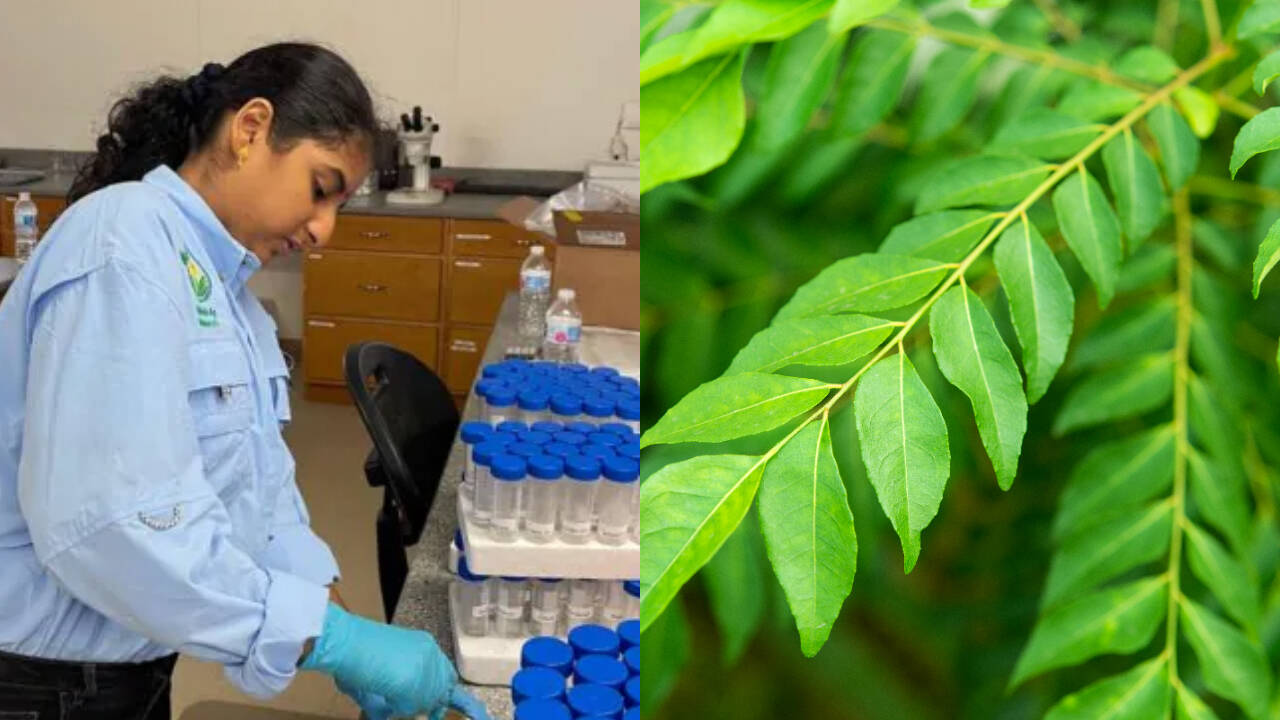
17-year-old Tanishka Aglave wins $50,000 for three-part citrus greening treatment
Topic: healthRegion: asia pacificUpdated: i2 outletsSources: 2Spectrum: Center Only⏱ 3 min read⚠ 48h+ old
Story Summary
SITUATION
Tanishka Aglave developed a three-pronged system — a curry leaf–based bactericide, a localized steam-therapy device, and an AI disease-tracking tool — and won a $50,000 Davidson Fellowship. The project took more than 300 hours starting in her freshman year and targeted citrus greening in Florida growers' groves (per timesofindia.indiatimes.com).
Coveragetap to expand ▾Spectrum: Center Only🌍Asia: 1 · Africa: 1
Political Spectrum
Position is inferred from coverage mix.
i2 outlets · Center
Left
Center
Right
Left: 0
Center: 2
Right: 0
Geography Coverage
Distribution of where coverage is coming from.
i2 unique outlets · Dominant: Asia
KEY FACTS
- Aglave won a $50,000 scholarship as a 2026 Davidson Fellow for the work (per timesofindia.indiatimes.com)
- The work took over 300 hours and began in her freshman year (per timesofindia.indiatimes.com)
- The three components are presented as complementary: a natural bactericide, a mechanical steam treatment, and an AI tracker for disease monitoring (per timesofindia.indiatimes.com)
HISTORICAL CONTEXT
The immediate backdrop is the long-running Huanglongbing (HLB, or citrus greening) crisis that has devastated U.S. citrus since the Asian citrus psyllid was first detected in Florida in 1998 and HLB was confirmed in Florida groves in January 2005; state quarantines and grower emergency measures have been continuous through the 2010s and 2020s.
Structural responses that shaped the field include the creation of the Citrus Research and Development Foundation (CRDF) in 2009 to coordinate HLB research, repeated USDA and state funding packages for HLB mitigation across the 2010s and early 2020s, and regulatory pesticide labels and quarantine rules implemented by the Florida Department of Agriculture since 2006.
Brief
Seventeen-year-old Tanishka Aglave won a $50,000 Davidson Fellowship for a three-pronged system she developed to fight citrus greening, a disease threatening Florida citrus groves.
Aglave combined a curry leaf–based bactericide with a localized steam-therapy device and an artificial-intelligence disease-tracking tool; the project took her more than 300 hours and began in her freshman year (per timesofindia.indiatimes.com).
The work is framed as an integrated approach: the curry leaf extract is presented as a biologically derived bactericide, the steam system as a targeted physical therapy to affected trees, and the AI tool as a way to monitor and predict outbreaks so interventions can be timed more effectively (per timesofindia.indiatimes.com).
The Davidson Fellowship awarded Aglave a $50,000 scholarship in recognition of the project's scope and potential applicability to Florida growers coping with citrus greening (per timesofindia.indiatimes.com).
The reporting emphasizes the student-driven research process — over 300 hours across high-school years — rather than independent field trials or large-scale grower adoption; the source does not document widescale efficacy measures, commercial partners, or regulatory approvals for the bactericide or device (per timesofindia.indiatimes.com).
What remains to be tested publicly is whether the curry leaf bactericide and localized steam therapy can control the bacterial pathogen in operational grove conditions and how the AI tracker performs outside trial datasets; the article reports the invention and award but does not provide independent validation data or deployment timelines (per timesofindia.indiatimes.com).
Aglave's win spotlights a student innovation pathway from school research to recognized funding, while leaving open the practical steps needed to move from prototype and scholarship to grower-ready tools (per timesofindia.indiatimes.com).
Why it matters
- Florida citrus growers bear direct costs: citrus greening reduces yields and tree health, and Aglave's tools—if validated—target that mechanism via bactericide application, steam therapy, and AI-based timing (per timesofindia.indiatimes.com).
- The $50,000 Davidson Fellowship funds further development and could help Aglave advance prototypes toward pilot testing, giving her a concrete means to seek growers or research partners (per timesofindia.indiatimes.com).
- If the curry leaf–based bactericide proves effective in field trials, citrus producers in Florida could gain a lower-cost, plant-derived treatment alternative to chemical bactericides, changing pest-management options (per timesofindia.indiatimes.com).
What to watch next
- Whether Tanishka Aglave uses the $50,000 Davidson Fellowship award to fund field trials of the curry leaf bactericide and steam device within the next 12 months (per timesofindia.indiatimes.com).
- Whether any Florida grower associations or university extension programs agree to pilot Aglave's system in commercial groves and report efficacy data (per timesofindia.indiatimes.com).
- Whether the AI disease-tracking tool is validated against independent outbreak data and released for grower use or research collaboration (per timesofindia.indiatimes.com).
Where sources differ
7 dimensionsFraming differences
?- Only timesofindia.indiatimes.com is provided; no other outlet in this pack offers alternative framing or omissions to compare.
Disputed or unclear
?- Efficacy in commercial grove conditions remains unverified in the provided source; no source in this pack disputes or confirms field effectiveness (per timesofindia.indiatimes.com).
Omitted context
?- No source in this pack mentions prior field trials or independent validation data for the curry leaf bactericide or steam device.
- No source names specific Florida grower organizations, university partners, regulatory approvals, or commercialization plans.
- No source provides quantified expected yield improvements, cost estimates for deployment, or timelines for testing and adoption.
Conflicting figures
?- Only one figure is provided: the $50,000 Davidson Fellowship award (per timesofindia.indiatimes.com); no conflicting figures appear.
Disputed causality
?- The article presents Aglave's project as a response to citrus greening in Florida groves but does not document prior interventions or trials that led to the specific design choices.
Attribution disputes
?- timesofindia.indiatimes.com attributes the three-pronged system and the $50,000 award to Tanishka Aglave; no alternative attribution appears in this pack.
Sources
2 of 2 linked articles