
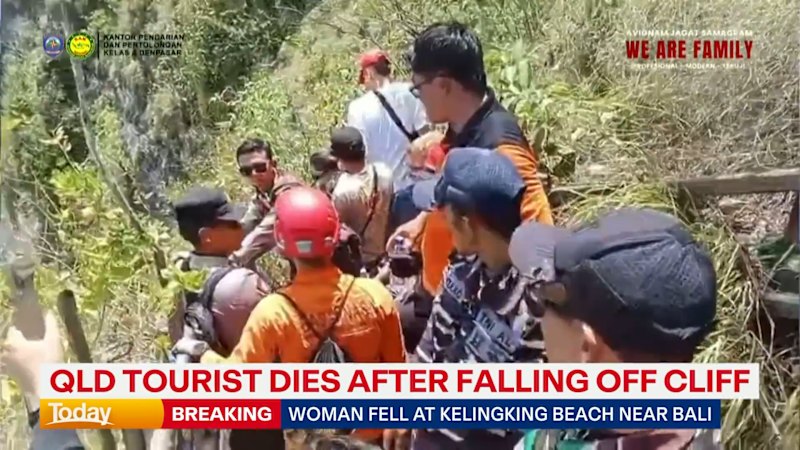
Australian tourist fell 80 metres from Nusa Penida cliff and died
Topic: generalRegion: asia pacificUpdated: i2 outletsSources: 5Spectrum: Center Only⏱ 2 min read⚠ 3d+ old
Story Summary
SITUATION
A 29-year-old Australian woman fell 80 metres from a popular tourist cliff in Nusa Penida and was killed (per smh.com.au). The Sydney Morning Herald reported the single fatality and did not cite any other casualties or additional circumstances (per smh.com.au).
Coveragetap to expand ▾Spectrum: Center Only🌍Europe: 1 · Asia: 1
Political Spectrum
Position is inferred from coverage mix.
i2 outlets · Center
Left
Center
Right
Left: 0
Center: 2
Right: 0
Geography Coverage
Distribution of where coverage is coming from.
i2 unique outlets · Dominant: Europe
KEY FACTS
- A 29-year-old Australian woman fell 80 metres and died.
- The incident involved a single fatality; no other casualties were reported in the article.
HISTORICAL CONTEXT
The immediate backdrop is a sustained surge in foreign visitors to Bali and nearby Nusa Penida since international borders reopened after the COVID-19 pandemic, which led local authorities to repeatedly warn about overcrowded viewpoints and informal access routes in 2022–2024. Structurally, Indonesia’s tourism framework under Law No.
10 of 2009 (Tourism) and subsequent provincial ordinances placed responsibility for visitor safety with regencies and village administrations, prompting a mix of formal signage campaigns and ad hoc measures by local tourist operators.
Brief
A 29-year-old Australian woman died after falling 80 metres from a popular tourist cliff on Nusa Penida near Bali, the Sydney Morning Herald reported. The newspaper’s account identifies a single fatality and does not name any other casualties or offer further on-the-ground detail about what led to the fall.
The report gives the basic facts — age, nationality, height of the fall and location — but it omits how or why the woman fell, whether local authorities opened an investigation, and whether any witnesses or companions were present.
That lack of detail leaves open core questions: whether the fall was an accident, the result of unsafe access to the cliff edge, or tied to other factors such as weather or terrain.
Indonesian police and Bali rescue agencies typically handle cliff accidents on Nusa Penida; the article does not quote any official statements from those bodies or from Australian consular officials.
For families of tourists and operators on Nusa Penida, the immediate consequence is the confirmed death of one Australian visitor and the absence of publicly reported follow-up actions.
Until authorities release a formal incident report, the available public record is limited to the Sydney Morning Herald’s single-sourced account of the fatal fall, leaving essential facts — motive or mechanism, timeline of rescue efforts, and any safety enforcement measures — unconfirmed.
Why it matters
- Concrete cost to a specific population: the deceased woman’s family bears the human loss from an 80-metre cliff fall that killed one Australian tourist (per smh.com.au).
- Mechanism of harm affecting other tourists: cliff-edge falls on Nusa Penida expose visitors to lethal terrain hazards and potential gaps in local safety measures (per smh.com.au).
- Local operators and tourists stand to lose income and confidence if cliff safety is questioned after a high-profile death on a popular site (per smh.com.au).
- Australian consular services and Indonesian rescue authorities are the actors who would benefit from clarifying procedures and emergency response if formal investigations are opened (per smh.com.au).
What to watch next
- Whether Indonesian police or Bali rescue agencies publish an official incident report naming cause and timeline within seven days of the Sydney Morning Herald report (per smh.com.au).
- Whether Australian consular officials confirm the identity of the deceased and announce any assistance to next of kin within one week (per smh.com.au).
- Whether Nusa Penida tourism operators or local authorities close or restrict access to the specific cliff site following an official investigation (per smh.com.au).
Where sources differ
7 dimensionsFraming differences
?- Only one outlet is in this pack; smh.com.au reports the fall, its height (80 metres), the victim's age and nationality, and lists a single fatality. No alternative framings are available.
Disputed or unclear
?- No source disputes any fact in this pack; key details remain unclear or unreported, notably cause of the fall, presence of companions, and official statements.
Omitted context
?- No source in this pack mentions whether Indonesian police launched an investigation into the fall.
- No source provides information on emergency response times, rescue procedures, or whether the site had safety measures (rails, signage) in place.
- No source cites statements from Australian consular officials or from the deceased's family.
- No source references prior accidents or safety records for the specific cliff involved.
Conflicting figures
?- Only smh.com.au provides the figure: an 80-metre fall and the victim’s age, 29 (per smh.com.au).
Disputed causality
?- Sources do not attribute a cause; smh.com.au reports the fall but does not state what triggered it.
Attribution disputes
?- Responsibility for the fall is not attributed by any source in this pack; smh.com.au does not assign blame or cause.
Sources
5 of 5 linked articles
Australian tourist dies on Nusa Penida near Bali
ua.newsSep 13Left
↗
Australian tourist dies after falling from beach cliff on island near Bali - ABC News & Headlines
abc.net.auSep 13Left
↗
Australian Woman Dies After Falling 80 Metres at Nusa Penida Tourist Destination
news.ssbcrack.comSep 12Left
↗
Aussie dies at busy Bali hotspot
au.news.yahoo.comSep 12Left
↗
29-year-old Australian woman falls 80 metres and dies at Nusa Penida, Bali
smh.com.auSep 12Center
↗