
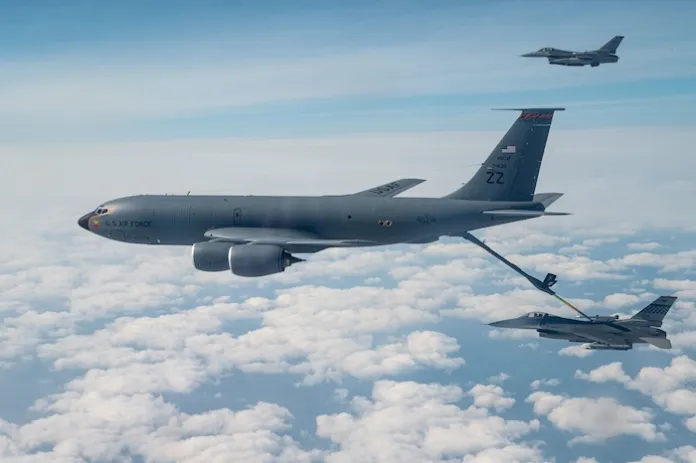
Air Force Says KC-135 Will Stay in Service as Refueler Modernization Stretches Decades
Topic: defense & securityRegion: north americaUpdated: i2 outletsSources: 2⚠ Bias gap — sources divergeSpectrum: Mixed⏱ 3 min read
Story Summary
SITUATION
The Air Force says modernizing its refueler fleet will take decades and that the KC-135 Stratotanker will remain in service (per Washington Examiner). The service says KC-46A production delays and program deficiencies force continued sustainment and refurbishment of KC-135s and slow the transition to newer tankers (per Washington Examiner).
Coveragetap to expand ▾Spectrum: Mixed🌍US: 1 · Other: 1
Political Spectrum
Position is inferred from coverage mix.
i2 outlets · Center
Left
Center
Right
Left: 0
Center: 1
Right: 1
Geography Coverage
Distribution of where coverage is coming from.
i2 unique outlets · Dominant: US/Canada
KEY FACTS
- Maj. Gen. Gerald Donohue said the Air Force must sustain legacy KC-135s while fielding newer platforms because modernization takes decades (per Washington Examiner).
- The KC-135 Stratotanker was first deployed in 1956 and will remain in the force’s fleet for the foreseeable future (per Washington Examiner).
- The KC-46A first entered service in January 2019 and is the planned replacement for legacy tankers (per Washington Examiner).
- A Government Accountability Office report said the Air Force had 373 KC-135s and 104 KC-46As in its inventory in March 2026 (per Washington Examiner).
- The GAO report said the Air Force expected to reach 65 KC-135s and 113 KC-46As by the end of the fiscal year (per Washington Examiner).
HISTORICAL CONTEXT
The immediate backdrop is an active U.S.–Israeli campaign against Iran that began with coordinated strikes in March 2026, when U.S. and Israeli forces attacked Iranian power plants, air defenses and other military infrastructure; Iranian military actions throughout 2026 have unfolded as responses to that campaign.
The structural conditions shaping U.S. force posture and logistics stem from long-standing procurement and alliance frameworks, including the North Atlantic Treaty Organization’s interoperability standards formalized in the 1949 Washington Treaty, U.S. defense acquisition statutes such as the Federal Acquisition Regulation and the Weapon Systems Acquisition Reform Act of 2009, and bilateral U.S. security commitments to regional partners codified in successive national defense strategies (most recently the 2022 National Defense Strategy).
Brief
The Air Force told attendees at the Air and Space Force Association conference in National Harbor that replacing its aging KC-135 Stratotanker fleet will take decades and that the KC-135 will remain an operational mainstay while newer tankers join the force (per Washington Examiner). Air Mobility Command Deputy Commander Maj. Gen.
Gerald Donohue framed the timeline bluntly: the service must sustain legacy KC-135s even as it fields newer platforms because modernization is inherently slow and protracted (per Washington Examiner).
The service faces an immediate inventory reality: a Government Accountability Office report cited by the Air Force showed 373 KC-135s and 104 KC-46As in March 2026, with a projected year-end posture of 65 KC-135s and 113 KC-46As (per Washington Examiner).
The KC-46A Pegasus — which first entered service in January 2019 — remains the planned replacement, but the GAO found major production delays and deficiencies in the KC-46A program that have slowed deliveries and increased maintenance pressure on the older fleet (per Washington Examiner).
That combination, Donohue said, obliges the Air Force to continue sustainment and refurbishment programs for KC-135s rather than rapidly retiring them (per Washington Examiner).
The message to operators and planners is practical: readiness depends on parallel support for both legacy and newer tankers as the industrial and programmatic problems with KC-46A are worked through (per Washington Examiner).
Officials did not announce a new fixed timeline for full transition to a modern tanker force at the conference; instead, they emphasized a phased, resource-dependent approach driven by production rates and identified deficiencies in the KC-46A program (per Washington Examiner).
For the Air Force, the operational implication is that air-refueling capacity will rely on a mixed fleet for the foreseeable future, with sustainment costs and refurbishment cycles shaping budgeting and force-planning decisions (per Washington Examiner).
Why it matters
- Concrete cost-bearers: Air Mobility Command and its crews must operate and maintain 373 KC-135s reported in March 2026, sustaining older airframes and paying refurbishment and sustainment costs as KC-46A production lags (per Washington Examiner).
- Operational mechanism of harm: Delays and deficiencies in the KC-46A program (per Washington Examiner) force the Air Force to allocate maintenance dollars and manpower to legacy KC-135s that would otherwise fund modernization.
- Who benefits: Defense sustainment contractors and depot workforce that service KC-135s will continue to receive work and revenue while the KC-46A program resolves its production issues (per Washington Examiner).
What to watch next
- Whether the Air Force meets the GAO-projected inventory milestone of 65 KC-135s and 113 KC-46As by the end of the fiscal year (per Washington Examiner).
- Whether the KC-46A program clears the GAO-identified production delays and deficiencies that are slowing deliveries (per Washington Examiner).
- Whether Air Mobility Command issues a revised retirements or sustainment plan for KC-135s at the next major Air and Space Force Association conference or related budget briefings (per Washington Examiner).
Where sources differ
7 dimensionsBias gap0.50 / 2.0
Left- and right-leaning outlets are covering this story differently — in which facts to emphasize, which context to include, and how to frame causes and consequences.
Center (1)
realcleardefense.com
Right-leaning (1)
washington_examiner+0.70
The Air Force says modernizing its refueler fleet will take decades and that the KC-135 Stratotanker will remain in service. KC-46A production delays and deficiencies have forced c…
7 specific areas where coverage diverges — see below.
Framing differences
?- Only the Washington Examiner is in this pack; it frames the story as a long-term sustainment challenge requiring continued KC-135 service and emphasizes KC-46A production problems (per Washington Examiner).
Disputed or unclear
?- No source in this pack disputes the GAO inventory figures or the characterization of KC-46A delays; no alternative figures or timelines are provided (per Washington Examiner).
Omitted context
?- No source mentions specific sustainment cost figures or budgetary trade-offs required to support KC-135 refurbishment versus KC-46A production.
- No source details which contractors or depots will perform the extended KC-135 sustainment work.
- No source provides a concrete, new timeline or specific retirement dates for KC-135 aircraft beyond the GAO-projected counts.
Conflicting figures
?- The Washington Examiner cites 373 KC-135s and 104 KC-46As in March 2026 and a GAO projection of 65 KC-135s and 113 KC-46As by fiscal year-end (per Washington Examiner).
Disputed causality
?- The Washington Examiner attributes extended KC-135 sustainment to KC-46A production delays and deficiencies; no source in this pack presents an alternate causal explanation (per Washington Examiner).
Attribution disputes
?- Maj. Gen. Gerald Donohue is quoted describing the modernization timeline and necessity to sustain legacy platforms; the GAO is cited for inventory and program problems (per Washington Examiner).
Sources
2 of 2 linked articles