
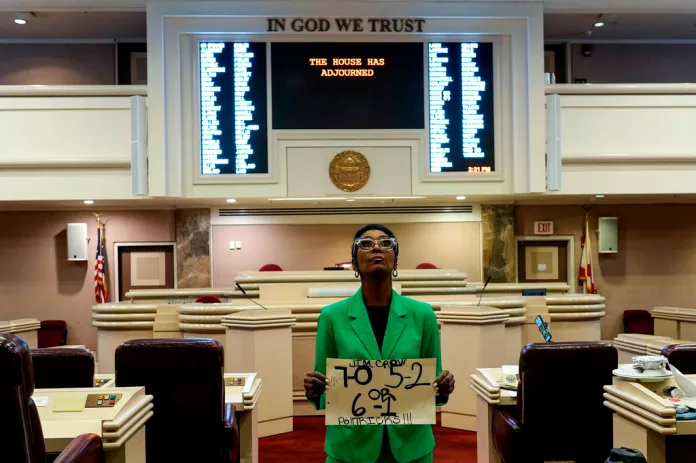
Alabama Bill Empowers Governor to Delay Primaries Amid Redistricting Battle
Coveragetap to expand ▾Spectrum: Mostly Center🌍Other: 3 · US: 2
- The Alabama legislature approved a Republican-backed bill after heated debate, granting Gov. Kay Ivey the authority to delay or reschedule House primaries if new district maps are approved by the courts (per washingtonexaminer.com).
- The bill was passed in response to a federal court's ruling that the existing congressional map likely violated the Voting Rights Act by not providing adequate representation for black voters (per washingtonexaminer.com).
- Alabama officials are attempting to revive a previously blocked congressional map (per washingtonexaminer.com).
- The legislation is part of a broader legal and political battle over redistricting in the South ahead of the 2026 midterm elections (per washingtonexaminer.com).
- The new legislation could significantly impact the timing and outcome of upcoming elections in Alabama (per news.google.com).
Alabama's legislature has passed a contentious Republican-backed bill that empowers Governor Kay Ivey to delay or reschedule U.S. House primaries if federal courts approve new district maps.
This legislative move comes in the wake of a federal court ruling that found the state's current congressional map likely violates the Voting Rights Act by failing to ensure adequate representation for black voters.
The court has mandated the creation of a second district where black voters could elect their preferred candidate, prompting Alabama officials to seek the revival of a previously blocked map. The bill's passage underscores the ongoing legal and political battles over redistricting in the South, particularly as the 2026 midterm elections approach.
Proponents argue that the legislation is necessary to comply with potential court-ordered changes and ensure fair representation, while critics contend that it could be used to delay elections and undermine voting rights.
The debate over the bill was heated, reflecting broader national tensions between state and federal authorities regarding voting rights and electoral fairness. Alabama's efforts to adjust its congressional map are part of a larger pattern of redistricting disputes across the United States, where issues of race, representation, and political power are at the forefront.
Governor Ivey's new authority to alter the timing of primaries could have significant implications for the state's political landscape, potentially affecting the balance of power in Congress. The legislation's impact will largely depend on the outcomes of ongoing court proceedings and the specific changes mandated by the judiciary.
As Alabama navigates these complex legal waters, the state's actions are being closely watched by both political analysts and civil rights advocates. The resolution of this redistricting issue could set important precedents for how similar disputes are handled in other states, particularly those with histories of racial discrimination in voting.
The situation remains dynamic, with potential for further legal challenges and political maneuvering as stakeholders on all sides seek to influence the final outcome. The stakes are high, not only for Alabama but for the broader national conversation about voting rights and electoral integrity.
- Black voters in Alabama could gain increased representation if a second district is created, addressing historical underrepresentation.
- Governor Kay Ivey and Alabama Republicans may benefit politically from the ability to delay primaries, potentially influencing election outcomes.
- The federal court's involvement highlights ongoing judicial oversight in ensuring compliance with the Voting Rights Act, impacting state autonomy.
- Whether federal courts approve the new district maps, triggering potential delays in Alabama's House primaries.
- Governor Kay Ivey's decision on whether to exercise her new authority to delay or reschedule primaries.
- The impact of the new legislation on the 2026 midterm elections in Alabama, particularly regarding representation for black voters.
Left- and right-leaning outlets are covering this story differently — in which facts to emphasize, which context to include, and how to frame causes and consequences.
7 specific areas where coverage diverges — see below.
- washingtonexaminer.com emphasizes the bill's potential to delay elections, while news.google.com focuses on the broader redistricting battle.
- No source disputes the federal court's ruling on the Voting Rights Act violation.
- No source mentions the specific historical context of racial discrimination in Alabama's voting practices that led to the court's ruling.
- No differing figures were provided by the sources.
- All sources agree that the bill is a response to the federal court's ruling.
- All sources attribute the bill's passage to the Republican majority in the Alabama legislature.