
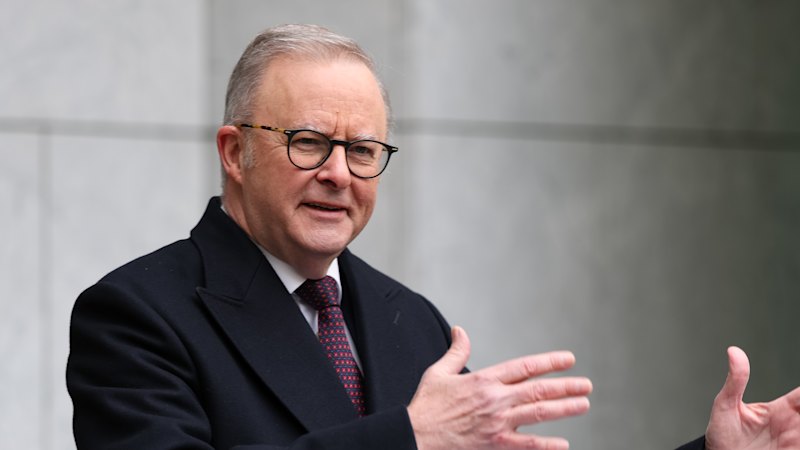
Albanese makes cyber safety core of Australia’s UN Security Council bid
Topic: geopoliticsRegion: AsiaUpdated: i2 outletsSources: 2Spectrum: Center Only⏱ 3 min read
Story Summary
SITUATION
Anthony Albanese is centering cyber safety, artificial intelligence and digital threats in Australia’s campaign for a UN Security Council seat (per smh.com.au). He will travel to New York to formally launch the campaign and is scheduled to meet Tim Cook and Volodymyr Zelensky during the trip (per smh.com.au).
Coveragetap to expand ▾Spectrum: Center Only🌍Asia: 1 · Other: 1
Political Spectrum
Position is inferred from coverage mix.
i2 outlets · Center
Left
Center
Right
Left: 0
Center: 2
Right: 0
Geography Coverage
Distribution of where coverage is coming from.
i2 unique outlets · Dominant: Asia
KEY FACTS
- Anthony Albanese is placing cyber safety, artificial intelligence and digital threats at the centre of Australia’s campaign for a UN Security Council seat (per smh.com.au).
- Albanese argues cyber and digital threats are matters of international peace and security (per smh.com.au).
- He will travel to New York to launch the formal campaign for the UN Security Council seat (per smh.com.au).
- He is also scheduled to meet Ukrainian President Volodymyr Zelensky at the UN, where they are expected to announce a bilateral security agreement (per smh.com.au).
HISTORICAL CONTEXT
The immediate backdrop is the wider regional and global security crisis that intensified when the United States and Israel began coordinated strikes on Iranian infrastructure in March 2026; those strikes followed months of escalatory actions by Iran and Iran-aligned proxies across the Middle East in 2025 and early 2026 and have since reshaped international discussions about cross-border and cross-domain threats.
Those hostilities have driven renewed attention at the United Nations to non-kinetic dimensions of conflict — notably cyber operations, information warfare and the emergent role of artificial intelligence — as member states press the Security Council and General Assembly to treat digital attacks as matters of international peace and security.
Brief
Anthony Albanese has repositioned Australia’s bid for a United Nations Security Council seat around cyber safety, artificial intelligence and digital threats, arguing those issues belong on the Council’s peace-and-security agenda (per smh.com.au).
The prime minister plans to travel to New York to formally launch the campaign and has built the trip to include high-profile technology and security meetings that signal Canberra’s priorities: a meeting with Apple executive chairman Tim Cook in California, and a session at the UN with Ukrainian President Volodymyr Zelensky in which the two leaders are expected to announce a bilateral security agreement (per smh.com.au).
Albanese’s framing elevates cyber and AI from domestic regulatory topics to instruments of international stability, a shift that aims to broaden Australia’s diplomatic appeal to governments worried about digital threats (per smh.com.au).
The scheduling of a Cupertino meeting with Tim Cook underscores Canberra’s push to engage major technology companies as partners on cyber safety norms and resilience (per smh.com.au). Likewise, the planned announcement with Volodymyr Zelensky ties Australia’s Security Council pitch to concrete security partnerships at the United Nations (per smh.com.au).
By making cyber safety a focal point, Albanese is betting Australia can offer technical and normative leadership on digital risks at a time when many states are seeking rules for AI and cross-border cyber operations (per smh.com.au).
The campaign launch in New York will test whether that policy emphasis wins votes among UN member states that prioritise either traditional security threats or newer digital vulnerabilities (per smh.com.au).
If Canberra secures the seat, it can push for Security Council attention to cyber incidents and AI governance mechanisms; if it fails, the campaign will still have signalled Australia’s intent to shape international digital rules (per smh.com.au).
Why it matters
- Australian civilians and businesses face the immediate costs of cyberattacks through data breaches and service disruptions; Albanese is proposing international norms and cooperation as the mechanism to reduce those harms (per smh.com.au).
- Tim Cook and Apple stand to benefit from closer public-private cooperation on cyber safety standards that could shape regulation and compliance frameworks affecting technology firms (per smh.com.au).
- Ukraine gains diplomatic support and a security partnership at the UN that can help its efforts to internationalise digital and security protections (per smh.com.au).
What to watch next
- Whether Anthony Albanese formally launches Australia’s UN Security Council campaign in New York as planned (per smh.com.au).
- Whether Albanese and Tim Cook issue a joint statement or commitments after their meeting in California (per smh.com.au).
- Whether Albanese and Volodymyr Zelensky announce a bilateral security agreement at the UN session and publish its terms (per smh.com.au).
Where sources differ
7 dimensionsFraming differences
?- Only smh.com.au is available in this pack; no alternative outlet framings are present to compare.
Disputed or unclear
?- No source disputes or contradicts the core claims in the single available article.
Omitted context
?- No source in this pack details which UN members Australia is courting or the voting timetable for the Security Council seat.
- No source in this pack specifies the content or legal form of the expected bilateral security agreement with Volodymyr Zelensky.
- No source in this pack provides detail on what concrete cyber or AI measures Australia will propose at the Security Council.
Conflicting figures
?- No differing numerical figures appear in the available source material.
Disputed causality
?- The source states Albanese is centering cyber safety in the campaign but does not specify what specific recent events or incidents triggered this policy emphasis.
Attribution disputes
?- All claims in this brief are attributed to smh.com.au.
Sources
2 of 2 linked articles