
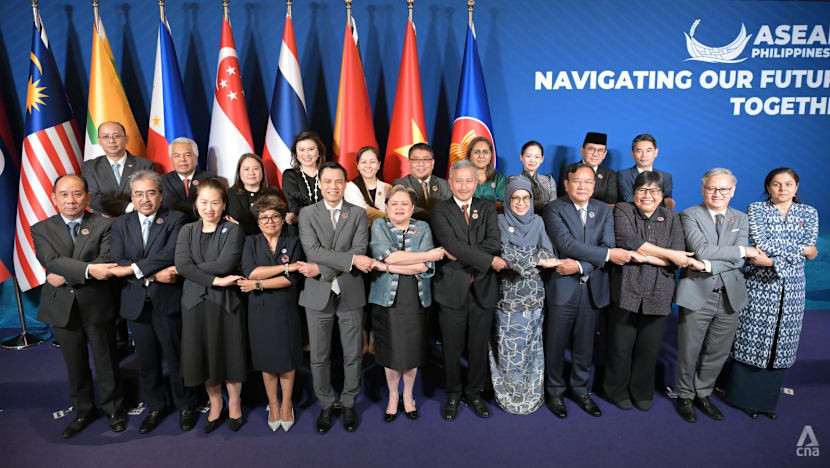
ASEAN Leaders Seek Unified Crisis Response Amid Middle East Tensions
Coveragetap to expand ▾Spectrum: Center Only🌍Other: 4 · Asia: 1
- ASEAN leaders are meeting in the Philippines to discuss a coordinated response to future crises amid the Middle East conflict (per channelnewsasia.com).
- Energy and food security are high on the agenda for ASEAN leaders during their talks (per news.google.com).
- The ongoing Middle East conflict is a significant backdrop to the ASEAN leaders' discussions (per news.google.com).
- ASEAN countries are concerned about the impact of the Middle East conflict on regional stability and economic security (per channelnewsasia.com).
- The Middle East conflict has heightened ASEAN's focus on securing energy supplies and food resources (per news.google.com).
- ASEAN leaders are gathering amid regional tensions and the broader Middle East crisis (per news.google.com).
ASEAN leaders are convening in the Philippines to address the pressing need for a coordinated response to future crises, with the ongoing Middle East conflict serving as a critical backdrop. The discussions are heavily focused on energy and food security, as the conflict has underscored vulnerabilities in these areas.
ASEAN countries are particularly concerned about how the Middle East tensions might affect regional stability and economic security, prompting a push for stronger regional cooperation. The Middle East conflict, which has been a focal point of international attention, is influencing ASEAN's strategic priorities.
The leaders are keen to ensure that their countries are better prepared for similar crises in the future, emphasizing the importance of securing energy supplies and food resources. This meeting in the Philippines is seen as a pivotal moment for ASEAN to enhance its collective resilience against global disruptions.
Energy and food security have emerged as top priorities for the ASEAN leaders, reflecting the immediate concerns that have arisen from the Middle East situation. The conflict has highlighted the interconnectedness of global supply chains and the potential for regional instability to have far-reaching impacts.
ASEAN's response aims to mitigate these risks by fostering greater collaboration among member states. The ASEAN summit is not only about addressing current challenges but also about laying the groundwork for a more unified approach to future crises.
By focusing on energy and food security, ASEAN leaders are acknowledging the critical role these sectors play in maintaining regional stability. The discussions are expected to lead to concrete measures that will strengthen ASEAN's ability to respond to global crises effectively.
As ASEAN countries navigate the complexities of the Middle East conflict, their leaders are also mindful of the broader geopolitical implications. The summit provides an opportunity for ASEAN to assert its role in the global arena, demonstrating its commitment to regional cooperation and crisis management.
The outcomes of this meeting could set a precedent for how ASEAN handles similar challenges in the future. In summary, the ASEAN leaders' meeting in the Philippines is a strategic response to the ongoing Middle East conflict, with a focus on enhancing regional cooperation and securing critical resources.
The discussions underscore the importance of a coordinated approach to crisis management, as ASEAN seeks to bolster its resilience against future global disruptions.
- ASEAN populations face potential energy shortages due to Middle East conflicts, impacting economic stability.
- Food security is at risk for ASEAN countries, as disruptions in global supply chains could lead to shortages.
- ASEAN's coordinated response efforts aim to mitigate these risks, benefiting regional stability and economic resilience.
- The Middle East conflict highlights the need for ASEAN to strengthen its crisis management capabilities.
- Whether ASEAN leaders agree on a unified crisis response strategy by the end of the summit.
- Decisions on energy and food security measures at the ASEAN meeting in the Philippines.
- Potential announcements of new regional cooperation initiatives following the ASEAN summit.
- Channelnewsasia.com emphasizes ASEAN's focus on future crisis response, while news.google.com highlights energy and food security concerns.
- No source mentions the specific impacts of the Middle East conflict on individual ASEAN countries' economies.
- The sources do not provide details on how ASEAN plans to implement coordinated crisis responses.