
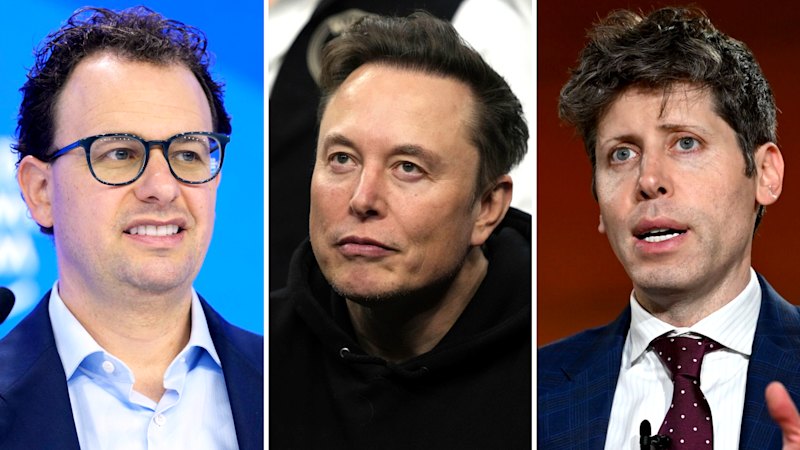
Amodei, Altman and Musk warn AI could exceed human understanding and urge slowdown
Coveragetap to expand ▾Spectrum: Center Only🌍Europe: 1 · Asia: 1
- Dario Amodei, Sam Altman and Elon Musk called for slowing AI development and warned that AI training itself could produce models beyond human understanding (per smh.com.au).
- The three warned such advanced AI could threaten humanity within a decade (per smh.com.au).
- The article warns a moratorium could cause the AI industry, its finances and infrastructure to implode (per smh.com.au).
Three prominent AI figures — Dario Amodei, Sam Altman and Elon Musk — urged a slowdown in AI development, saying that systems now capable of training themselves risk producing models beyond human comprehension and could threaten humanity within a decade (per smh.com.au).
They framed their call as a warning about trajectory and capability: self-training architectures, in their view, open the path to opaque, fast-evolving models whose behaviors may exceed human ability to predict or control (per smh.com.au).
The piece also raised a sharp practical objection: a coordinated moratorium would likely fail because Chinese and Russian developers would not participate, and such a moratorium could implode the AI industry's finances and infrastructure if attempted (per smh.com.au).
The article presents both the existential risk claim and the geopolitical feasibility argument as central tensions — the signatories say urgent restraint is needed, while the piece questions whether restraint is achievable in a competitive international landscape (per smh.com.au).
The coverage is limited to those core claims and does not provide independent technical evidence or a timetable of policy steps; it reports the warnings and the skepticism about a moratorium's viability without documenting specific governmental responses or pledged commitments (per smh.com.au).
Readers should note this is a statement from industry figures rather than a multilateral political agreement, and the article emphasizes that stopping development would require participation from actors in China and Russia whom the piece says would not join (per smh.com.au).
- - Residents of countries hosting major AI firms — notably employees and investors in Silicon Valley firms — risk financial disruption if a moratorium were attempted and, per the article, industry finances and infrastructure 'could implode' (per smh.com.au). - Developers and researchers face tightened operational constraints if the industry follows calls to slow development; Amodei, Altman and Musk framed the immediate mechanism as halting or slowing self-training model programs (per smh.com.au). - Governments in China and Russia stand to benefit if Western states or firms impose slowdowns that those governments do not join, because the article warns nonparticipation would create a competitive advantage (per smh.com.au).
Whether major AI firms named by the signatories publicly commit to concrete slowdown measures by industry bodies or trade groups within the next three months (per smh.com.au). 2) Whether governments in China or Russia announce coordinated AI development policies that would amount to joining or rejecting a proposed moratorium (per smh.com.au). 3) Whether any international forum or coalition forms to translate the warnings into enforceable rules or financial safeguards for AI infrastructure within six months (per smh.com.au).
- Only smh.com.au is in this pack; it frames the story around industry figures' warnings and the impracticality of a moratorium.
- No source in this pack disputes the claims; technical feasibility of the existential risk and the prediction about moratorium failure remain unverified by independent experts in the provided article (per smh.com.au).
- No source in this pack cites specific technical evidence, timeline, or peer-reviewed studies quantifying the 'within a decade' risk.
- No source in this pack documents any government statements, multilateral negotiations, or regulatory proposals that would translate the industry warnings into policy.
- No source in this pack provides data on which specific Chinese or Russian developers would refuse a moratorium or their current capabilities.
- The article gives the timeframe 'within a decade' for the threat but provides no other numerical estimates; no other figures are provided in this pack (per smh.com.au).
- The article links the existence of self-training systems to the risk of models beyond human understanding and then links a proposed moratorium to likely failure because Chinese and Russian developers would not join; those causal links are asserted by the article but not independently proven within the source (per smh.com.au).
- smh.com.au attributes the slowdown call and the warnings about moratorium failure to Dario Amodei, Sam Altman and Elon Musk (per smh.com.au).