
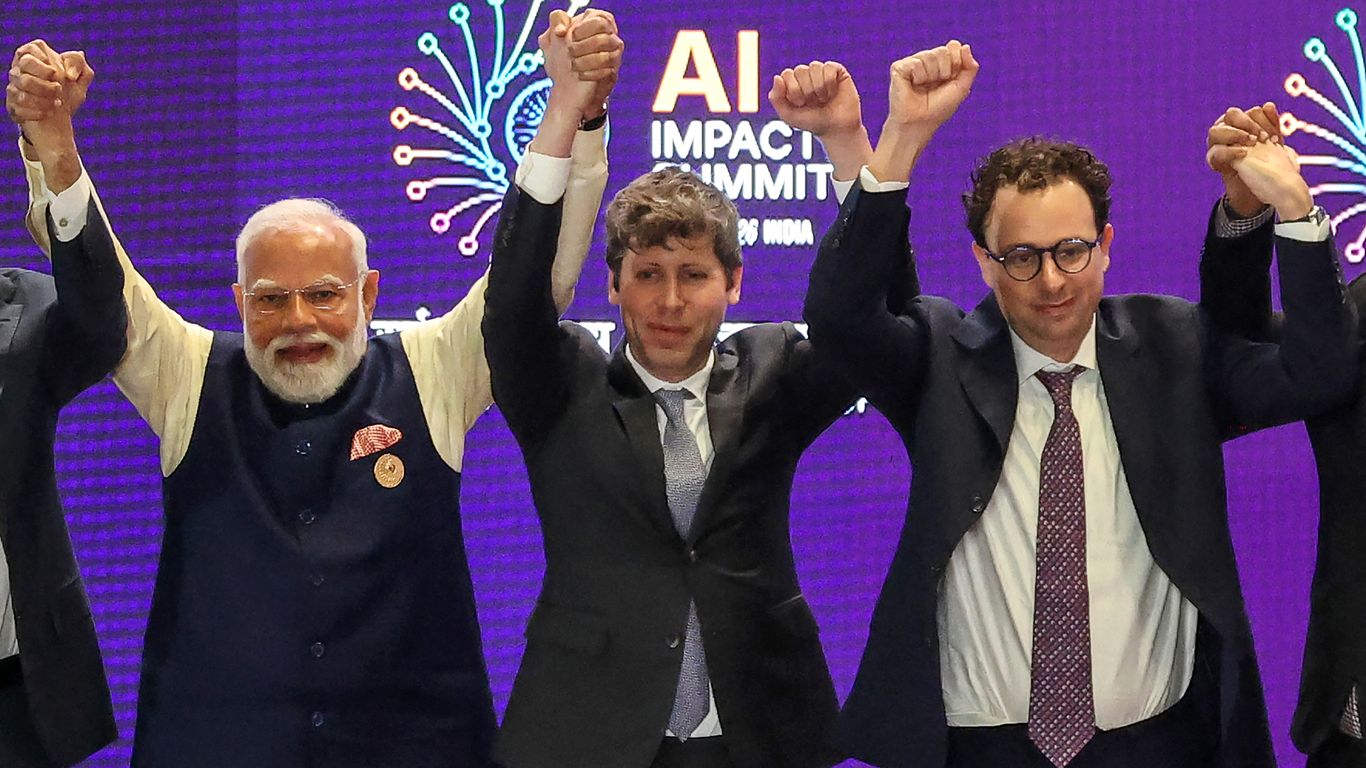
Anthropic and OpenAI CEOs Urge Slower AI Pace After Misuse Report
Topic: technologyRegion: north americaUpdated: i2 outletsSources: 3Spectrum: Mostly Center⏱ 2 min read
Story Summary
SITUATION
Anthropic CEO called for a deliberate slowdown in AI development after a report on misuse of Claude (per news.google.com). OpenAI's CEO joined the call, and outlets emphasized either safety risks or potential innovation costs (per news.google.com).
Coveragetap to expand ▾Spectrum: Mostly Center🌍US: 1 · Asia: 1
Political Spectrum
Position is inferred from coverage mix.
i2 outlets · Center
Left
Center
Right
Left: 0
Center: 2
Right: 0
Geography Coverage
Distribution of where coverage is coming from.
i2 unique outlets · Dominant: US/Canada
KEY FACTS
—
HISTORICAL CONTEXT
The immediate backdrop is the ongoing March 2026 U.S.–Israeli military campaign against Iran that began with coordinated strikes in March 2026, launched after a series of Iranian-backed attacks on regional partners and escalatory moves earlier in 2026.
Structurally, that campaign sits atop the breakdown of the 2015 Joint Comprehensive Plan of Action (JCPOA; July 14, 2015) and the U.S. withdrawal from it on May 8, 2018, plus subsequent reimposed sanctions and UN scrutiny that shaped regional tensions.
Brief
Anthropic's chief executive publicly urged a deliberate slowdown in AI development after recent reporting showed misuse of the company's Claude model, and OpenAI's CEO joined that call (per news.google.com).
The two leaders framed slowing development as the immediate step needed to address safety gaps exposed by the misuse report, with their statements driven by the specifics revealed in that reporting (per news.google.com).
Coverage of the CEOs' joint stance split on emphasis: some accounts foregrounded the safety imperative — arguing that rapid deployment risks enabling harmful uses — while others stressed the potential cost to innovation and competition if companies pause advancement (per news.google.com).
Neither position in the sourced coverage offered independent verification of the suggested slowdown's technical feasibility or a detailed plan for how firms would coordinate pacing, leaving open questions about enforcement, timelines, and what metrics would define 'slowdown' (per news.google.com).
The CEOs framed their appeal as an industry-level responsibility tied directly to the misuse examples in the report; the sourced article did not publish detailed reactions from governments, regulators, or other AI firms (per news.google.com).
With both Anthropic and OpenAI publicly signaling concern, the debate now centers on reconciling urgent safety fixes with commercial and research incentives that reward speed — a tension the sourced coverage highlights without resolving (per news.google.com).
Why it matters
- - Residents and users of deployed AI systems bear concrete costs if misuse continues: the sourced report documented misuse of Claude that prompted the CEOs' call, indicating immediate harms to identifiable users (per news.google.com). - Anthropic and OpenAI executives stand to lose competitive advantage if a voluntary slowdown reduces deployment speed, meaning investors and employees at those firms face financial and career impacts tied to any pause (per news.google.com). - Regulators who must decide whether to mandate pacing will confront a trade-off between enforcing safety fixes and constraining innovation; the sourced coverage shows no current regulatory plan, leaving policymakers to weigh which constituencies to prioritize (per news.google.com).
What to watch next
Whether Anthropic issues specific, time-bound steps to limit Claude's capabilities or access within 30 days of the misuse report (per news.google.com). 2) Whether OpenAI and other major AI companies publicly endorse shared pacing metrics or a voluntary moratorium at an industry forum in the next quarter (per news.google.com). 3) Whether national regulators cite the CEOs' statements when proposing new AI safety rules or mandatory development controls in upcoming policy proposals (per news.google.com).
Where sources differ
7 dimensionsFraming differences
?- The sourced coverage framed the CEOs' call primarily as a safety imperative; it also noted concerns that slowing development could harm innovation and competition (per news.google.com)
Disputed or unclear
?- No source in this pack disputes whether misuse occurred, but the feasibility and definition of an enforceable 'slowdown' remain unclear (per news.google.com)
Omitted context
?- No source in this pack specified whether governments or regulators had been alerted or had reacted to the misuse report (per news.google.com)
- No source in this pack provided details on the specific misuse incidents, affected populations, or quantified harms beyond stating misuse occurred (per news.google.com)
- No source in this pack named concrete enforcement mechanisms, timelines, or agreed industry metrics that would implement a slowdown (per news.google.com)
Conflicting figures
?- The single source did not provide differing numerical figures for the same quantity (per news.google.com)
Disputed causality
?- The sourced article establishes the sequence: a report documented misuse of Claude → Anthropic CEO called for a deliberate slowdown; OpenAI's CEO then joined the call (per news.google.com)
Attribution disputes
?- The sourced coverage attributes the call for slowdown to statements by Anthropic's CEO and notes OpenAI's CEO joined that appeal (per news.google.com)
Sources
3 of 3 linked articles
Anthropic boss calls for AI slowdown, Altman and Musk agree - ABC News & Headlines
abc.net.auSep 12Center
↗
Anthropic, OpenAI CEOs call for slowdown in AI development
axios.comSep 12Left
↗
‘We must slow the pace’: Anthropic CEO calls for deliberate AI slowdown after report on Claude misuse
moneycontrol.comSep 12Left
↗