
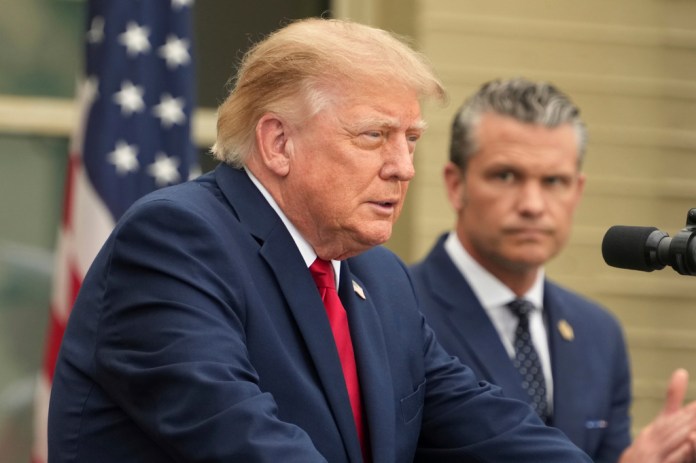
Op-ed: Trump traded Venezuelan freedom for oil payments, author says
Coveragetap to expand ▾Spectrum: Right Only🌍US: 1
- The op-ed states the oil payments from Venezuela are "America will never see," framing the deal as financially and politically disadvantageous to the U.S.
- The piece is an opinion column in the Washington Examiner, a publication the source metadata identifies as leaning right.
An opinion column in the Washington Examiner argues that President Donald Trump struck a deal with Venezuela that traded Venezuelan political freedom for oil payments the United States "will never see." Daniel Sánchez-Piñol writes that the arrangement amounts to a political bargain in which Venezuelan freedom was exchanged for financial flows tied to oil, and he frames the deal as consistent with a presidential disposition to tolerate leaders who flatter him (per Washington Examiner).
The column does not provide transactional documents or independent verification of the payment flows it describes; it presents an interpretation of the deal and cites the phrase "America will never see" to underline its skepticism about U.S. benefit (per Washington Examiner).
Sánchez-Piñol's piece is explicitly opinion journalism: it attributes motive and political judgment to President Donald Trump and casts the agreement as damaging to Venezuelan democracy while highlighting the financial losers as American taxpayers who, the author contends, will not receive the promised economic returns (per Washington Examiner).
The column offers a political critique rather than an evidentiary account: it does not quantify the alleged oil payments, name Venezuelan officials involved, or cite contracts or banking records that would substantiate the claim in print (per Washington Examiner).
Readers should note the piece's placement in a right-leaning outlet and treat its assertions as an interpretation anchored in opinion, not as a standalone factual audit; independent reporting or primary-source documents would be necessary to confirm the op-ed's central allegation that a quid pro quo exchanged Venezuelan freedom for oil money (per Washington Examiner).
- American taxpayers: the op-ed claims the oil payments are money "America will never see," implying a financial loss to U.S. taxpayers if promised returns fail to materialize (per Washington Examiner).
- Venezuelan citizens: the author argues Venezuelan political freedom was traded away, which the column portrays as a direct cost to Venezuelans' democratic rights (per Washington Examiner).
- President Donald Trump: the column frames him as politically benefiting from accommodating authoritarian leaders, a reputational stake that could affect U.S. diplomatic leverage (per Washington Examiner).
- Whether independent reporters or U.S. officials release documents or statements by October 15, 2026 that corroborate or refute the op-ed's claim about oil payments (per Washington Examiner).
- Whether congressional committees request briefings or launch inquiries into any U.S.-Venezuela deals referenced in the op-ed within 30 days (per Washington Examiner).
- Whether the White House issues a detailed response addressing the op-ed's allegation that a deal traded Venezuelan freedom for oil money within one week of publication (per Washington Examiner).
- Only the Washington Examiner frames the deal as trading Venezuelan freedom for oil payments; no other outlets are present to offer alternate framings (per Washington Examiner).
- The existence, size, and beneficiaries of the alleged oil payments are not documented in the source; the op-ed asserts them but provides no corroborating evidence (per Washington Examiner).
- No source in this pack cites specific contractual terms, banking records, named Venezuelan officials, or independent audits that would verify the alleged payments.
- No source mentions any U.S. government investigation, congressional subpoena, or official accounting that would establish whether American taxpayers will lose the stated funds.
- The op-ed does not provide casualty, sanctions, or diplomatic-action context that would explain formal consequences of the alleged deal.
- The Washington Examiner uses the phrase "America will never see" but gives no dollar figures or payment amounts (per Washington Examiner).
- The op-ed claims a causal trade—Venezuelan freedom exchanged for oil payments—but offers no documented transactional evidence to prove the causal linkage (per Washington Examiner).
- The Washington Examiner attributes the allegation to the author Daniel Sánchez-Piñol; no government or third-party source is cited as confirming the claim (per Washington Examiner).