
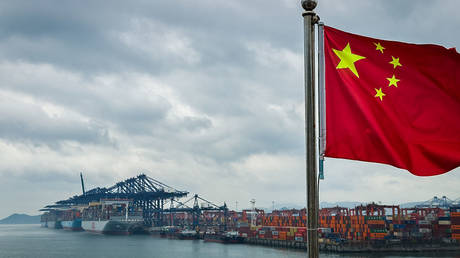
Beijing has argued that sanctions imposed without a UN mandate are illegal under international law.
Coveragetap to expand ▾Spectrum: Mostly Center🌍Other: 4 · Europe: 1
- China orders domestic refineries to ignore US sanctions China orders domestic refineries to ignore US sanctions Beijing has argued that sanctions imposed without a UN mandate are illegal under international law.
- China orders domestic refineries to ignore US sanctions China’s Ministry of Commerce has instructed domestic companies not to comply with US sanctions targeting refiners allegedly linked to the Iranian oil trade.
- China’s Ministry of Commerce has instructed domestic companies not to comply with US sanctions targeting refiners allegedly linked to the Iranian oil trade.
These rules are designed to counter foreign actions that China deems improper, and their activation could pose challenges for US sanctions enforcement. China's Ministry of Commerce has instructed domestic companies not to comply with the US sanctions, arguing that such measures, imposed without a United Nations mandate, are illegal under international law.
This defiance by China is seen as a direct challenge to what it perceives as American overreach in international trade matters. The US sanctions targeted five Chinese refineries, which Washington claims are involved in the Iranian oil trade.
This move is part of a broader strategy by the US to curb Iran's oil exports, which have been a point of contention in international relations. Analysts warn that China's decision to ignore the sanctions could complicate efforts by the US to enforce its measures and may have broader implications for the global oil market.
The potential for disruptions in oil supply has raised concerns among international observers, as China is a significant player in the global energy sector. Beijing's use of the 'Blocking Rules' is a clear signal of its intent to resist what it views as unilateral actions by the US.
This development highlights the ongoing tensions between the two economic giants, particularly in the realm of trade and energy. The situation underscores the complex interplay of international law, economic interests, and geopolitical strategy.
As China and the US continue to navigate their fraught relationship, many governments watches closely, aware of the potential ramifications for international trade and energy markets.
Left- and right-leaning outlets are covering this story differently — in which facts to emphasize, which context to include, and how to frame causes and consequences.