
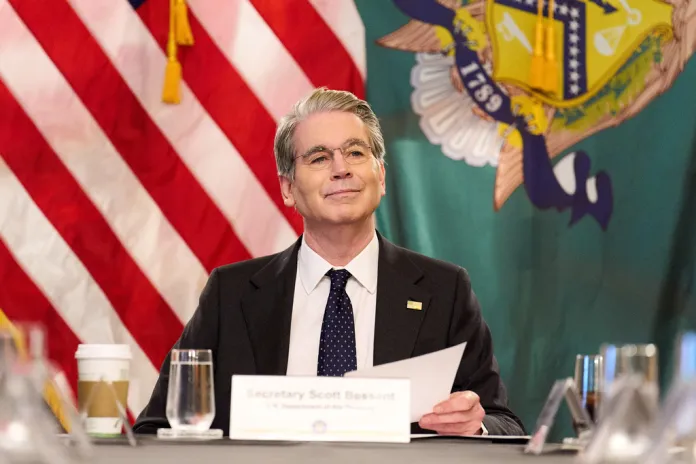
Bessent's 'Project Freedom' Aims to Lower Oil Prices by Securing Hormuz
Coveragetap to expand ▾Spectrum: Mostly Center🌍Other: 4 · US: 1
- Treasury Secretary Scott Bessent announced 'Project Freedom' to stabilize global energy markets (per washingtonexaminer.com).
- Two commercial vessels have safely transited the Strait of Hormuz as part of the project (per washingtonexaminer.com).
- Bessent stated that the U.S. has absolute control over the strait, countering Iranian influence (per washingtonexaminer.com).
- The United Arab Emirates' decision to leave OPEC is seen as a move that could weaken the oil cartel's leverage over global oil supply and prices (per washingtonexaminer.com).
- Bessent expressed confidence that the market will be well supplied and that oil prices will stabilize (per washingtonexaminer.com).
Treasury Secretary Scott Bessent has introduced 'Project Freedom,' a strategic initiative aimed at stabilizing global energy markets by reducing Iranian influence in the Strait of Hormuz. This move comes as part of President Donald Trump's broader efforts to secure vital maritime routes and ensure a steady supply of oil.
The project involves the United States deploying 15,000 personnel, guided-missile destroyers, and over 100 aircraft to escort oil tankers and other vessels through the strait, a critical chokepoint for global oil shipments.
Bessent emphasized that the U.S. now has absolute control over the Strait of Hormuz, countering any Iranian attempts to exert influence over this strategic waterway. He expressed optimism that these measures, along with the United Arab Emirates' recent decision to exit OPEC, will lead to a well-supplied market and potentially lower oil prices.
The UAE's departure from OPEC is significant, as it diminishes the cartel's control over global oil supply and prices, potentially expanding market access to the UAE's energy reserves. The announcement has sparked differing views on its potential impact.
While Bessent is confident that the initiative will stabilize oil prices, critics argue that the geopolitical tensions in the region could still pose risks to market stability. The safe transit of two commercial vessels through the strait under the project's protection has been highlighted as an early success, but the long-term effects remain to be seen.
The operation is part of a larger strategy by the Trump administration to assert U.S. influence in the Middle East and reduce the economic power of Iran, which has been a point of contention in international relations. The initiative also reflects ongoing efforts to secure energy supplies amid fluctuating global oil prices and regional instability.
As the situation develops, the effectiveness of 'Project Freedom' in achieving its goals will be closely monitored. The U.S. government's ability to maintain control over the strait and ensure the safe passage of oil shipments will be crucial in determining the project's success and its impact on global energy markets.
- The initiative directly affects global oil prices, impacting consumers worldwide by potentially lowering costs.
- Iran's reduced influence in the Strait of Hormuz could weaken its economic position, affecting its government revenues.
- The UAE's departure from OPEC may lead to shifts in global oil supply dynamics, benefiting countries seeking more stable energy prices.
- The U.S. military presence in the strait increases regional security but also raises geopolitical tensions, affecting regional stability.
- Whether the U.S. maintains control over the Strait of Hormuz and ensures safe passage for vessels.
- The impact of the UAE's exit from OPEC on global oil prices and supply dynamics.
- Potential Iranian responses to the increased U.S. military presence in the region.
Left- and right-leaning outlets are covering this story differently — in which facts to emphasize, which context to include, and how to frame causes and consequences.
3 specific areas where coverage diverges — see below.
- washingtonexaminer.com emphasizes the potential positive impact on oil prices, while news.google.com focuses on the strategic aspects of the initiative.
- No source mentions the broader geopolitical implications of increased U.S. military presence in the region.
- The potential impact on Iranian civilian economy due to reduced influence in the Strait of Hormuz is not discussed.
- Bessent: 'We are saying the Iranians do not have control of the strait. We have absolute control of the strait.' (per washingtonexaminer.com)