
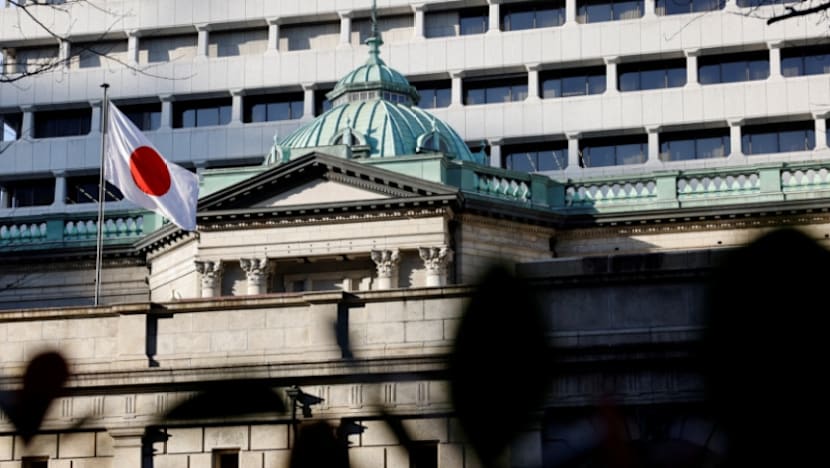
BOJ executive warned of need to guard against 'non-linear' inflation spikes
Topic: finance & marketsRegion: asia pacificUpdated: i2 outletsSources: 3Spectrum: Center Only⏱ 2 min read
Story Summary
SITUATION
A Bank of Japan executive warned that policymakers must guard against 'non-linear' inflation spikes, stressing heightened vigilance. Reporting is limited and the outlet provided only a brief excerpt without additional detail or named individuals (per channelnewsasia.com).
Coveragetap to expand ▾Spectrum: Center Only🌍Asia: 1 · Other: 1
Political Spectrum
Position is inferred from coverage mix.
i2 outlets · Center
Left
Center
Right
Left: 0
Center: 2
Right: 0
Geography Coverage
Distribution of where coverage is coming from.
i2 unique outlets · Dominant: Asia
KEY FACTS
- A Bank of Japan executive warned of the need for vigilance against 'non-linear' inflation spikes (per channelnewsasia.com).
- The reporting available from the outlet is limited and largely repetitive, providing no further specifics about timing, policy response, or the executive's identity (per channelnewsasia.com).
- The phrase 'non-linear' inflation spikes appears verbatim in the source excerpt and is the central concern reported (per channelnewsasia.com).
HISTORICAL CONTEXT
The immediate backdrop is the broader Middle East crisis that began in March 2026, when the United States and Israel launched coordinated strikes on Iranian power plants, air defenses and military infrastructure after weeks of Iranian-linked attacks on regional shipping and strikes on allied bases that Western officials cited as the trigger for the campaign.
That conflict has driven sharp volatility in global energy and insurance markets, feeding through to imported inflation pressures in energy-dependent economies such as Japan.
Brief
A Bank of Japan executive cautioned that policymakers must guard against 'non-linear' inflation spikes, according to a brief Channel NewsAsia excerpt. The outlet reproduces the warning repeatedly but provides no name, date, or further context about what scenarios the executive had in mind or what policy tools the BOJ might deploy.
That absence leaves open whether the comment reflects a new risk assessment tied to recent global price swings or a reiteration of existing BOJ vigilance.
Channel NewsAsia makes the phrase 'non-linear' central but offers no supporting data, forecast, or quotes that would let markets judge whether the BOJ expects temporary volatility or a sustained regime shift in inflation dynamics.
Without additional reporting — such as minutes from BOJ meetings, named remarks at a speech, or a statement from the Bank — the public record here is limited to a single, emphatic alert.
For readers and markets, the practical question is whether the BOJ will change its forward guidance, adjust interest-rate projections, or alter asset-purchase plans; the source does not supply evidence on any of those points.
Investors and analysts will need full reporting of the speaker, timing, and any internal BOJ debate to assess the credibility and policy implications of a warning about 'non-linear' inflation spikes.
Why it matters
- Japanese households face higher living-cost risk if 'non-linear' inflation spikes materialize; the source names the BOJ executive warning but gives no numbers on price or wage impacts (per channelnewsasia.com).
- Markets and fixed-income investors bear financial risk from abrupt policy shifts if the BOJ reacts to such spikes; the article documents only the warning, not any planned BOJ action (per channelnewsasia.com).
- The lack of identifying details benefits actors who can influence perception — such as market strategists and foreign central banks — because a vague official warning can move expectations without committing policy (per channelnewsasia.com).
What to watch next
- Whether the Bank of Japan issues an official statement naming the executive or clarifying the timing and basis for the 'non-linear' inflation warning within the next two weeks.
- Whether BOJ policy documents or the minutes of recent meetings cite 'non-linear' inflation risks or propose changes to interest-rate guidance at the next policy review.
- Whether Japan's consumer-price index releases for the upcoming month show acceleration consistent with a 'non-linear' spike, prompting reassessment by analysts.
Where sources differ
7 dimensionsFraming differences
?- Only Channel NewsAsia is present; no other outlet provides alternative framing in this pack — the outlet frames the story as a pointed BOJ warning but supplies no named speaker or context (per channelnewsasia.com).
Disputed or unclear
?- The identity of the BOJ executive, the date of the remark, and whether this reflects a new BOJ assessment are all unclear and unreported in the source (per channelnewsasia.com).
Omitted context
?- No source mentions the specific BOJ meeting, speech, or publication that triggered the warning; readers lack the prior triggering action needed to evaluate the response (omitted in channelnewsasia.com).
- The excerpt omits any CPI, wage, or survey figures that would substantiate the risk of 'non-linear' inflation spikes (omitted in channelnewsasia.com).
- No source in this pack cites BOJ internal debate, minutes, or named policymakers, which are necessary to judge policy implications (omitted in channelnewsasia.com).
- The potential market or fiscal consequences for pension funds, savers, or the government budget are not mentioned (omitted in channelnewsasia.com).
Conflicting figures
?- No numerical figures (dates, percentages, casualties, or monetary amounts) appear in the source excerpt to compare.
Disputed causality
?- The source reports a warning about 'non-linear' inflation spikes but does not identify any triggering economic developments that prompted the warning (per channelnewsasia.com).
Attribution disputes
?- Channel NewsAsia attributes the warning generically to 'a BOJ executive' but does not provide a personal name or official title in the excerpt (per channelnewsasia.com).
Sources
2 of 2 linked articles