
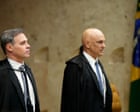
Brazil supreme court judges trade explosive accusations in livestreamed clash before election
Coveragetap to expand ▾Spectrum: Left Only🌍Europe: 1
- The confrontation occurred during a supreme court hearing that was livestreamed into millions of Brazilian homes.
- Alexandre de Moraes accused André Mendonça of serving "a political group that tried to launch a coup."
- André Mendonça responded in the hearing with "It's a lie!"
Two of Brazil’s supreme court judges, Alexandre de Moraes and André Mendonça, publicly traded insults during a livestreamed hearing that drew millions of viewers, an episode theguardian.com calls the country’s greatest institutional crisis since the 1980s.
The exchange featured de Moraes accusing Mendonça of serving "a political group that tried to launch a coup," language that made the hearing not only a legal proceeding but a televised political confrontation. The hearing unfolded on the eve of the presidential election, injecting a raw institutional dispute directly into a sensitive electoral moment (per theguardian.com).
The competing accounts inside the court are straightforward in the reporting available: de Moraes framed Mendonça as politically aligned with forces accused of attempting a coup, while Mendonça is presented as the target of that charge; theguardian.com reported the accusation verbatim.
The livestream amplified the spectacle, bringing the clash to millions and widening its political reverberations beyond the courtroom (per theguardian.com).
Why now: the timing — immediately before the presidential vote — made the clash especially consequential, turning a judicial dispute into a public signal about the court’s standing in Brazil’s polarized politics (per theguardian.com).
The reporting cites the livestreamed format and the timing as central to why the incident resonated so widely, but provides no further documentation of institutional follow-up actions or formal disciplinary measures in the court record (per theguardian.com).
Confirmed versus claimed: theguardian.com documents the insult exchange and the quoted accusation by de Moraes; it does not provide corroborating sources that independently verify the broader claim that Mendonça "served a political group that tried to launch a coup." Likewise, the outlet’s characterization of this as the greatest crisis since the 1980s is presented as its analysis rather than a settled consensus among other outlets or institutions (per theguardian.com).
Immediate implications are clear in the coverage: a livestreamed judicial fight between named justices has made the supreme court’s internal divisions a public political spectacle on the eve of a presidential election, raising questions about the court’s authority and impartiality at a politically sensitive moment (per theguardian.com).
The reporting does not detail subsequent votes, disciplinary steps, or political actions that would follow from the hearing, leaving the next legal and political moves unresolved (per theguardian.com).