
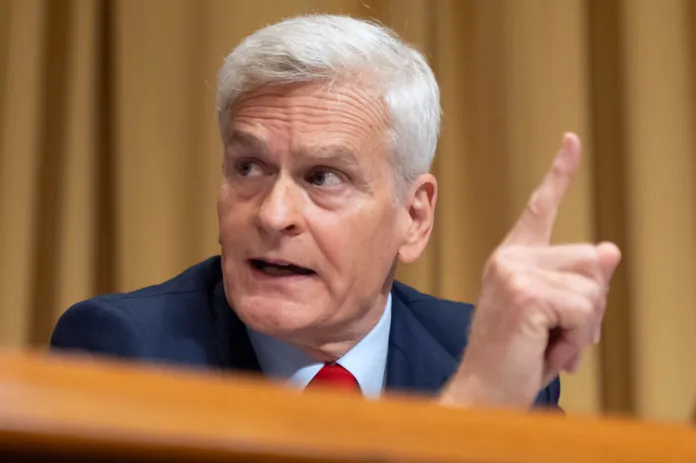
will work with “regional partners” to supply Iran with $300 billion in reconstruction after the war.
Topic: politicsRegion: Middle EastUpdated: i2 outletsSources: 5⚠ Bias gap — sources divergeSpectrum: Mostly Center⏱ 4 min read
Story Summary
SITUATION
Senator Cassidy criticized Trump's deal with Iran, labeling it the 'worst foreign policy blunder in decades.' This statement reflects ongoing debates about the implications of the deal amid current geopolitical tensions (per The New York Sun).
Coveragetap to expand ▾Spectrum: Mostly Center🌍US: 3 · Other: 2
Political Spectrum
Position is inferred from coverage mix.
i2 outlets · Center
Left
Center
Right
Left: 0
Center: 4
Right: 1
Geography Coverage
Distribution of where coverage is coming from.
i2 unique outlets · Dominant: US/Canada
KEY FACTS
- Bill Cassidy (R-LA) ripped into the Trump administration’s Memorandum of Understanding with Iran, calling it the “worst foreign policy blunder in decades.” “Reagan is rolling over in his grave,” Cassidy wrote Wednesday.
- “Iran’s nuclear ambitions were not curbed, and they have learned that threatening the Strait of Hormuz works and will undoubtedly leverage it in the future.
- “Before the war, the strait was open, Iran was being crushed by sanctions, and 13 service members were still alive,” he said.
- “Now, 13 Americans are dead, families have paid billions at the pump, sanctions will be lifted, and the bombing has stopped.
HISTORICAL CONTEXT
The ongoing military conflict between the United States and Israel against Iran, which began with coordinated strikes in March 2026, has escalated tensions in the region significantly. The strikes targeted Iranian military infrastructure, air defenses, and power plants, marking a critical point in a long-standing adversarial relationship.
In response to these military actions, Iran has engaged in retaliatory measures, further complicating the geopolitical landscape. This military campaign is a culmination of years of escalating hostilities, driven by a series of events that have shaped U.S.-Iran relations.
Brief
Senator Cassidy has publicly denounced former President Trump's deal with Iran, describing it as the 'worst foreign policy blunder in decades.' This criticism comes amid heightened tensions between the U.S. and Iran, particularly following recent military actions that have further complicated the geopolitical landscape.
Cassidy's remarks underscore a significant divide among U.S. lawmakers regarding the effectiveness and implications of the Iran deal, which has been a point of contention since its inception. Critics argue that the agreement has inadvertently facilitated Iran's nuclear program, raising alarms about regional security and the potential for further conflict.
As the U.S. continues to engage militarily in the region, Cassidy's comments reflect a growing concern among some lawmakers about the long-term consequences of the deal on national security and American interests abroad.
The ongoing debate illustrates the complexities of U.S. foreign policy in the Middle East, particularly as the situation evolves with each new military engagement and diplomatic maneuvering.
Where sources differ
Bias gap0.50 / 2.0
Left- and right-leaning outlets are covering this story differently — in which facts to emphasize, which context to include, and how to frame causes and consequences.
Center (4)
nysun.commediaite.comrawstory.comthehill.com
Right-leaning (1)
washington_examiner+0.70
will work with “regional partners” to supply Iran with $300 billion in reconstruction after the war. Cassidy calls Trump’s deal with Iran ‘worst foreign policy blunder in decades’ …
Sources
5 of 5 linked articles
Cassidy Calls Trump’s Iran Deal the ‘Worst Foreign Policy Blunder in Decades’
nysun.com12h agoLeft
↗
Bill Cassidy Rips Trump's Iran Deal 'Foreign Policy Blunder'
mediaite.com13h agoLeft
↗
will work with “regional partners” to supply Iran with $300 billion in reconstruction after the war.
washingtonexaminer.com13h agoCenter
↗
Outgoing GOP senator torches Trump's Iran deal: 'Worst foreign policy blunder in decades' - rawstory.com
rawstory.com13h agoLeft
↗
GOP senator: Trump Iran deal ‘tremendous foreign policy blunder’
thehill.com17h agoLeft
↗