
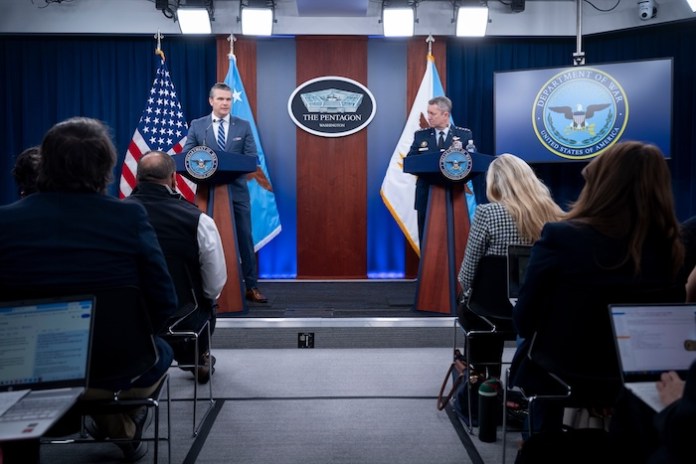
Ceasefire is ongoing despite Iran’s missile attacks: Hegseth
Coveragetap to expand ▾Spectrum: Mostly Center🌍Other: 3 · US: 2 · Europe: 1
- Pete Hegseth stated that the ceasefire with Iran is still holding despite missile attacks on the UAE and U.S. Navy destroyers (per washingtonexaminer.com).
- The attacks occurred on Monday, but the ceasefire was not declared over (per washingtonexaminer.com).
- General Dan Caine, chairman of the Joint Chiefs of Staff, confirmed that the ceasefire violations were below the threshold for restarting major combat operations (per washingtonexaminer.com).
- Hegseth emphasized that any decision to escalate would be made by President Donald Trump (per washingtonexaminer.com).
- Hegseth's comments were made during a press briefing following the missile attacks (per washingtonexaminer.com).
- The ceasefire was originally announced by President Trump on April 7, 2026 (per washingtonexaminer.com).
In the wake of recent missile attacks by Iran targeting the United Arab Emirates and two U.S. Navy destroyers, U.S. Secretary of Defense Pete Hegseth has confirmed that the ceasefire between the United States and Iran remains intact.
Despite these violations, Hegseth, alongside General Dan Caine, chairman of the Joint Chiefs of Staff, assured that the incidents have not crossed the threshold that would necessitate a resumption of major combat operations. This threshold, as Hegseth noted, is ultimately a political decision that rests with President Donald Trump.
The missile attacks on Monday have raised concerns about the stability of the ceasefire, which was initially declared by President Trump on April 7, 2026.
However, Hegseth reiterated that the current military operations, dubbed 'Operation Freedom', are focused on ensuring the safe passage of commercial ships through the Strait of Hormuz, separate from the broader conflict that had previously unfolded.
While left-leaning sources have highlighted the potential political ramifications and the fragility of the ceasefire, right-leaning outlets have concentrated on the military's evaluation of the situation, emphasizing that the recent actions by Iran have not yet warranted a full-scale military response.
The continuation of the ceasefire is critical in maintaining a semblance of stability in the region, as any escalation could have significant geopolitical consequences. The U.S. administration's approach appears to be one of cautious restraint, with a focus on diplomatic and strategic measures to prevent further deterioration of the situation.
As many governments watches closely, the decision-making process within the U.S. government will be pivotal in determining the next steps. The potential for escalation remains, but for now, the ceasefire holds, providing a window for diplomatic efforts to address the underlying tensions.
The situation underscores the delicate balance of power and the importance of strategic decision-making in conflict resolution. Both military and political leaders are acutely aware of the stakes involved, as they navigate the complexities of international diplomacy and security.
- The residents of the United Arab Emirates face direct threats from missile attacks, impacting their safety and security.
- Commercial shipping companies benefit from 'Operation Freedom', ensuring safe passage through the Strait of Hormuz.
- The U.S. military's restraint in response to the attacks helps prevent immediate escalation, maintaining regional stability.
- Iran's actions test the limits of the ceasefire, influencing future diplomatic and military strategies by the U.S.
- Whether President Donald Trump decides to escalate military operations in response to further violations.
- The effectiveness of 'Operation Freedom' in securing commercial shipping routes in the Strait of Hormuz.
- Any additional missile attacks by Iran that could challenge the current ceasefire agreement.
- Potential diplomatic engagements between the U.S. and Iran to address the ceasefire violations.
Left- and right-leaning outlets are covering this story differently — in which facts to emphasize, which context to include, and how to frame causes and consequences.
3 specific areas where coverage diverges — see below.
- Left-leaning sources emphasize political implications of the ceasefire's fragility; right-leaning sources focus on military assessments.
- No source mentions the initial U.S. and Israeli military strikes on Iran that triggered the current conflict.
- Civilian impact data from the missile attacks on the UAE is not provided by any source.
- Hegseth: 'No, the ceasefire is not over.'