
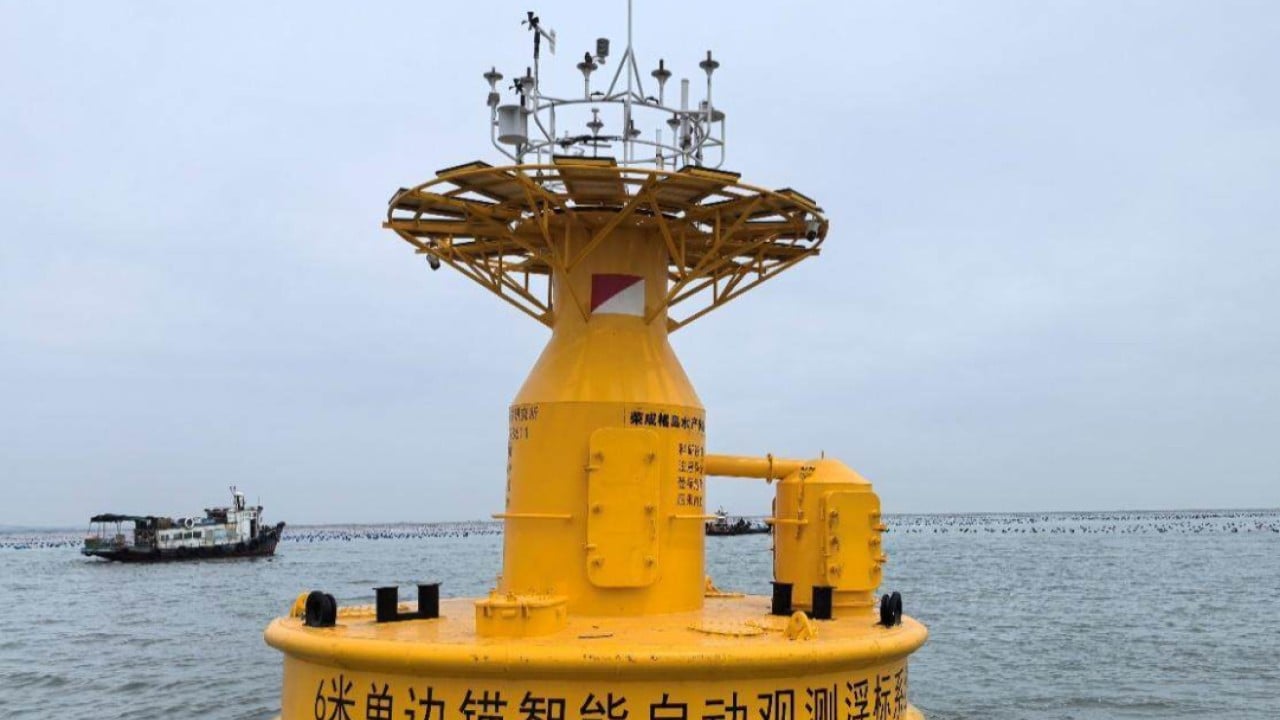
China Deploys Innovative Marine Buoy, Departing from Western Designs
Coveragetap to expand ▾Spectrum: Left Only🌍Asia: 1
- China deployed a new intelligent marine buoy off Rongcheng in Shandong province (per scmp.com).
- The buoy is described as the world's first of its kind with a disc-shaped single-side anchor structure (per scmp.com).
- This design abandons the traditional single-point mooring structure that has dominated Western marine engineering since World War II (per scmp.com).
- The buoy is six meters wide and has completed sea trials (per scmp.com).
- Technicians recovered a smaller three-meter buoy that had been in use for over 16 years at the same station (per scmp.com).
- The Institute of Oceanology, Chinese Academy of Sciences, is responsible for the buoy's deployment (per scmp.com).
China has taken a significant step in marine technology by deploying a new intelligent buoy off the coast of Rongcheng in Shandong province. This buoy, described by Chinese researchers as the first of its kind globally, marks a departure from the traditional Western designs that have been in use since World War II.
The buoy's innovative design features a disc-shaped single-side anchor structure, breaking away from the conventional single-point mooring systems that have dominated marine engineering for nearly 80 years. The six-meter-wide buoy has successfully completed sea trials and is now part of the Yellow Sea observation network.
This integration allows for continuous, real-time monitoring across the entire water column, enhancing the capabilities of marine observation in the region. The deployment was managed by the Institute of Oceanology, Chinese Academy of Sciences, which has emphasized the buoy's advanced technological features.
Simultaneously, technicians recovered a much smaller three-meter buoy that had been operational at the same station for more than 16 years. This transition highlights China's commitment to advancing its marine observation infrastructure and adopting new technologies that can provide more comprehensive data.
The new buoy's deployment is a rare attempt to redesign a buoy configuration that has remained largely unchanged for decades. By moving away from Western designs, China is not only showcasing its technological advancements but also asserting its independence in marine engineering.
This development is part of a broader strategy to enhance China's capabilities in oceanographic research and monitoring. The continuous real-time data provided by the buoy will be crucial for various applications, including environmental monitoring, resource management, and maritime safety.
As China continues to innovate in this field, the international marine engineering community will likely take note of these advancements. The success of this buoy could pave the way for further innovations and potentially influence future designs in marine technology globally.
- The deployment of the new buoy enhances China's ability to monitor marine environments, benefiting Chinese researchers and policymakers with more accurate data.
- The innovation represents a shift away from Western marine engineering dominance, potentially reducing reliance on foreign technology.
- The continuous real-time monitoring capability could improve maritime safety and resource management in the Yellow Sea, directly impacting local fishing communities and industries.
- Whether the new buoy's design influences future marine engineering projects globally.
- The impact of real-time monitoring data on maritime safety and environmental policies in China.
- Potential adoption of similar buoy designs by other countries in the coming years.
- No source mentions the specific technological advancements or challenges faced during the buoy's development.
- The potential geopolitical implications of China developing independent marine technology are not discussed.