
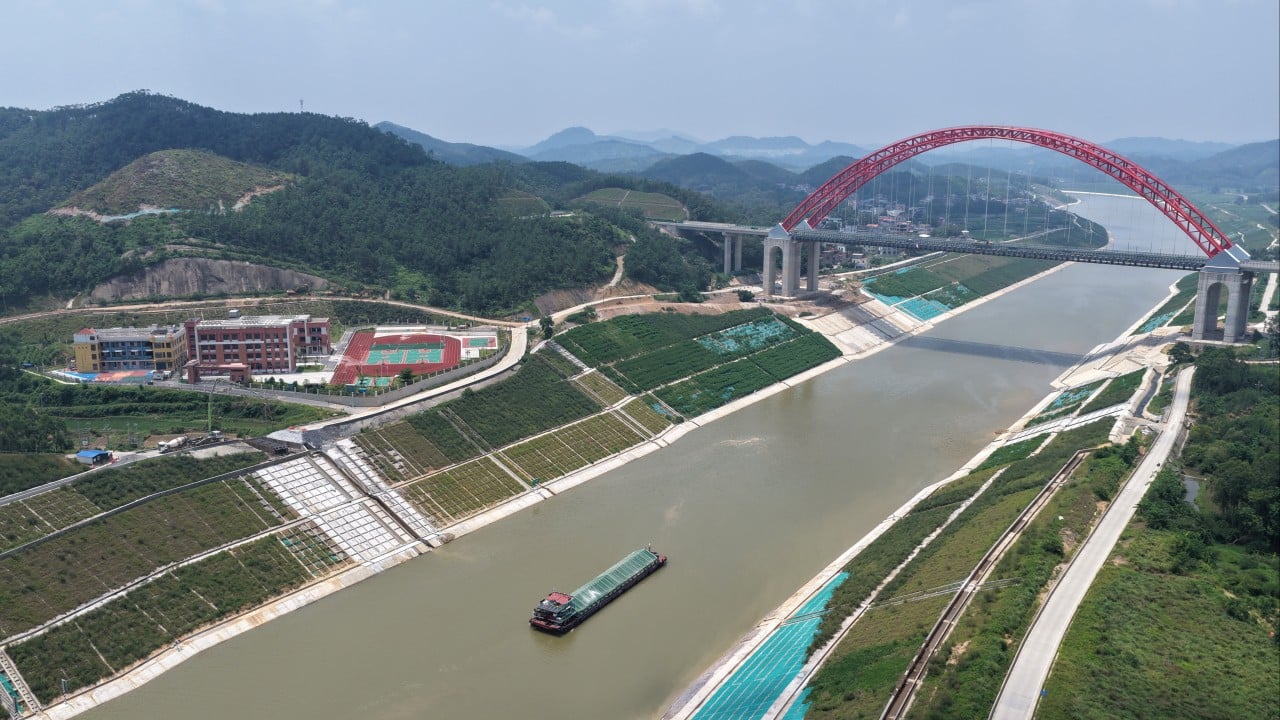
China opens Pinglu Canal, cutting sea route to Southeast Asia and linking southwest hinterland
Topic: geopoliticsRegion: AsiaUpdated: i2 outletsSources: 5Spectrum: Center Only⏱ 3 min read
Story Summary
SITUATION
China opened the Pinglu Canal to navigation, creating a new maritime gateway for the country’s southwestern hinterland (per scmp.com). Chinese state media framed the move as deepening trade links with Southeast Asia while the South China Morning Post highlighted the canal alongside Hong Kong’s new five-year plan (per news.google.com, scmp.com).
Coveragetap to expand ▾Spectrum: Center Only🌍Asia: 1 · Other: 1
Political Spectrum
Position is inferred from coverage mix.
i2 outlets · Center
Left
Center
Right
Left: 0
Center: 2
Right: 0
Geography Coverage
Distribution of where coverage is coming from.
i2 unique outlets · Dominant: Asia
KEY FACTS
- Chinese state media reported the canal shortens transit routes to Southeast Asia (per news.google.com)
- CCTV English reported the Pinglu Canal opens and creates a new gateway to the sea for southwest China (per news.google.com)
HISTORICAL CONTEXT
The immediate backdrop is the wider regional security crisis that has dominated Asia and the Middle East since March 2026, when the United States and Israel launched coordinated strikes on Iranian power plants, air defenses and military infrastructure; those strikes opened an active war in which subsequent Iranian military actions have been responses to that campaign.
At the same time, intensifying great-power competition in the Indo-Pacific — notably between China and the United States — has driven a renewed Chinese emphasis on securing trade routes and alternative maritime links to Southeast Asia and the Indian Ocean.
Brief
China opened the Pinglu Canal to navigation, a single confirmed development reported by Chinese state media and the South China Morning Post that officials say will create a maritime gateway for the country’s southwestern hinterland.
State outlets including CCTV framed the canal as shortening transit routes to Southeast Asia and deepening trade ties, while the South China Morning Post placed the canal’s opening alongside coverage of Hong Kong’s new five-year plan, signaling Beijing’s simultaneous economic messaging.
Chinese authorities have emphasized the canal’s role in logistics and export connectivity for inland provinces; the reporting available focuses on the infrastructure and trade rationale rather than operational details such as tolls, draft limits, or phased openings.
Independent data on capacity, projected cargo volumes, and which ports will handle diverted traffic were not provided in the cited coverage, so claims about economic impact remain stated by officials rather than independently verified.
The joint framing in state and Hong Kong outlets suggests a coordinated rollout of the narrative that the canal both integrates southwest China more directly with maritime routes and enhances links to Southeast Asian markets.
What comes next, according to the available reports, is likely operational testing and navigation by commercial vessels under state supervision, but the sources do not supply timelines, environmental impact assessments, or specific commercial agreements with Southeast Asian partners.
Absent from the reporting are third-party economic forecasts or detailed technical specifications that would let analysts quantify how much shorter transit times will be or which shippers will shift routes; those gaps will determine how rapidly the Pinglu Canal changes established patterns of freight movement in the region.
Why it matters
- Southwest Chinese provinces that depend on overland routes bear concrete costs or benefits through changed logistics: the canal is billed to shorten transit to Southeast Asia, which can lower transport times and costs for exporters in that hinterland (per scmp.com, news.google.com).
- Chinese exporters and state-owned ports stand to benefit from increased maritime access, channeling cargo through new gateway infrastructure that officials say deepens trade ties with Southeast Asia (per scmp.com).
- Southeast Asian port operators and shipping companies face a specific mechanism of competition—reduced transit distance could divert cargo volumes to different ports, affecting dock throughput and revenues in named regional hubs (per news.google.com, scmp.com).
- Local environmental and navigation authorities will bear the costs of managing any operational or ecological impacts because the sources provide no environmental assessment or mitigation details to date (per scmp.com).
What to watch next
- Whether Chinese authorities publish technical specifications and capacity projections for Pinglu Canal navigation within the next three months (per scmp.com reporting that the canal has opened but lacks operational details).
- Whether commercial shipping lines re-route services to use the Pinglu Canal and announce new calls at southwest-linked ports by the next quarter (an operational test of the canal’s trade rationale per news.google.com).
- Whether Chinese and Southeast Asian trade officials sign bilateral port or logistics agreements referencing Pinglu Canal access in upcoming regional trade meetings (per the canal’s framing as deepening trade ties in scmp.com).
Where sources differ
7 dimensionsFraming differences
?- scmp.com emphasizes the canal as a strategic gateway for southwestern China and links the announcement to Hong Kong’s five-year plan; news.google.com (CCTV English) frames the opening primarily as a new gateway to the sea for southwest China.
Disputed or unclear
?- No source disputes the opening itself, but neither source provides independent verification of the canal’s operational capacity, economic forecasts, or environmental impacts.
Omitted context
?- No source mentions independent cargo-capacity figures or which commercial ports will receive diverted traffic.
- No source provides an environmental impact assessment or mitigation plan for the canal.
- No source cites third-party economic modeling to quantify projected transit-time savings or trade-volume shifts.
Conflicting figures
?- No differing numerical figures appear in the provided sources; neither source gives cargo volumes, distances saved, or cost estimates.
Disputed causality
?- Both sources present the canal opening as an action by Chinese authorities framed to deepen trade; neither source identifies a preceding trigger that caused the canal’s opening.
Attribution disputes
?- scmp.com attributes strategic framing to Beijing and links to Hong Kong planning; CCTV English (via news.google.com) attributes the opening to state media announcements about creating a gateway for southwest China.
Sources
5 of 5 linked articles
China launches Pinglu Canal; Hong Kong unveils first 5-year plan: SCMP’s 7 highlights
scmp.com20h agoCenter
↗
Pinglu Canal opens, creating a new gateway to the sea for southwest China
english.cctv.com22h agoLeft
↗
China opens $10.8B Pinglu Canal, creating first major river-to-sea shortcut since 1949 - streamlinefeed.co.ke
streamlinefeed.co.keSep 17Left
↗
China opens major river-to-sea canal, creating trade shortcut to Southeast Asia - en.people.cn
en.people.cnSep 17Left
↗
China opens Pinglu Canal, launching new shipping gateway to ASEAN
container-news.comSep 16Left
↗