
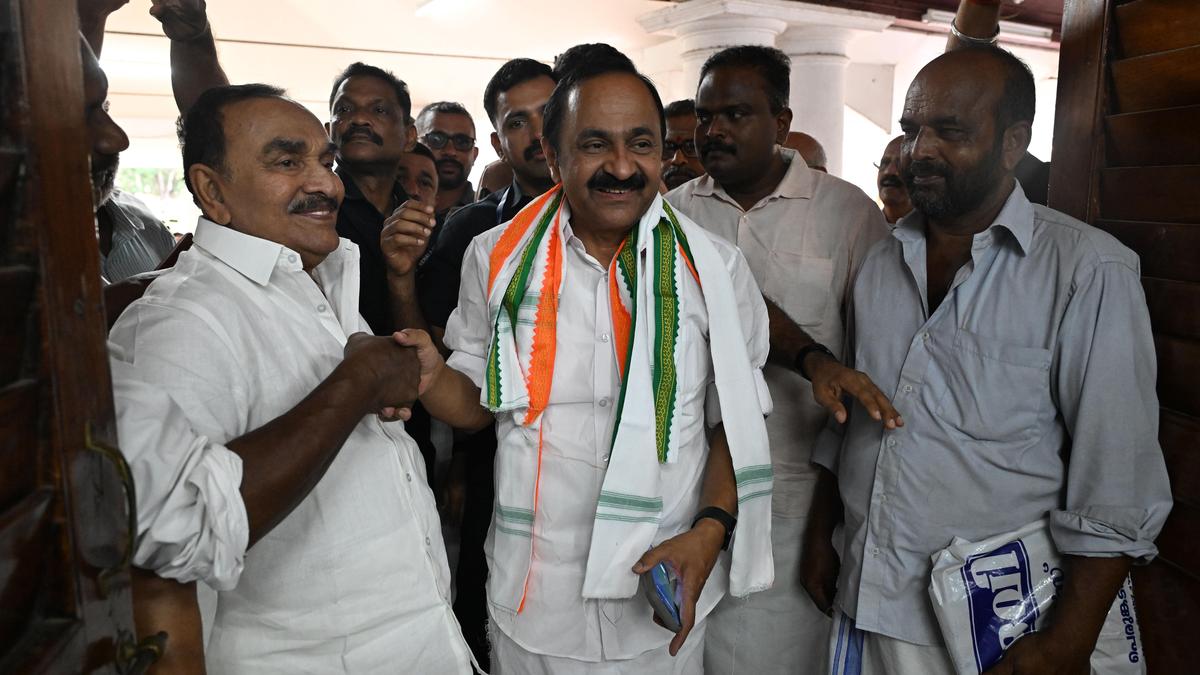
Congress Faces Internal Strife as Leadership Battle Intensifies in Kerala
Topic: politicsRegion: North AmericaUpdated: i3 outletsSources: 25⚠ Bias gap — sources divergeSpectrum: Center Only⏱ 4 min read
Story Summary
SITUATION
After securing a significant victory in the Kerala assembly elections, Congress is struggling to finalize its chief minister candidate amid competing claims from three senior leaders. The internal discord has led to public protests and a warning from party leadership to manage dissent among supporters (per Times of India).
Coveragetap to expand ▾Spectrum: Center Only🌍Other: 12 · Asia: 9
Political Spectrum
Position is inferred from coverage mix.
i3 outlets · Center
Left
Center
Right
Left: 0
Center: 21
Right: 0
Geography Coverage
Distribution of where coverage is coming from.
i3 unique outlets · Dominant: Global
KEY FACTS
- Congress has not yet finalized its chief minister candidate following a victory in the Kerala assembly elections (per Times of India).
- Congress leadership is in discussions with United Democratic Front (UDF) allies to finalize ministerial allocations, with the Indian Union Muslim League (IUML) securing five posts (per The Hindu).
- The Congress party's internal conflicts have spilled into public view, with competing marches and poster campaigns among supporters (per The Hindu).
- A final decision on the chief minister candidate is expected within 24 hours as Congress high command holds meetings (per Times of India).
HISTORICAL CONTEXT
The current internal struggles within the Indian National Congress (INC) over the selection of a Chief Minister for Kerala can be traced back to a complex interplay of historical, political, and organizational factors.
The Congress party, once a dominant force in Kerala's political landscape, has faced significant challenges in recent years, both at the state and national levels. The last time Congress held power in Kerala was under the leadership of Oommen Chandy, whose government ended in 2016.
Brief
In the wake of a decisive victory in the Kerala assembly elections, Congress is grappling with a leadership crisis as it seeks to finalize its chief minister candidate. Three prominent leaders—V.D. Satheesan, Ramesh Chennithala, and K.C. Venugopal—are vying for the position, leading to significant internal strife.
Public protests have erupted in support of Satheesan, reflecting a strong faction within the party that is pushing for his nomination. Meanwhile, Chennithala has voiced his dissatisfaction with the cabinet formation discussions, suggesting he may not accept a ministerial role if the situation does not improve.
The Congress leadership is currently engaged in negotiations with its UDF allies to allocate ministerial positions, with the IUML already securing five posts. This internal discord has manifested in public displays of support and dissent, with competing marches and poster campaigns highlighting the divisions within the party.
As Congress leadership convenes in Delhi to resolve these issues, a final decision on the chief minister candidate is anticipated within the next day, underscoring the urgency of the situation as the party seeks to present a united front following its electoral success.
Why it matters
- The internal conflict within Congress could weaken its governance in Kerala, impacting the state's political stability and policy implementation.
- Public protests in support of V.D. Satheesan indicate a significant factional divide, which may lead to further unrest among party supporters if not addressed promptly.
- Ramesh Chennithala's potential withdrawal from a ministerial role could diminish the party's representation and influence in the new government, affecting its ability to govern effectively.
What to watch next
- Whether Congress leadership finalizes the chief minister candidate by May 18, 2026.
- The outcome of ongoing negotiations regarding ministerial allocations within the UDF.
- Any further public demonstrations or protests from party supporters in response to leadership decisions.
Where sources differ
1 dimensionBias gap0.60 / 2.0
Left- and right-leaning outlets are covering this story differently — in which facts to emphasize, which context to include, and how to frame causes and consequences.
Center (21)
m.economictimes.comnewindianexpress.comndtvprofit.comsundayguardianlive.comthe_hinduenglish.mathrubhumi.comonmanorama.comthehansindia.comrepublicworld.comdeccanherald.comdeccanherald.comthesouthfirst.comtimesofindia.indiatimes.comtimesofindia.indiatimes.comnewskarnataka.comwionews.comindianexpress.comtimesofindia.indiatimes.comtheprint.inlivemint.comenglish.mathrubhumi.com
1 specific area where coverage diverges — see below.
Framing differences
?- The Times of India emphasizes the urgency of finalizing the chief minister candidate, while The Hindu focuses on the internal protests and public displays of dissent.
Sources
21 of 21 linked articles
VD Satheesan finalises Kerala Cabinet, submits minister list to governor ahead of swearing-in
m.economictimes.comMay 17Left
↗
Kerala CM-designate Satheesan announces new cabinet; IUML names ministers ahead of swearing-in
newindianexpress.comMay 17Left
↗
Kerala: UDF Finalises Cabinet List, CM-Designate Satheesan Meets Governor
ndtvprofit.comMay 17Left
↗
Kerala Cabinet Formation Live Updates: IUML Secures 5 Posts, Congress May Get 12. Who Is Getting What?
sundayguardianlive.comMay 17Left
↗
Kerala Cabinet: Congress leadership in talks with UDF allies to seal allocation of ministerial berths
thehindu.comMay 17Center
↗
Kerala Cabinet list to reach Governor by 2 pm today ahead of VD Satheesan swearing-in
english.mathrubhumi.comMay 17Left
↗