
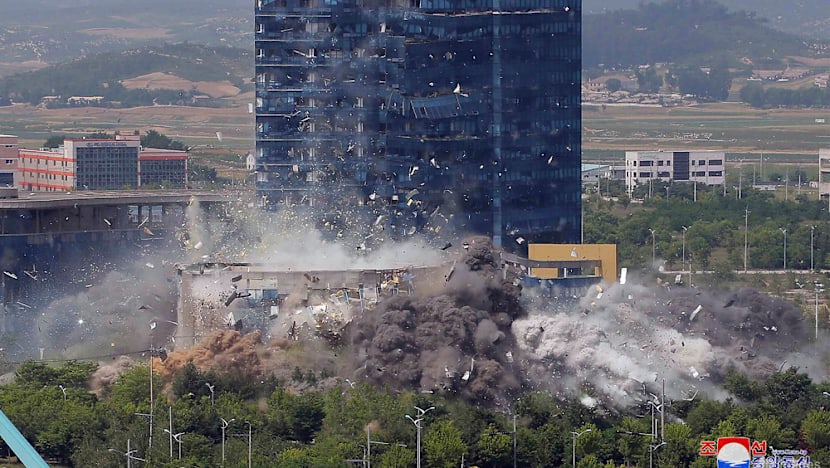
Seoul court orders North Korea to pay W44.6 billion (US$32.5m) for blowing up liaison office
Topic: politicsRegion: AsiaUpdated: i2 outletsSources: 5Spectrum: Mostly Center⏱ 3 min read⚠ 48h+ old
Story Summary
SITUATION
A South Korean court has ordered North Korea to pay W44.6 billion (about US$32.5 million) for blowing up the inter‑Korean liaison office. The ruling appears in coverage that gives the same judgment amount but uses differing local currency and phrasing between outlets (per koreajoongangdaily.com, The Korea Herald).
Coveragetap to expand ▾Spectrum: Mostly Center🌍ME: 1 · Asia: 1
Political Spectrum
Position is inferred from coverage mix.
i2 outlets · Center
Left
Center
Right
Left: 1
Center: 1
Right: 0
Geography Coverage
Distribution of where coverage is coming from.
i2 unique outlets · Dominant: Middle East
KEY FACTS
- A Seoul court ordered North Korea to pay W44.6 billion (about US$32.5 million) for blowing up the inter‑Korean liaison office (per The Korea Herald).
- The two sources use slightly different headline phrasing: one emphasizes the US dollar amount while the other gives the Korean‑won figure W44.6b (per koreajoongangdaily.com, The Korea Herald).
- The ruling is presented as a civil monetary judgment rather than a criminal sentence in both pieces (per koreajoongangdaily.com, The Korea Herald).
HISTORICAL CONTEXT
The immediate backdrop is the long-running confrontation between Seoul and Pyongyang that has included episodic diplomatic engagement, military provocations, and cross-border civilian campaigns; most recently this cycle of tension centered on the destruction of the inter-Korean liaison office in Kaesong on June 16, 2020, which followed weeks of escalatory rhetoric and activist leaflet launches from the South that Pyongyang said it could not tolerate.
The structural conditions for today’s dispute were shaped by the armistice and the legal framework separating wartime and peacetime relations: the Korean Armistice Agreement signed on July 27, 1953 ended active hostilities without a peace treaty, the South–North Joint Declaration of July 4, 1972 set an early aspiration for reunification and nonaggression, and the South–North Basic Agreement, concluded December 13, 1991, created bilateral obligations and mechanisms for cooperation that successive administrations invoked or ignored.
Brief
A Seoul court has ordered North Korea to pay W44.6 billion — reported as about US$32.5 million — for blowing up the inter‑Korean liaison office that was destroyed in 2020. South Korean reporting from koreajoongangdaily.com and The Korea Herald both name North Korea as the defendant and treat the decision as a civil money judgment tied to the 2020 explosion.
The two outlets differ primarily in presentation: one frames the decision using the local currency figure W44.6b while the other highlights the US dollar equivalent, but both report the same court finding.
South Korean authorities and the plaintiffs who sought damages view the ruling as legal recognition of state responsibility for the destruction of the liaison office; the articles do not quote North Korean officials or present a North Korean response.
The coverage treats the judgment as part of a continuing legal and political accountability effort over the 2020 incident, noting the court tied the liability specifically to the act of blowing up the office.
While the reports convey the amount and the link to the 2020 blast, neither article provides details in this pack on how Seoul plans to enforce the judgment against North Korea or whether any assets are available to satisfy the award.
This ruling completes a domestic judicial step assigning financial liability to North Korea for the liaison office explosion and sets up further questions about enforcement and diplomatic implications between the two governments.
Why it matters
- Who bears the cost: South Korean plaintiffs named in the suit hold the right to seek W44.6 billion (about US$32.5 million) from North Korea as the court judgment assigns monetary liability (per The Korea Herald, koreajoongangdaily.com).
- Mechanism of harm: The court framed the 2020 destruction of the liaison office as an act that produced measurable monetary damages now quantified at W44.6 billion, creating a legal claim that plaintiffs can attempt to collect (per The Korea Herald).
- Who benefits: South Korean plaintiffs and legal actors pursuing accountability benefit materially if they can collect the award; South Korean courts and officials benefit politically by documenting state responsibility in a domestic legal record (per koreajoongangdaily.com, The Korea Herald).
What to watch next
- Whether South Korean authorities or plaintiffs initiate legal or diplomatic measures to enforce the W44.6 billion judgment against North Korea within the next 12 months.
- Whether any South Korean court filings will disclose identified North Korean assets or third‑party holdings that could be targeted for seizure to satisfy the award.
- Whether North Korea issues an official response or denial to the Seoul court ruling through state media or diplomatic channels in the weeks following publication.
Where sources differ
7 dimensionsFraming differences
?- koreajoongangdaily.com emphasizes the US dollar equivalent (US$32.5 million) in its headline framing; The Korea Herald presents the Korean‑won amount W44.6b more prominently.
Disputed or unclear
?- Neither source in this pack provides details on enforcement mechanisms or whether any North Korean assets exist that could be used to satisfy the judgment.
Omitted context
?- No article in this pack mentions what prior actions, negotiations, or legal steps by plaintiffs led to this particular civil judgment beyond linking it to the 2020 blast.
- No source here provides information on any North Korean official response or denial to the ruling.
- No source cites international legal avenues (ICC/ICJ) or bilateral enforcement mechanisms relevant to collecting a judgment from a foreign state.
Conflicting figures
?- koreajoongangdaily.com cites 'US$32.5 million' while The Korea Herald cites the equivalent 'W44.6b' — both refer to the same judgment amount in different currencies.
Disputed causality
?- Both outlets attribute the judgment directly to North Korea 'blowing up' or 'destroying' the liaison office in 2020; neither source in this pack presents a competing account of who performed the blast.
Attribution disputes
?- Both sources attribute the court ruling and the monetary figure to Seoul court records or reporting on the decision; no source attributes responsibility to any actor other than North Korea.
Sources
5 of 5 linked articles
Seoul court orders North Korea to pay $32.5m for blowing up office
aljazeera.comSep 16Center
↗
Court orders North Korea to pay Seoul for blowing up office
yahoo.comSep 16Left
↗
Seoul court orders North Korea to pay $32.5 million for 2020 liaison office blast - koreajoongangdaily.com
koreajoongangdaily.comSep 16Left
↗
Court orders North Korea pay Seoul US$32.5 million for blowing up office
channelnewsasia.comSep 16Center
↗
Seoul court orders N. Korea to pay W44.6b for blowing up inter-Korean liaison office
koreaherald.comSep 16Left
↗