
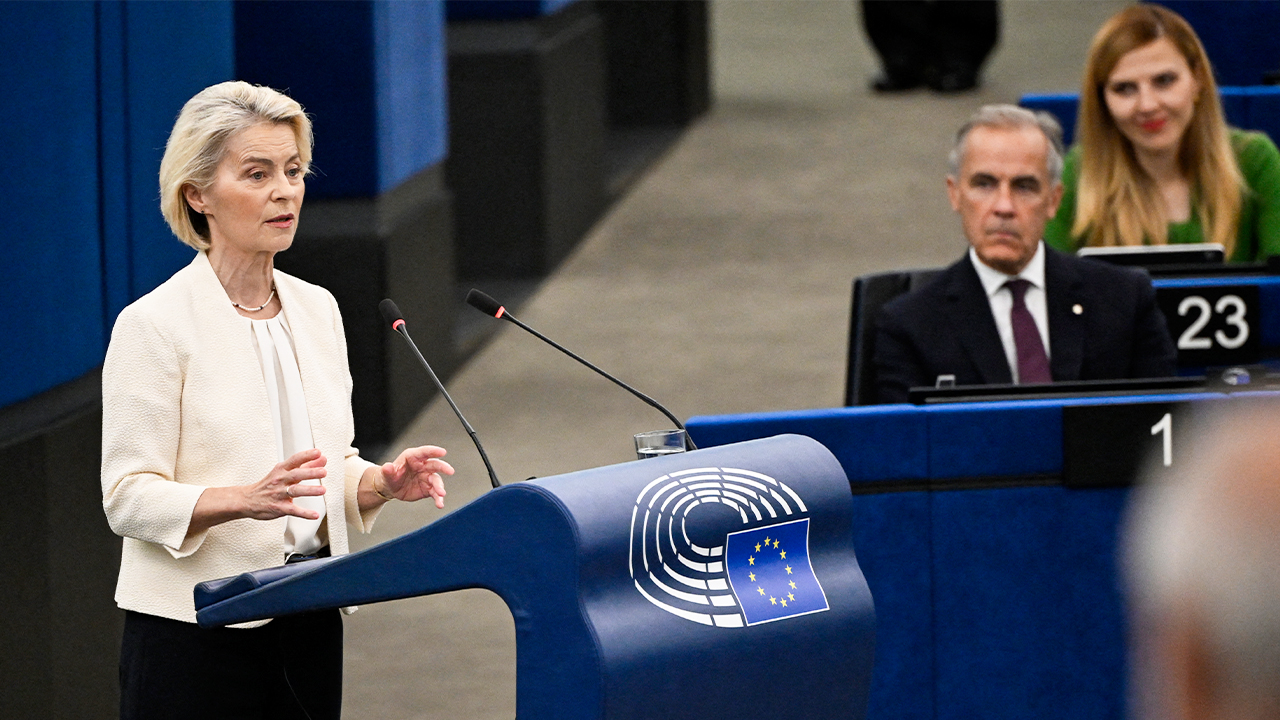
Von der Leyen offers Canada EU 'associate member' status to link defense, AI and energy
Topic: defense & securityRegion: EuropeUpdated: i3 outletsSources: 5⚠ Bias gap — sources divergeSpectrum: Mostly Center⏱ 3 min read📡 Wire pickup⚠ 48h+ old
Story Summary
SITUATION
European Commission President Ursula von der Leyen proposed opening the door for Canada to become the European Union's first "associate member," integrating Ottawa across critical minerals, defense, AI and energy (per Fox Business). The proposal would be an unprecedented step in EU external relations as Canada seeks to diversify away from the United States amid a US trade spat (per Fox Business).
Coveragetap to expand ▾Spectrum: Mostly Center🌍Other: 2 · Asia: 1
Political Spectrum
Position is inferred from coverage mix.
i3 outlets · Center
Left
Center
Right
Left: 0
Center: 2
Right: 1
Geography Coverage
Distribution of where coverage is coming from.
i3 unique outlets · Dominant: Global
KEY FACTS
- European Commission President Ursula von der Leyen proposed allowing Canada to become the EU's first "associate member" (per Fox Business).
- Von der Leyen's proposal would integrate Canada with the bloc across critical minerals, defense, artificial intelligence and energy (per Fox Business).
- Fox Business reports Canada is seeking to diversify away from the United States amid a US trade spat, which frames Ottawa's interest in closer ties with the EU (per Fox Business).
HISTORICAL CONTEXT
The legal architecture that allows a supranational bloc to negotiate novel forms of external association traces to the founding of European integration.
In 1951 the six states that created the European Coal and Steel Community delegated sovereign control over key industrial sectors to a common authority to prevent war, establishing the precedent that states could pool sovereignty in specific policy areas.
Brief
European Commission President Ursula von der Leyen proposed that Canada be invited to become the European Union's first "associate member," a move that would bind Ottawa and the bloc across critical minerals, defense, artificial intelligence and energy (per Fox Business).
Von der Leyen framed the idea as an unprecedented form of external integration for the EU, signaling a willingness in Brussels to experiment with new institutional ties beyond traditional membership and partnership models (per Fox Business).
Fox Business reports Ottawa's interest in deeper links comes as Canada looks to diversify away from the United States amid a US trade spat, which European officials appear to see as an opening to lock in supply chains for minerals, secure energy ties and align on defense and AI standards (per Fox Business).
The proposal explicitly couples economic security — critical minerals and energy — with military and technological cooperation, suggesting Brussels wants partners that can supply inputs and align on emerging defense and AI governance simultaneously (per Fox Business).
The idea remains at the proposal stage in the Fox Business account; the outlet characterizes it as a political initiative rather than a completed treaty, leaving significant questions about legal mechanics, voting rights, and how associate membership would differ from existing EU frameworks such as association agreements or sectoral partnerships (per Fox Business).
If advanced, negotiators would need to define which EU competences an associate Canada would adopt and how integration on defense and AI would reconcile with both EU institutions and Canadian sovereignty — issues Fox Business notes but does not resolve (per Fox Business).
Why it matters
- - Canadian manufacturers and mining regions: locking Canada into EU critical-minerals supply chains would channel investment and regulatory alignment toward Canadian producers while potentially shifting procurement away from US vendors (per Fox Business). - European defense planners and armed forces: formalized military and defense cooperation with Canada could deepen interoperability, procurement coordination, and shared capability development across NATO-adjacent partners (per Fox Business). - AI developers and regulators in Canada: aligning AI rules with the EU could impose EU-style governance and compliance costs on Canadian tech firms while giving them clearer access to EU markets (per Fox Business). - Governments seeking strategic autonomy: Brussels gains a partner that can help secure mineral and energy inputs, reducing reliance on single suppliers—benefiting EU policymakers aiming to lock supply chains (per Fox Business).
What to watch next
Whether the European Commission advances formal negotiations on an "associate member" framework for Canada during upcoming EU policy cycles later this year (per Fox Business). 2) Whether Canada publicly accepts exploratory talks with the EU on integrating defense, AI, energy and critical-minerals cooperation (per Fox Business). 3) Whether the proposal prompts bilateral consultations between Ottawa and Washington given Fox Business reports Canada is seeking diversification amid a US trade spat (per Fox Business). 4) Whether EU institutions clarify legal mechanics: which competences an associate Canada would adopt and how voting or representation would work in EU decision-making (per Fox Business).
Where sources differ
7 dimensionsBias gap0.90 / 2.0
Left- and right-leaning outlets are covering this story differently — in which facts to emphasize, which context to include, and how to frame causes and consequences.
Center (4)
houstonpublicmedia.orgchannel_news_asiatelegraphherald.com10tv.com
Right-leaning (1)
fox_business+0.75
European Commission President Ursula von der Leyen proposed opening the door for Canada to become the European Union's first "associate member," integrating Ottawa with the bloc ac…
7 specific areas where coverage diverges — see below.
Framing differences
?- Only Fox Business is in this pack; it frames the proposal as an unprecedented step tying economic sectors and defense, and emphasizes Canada's desire to diversify from the US amid a trade spat (per Fox Business).
Disputed or unclear
?- No other outlet in this pack disputes or corroborates Fox Business's account; details such as legal mechanics, timelines, and formal responses from Canada, EU member states, or the United States remain unclear (per Fox Business).
Omitted context
?- No source here explains the exact legal model for "associate membership" or how it would differ from existing EU association agreements.
- No source in this pack provides statements from Canadian government officials, EU member-state leaders, or the United States reacting to the proposal.
- No source provides timelines, negotiating mandates, or whether NATO-related approvals would be needed for the proposed defense integration.
Conflicting figures
?- No differing numerical figures appear in the available source set (per Fox Business).
Disputed causality
?- Fox Business links Canada's push to diversify away from the United States to a US trade spat and presents von der Leyen's proposal as responding to that opportunity; no alternative causal narratives appear in this pack (per Fox Business).
Attribution disputes
?- Fox Business attributes the proposal to Ursula von der Leyen and attributes Canada's motives to a desire to diversify away from the United States amid a US trade spat (per Fox Business).
Sources
5 of 5 linked articles
EU opens door to unprecedented 'associate member' status for Canada amid US trade spat
foxbusiness.comSep 16Right
↗
EU's Ursula von der Leyen says she wants Canada to become an associate member
houstonpublicmedia.orgSep 16Left
↗
EU opens door for Canada to become first associate member
channelnewsasia.comSep 16Center
↗
EU chief Ursula von der Leyen says she wants Canada to become the bloc's 1st associate member
telegraphherald.comSep 16Left
↗
EU chief Ursula von der Leyen says she wants Canada to become the bloc's 1st associate member - 10TV
10tv.comSep 16Left
↗