
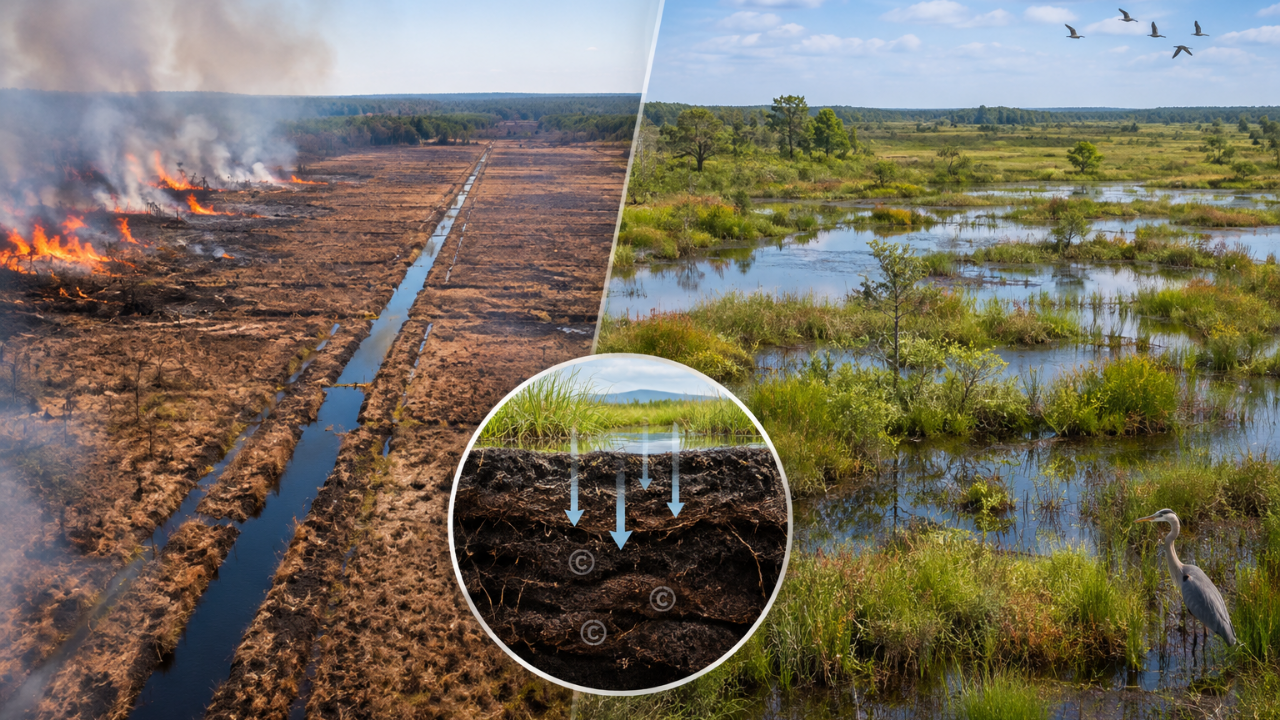
Abandoned farm’s 50-mile ditches turned North Carolina peatland into 130,000‑ton CO₂ source
Coveragetap to expand ▾Spectrum: Center Only🌍Asia: 1 · Africa: 1
- A failed farming venture carved about 50 miles of drainage ditches through a peatland in North Carolina (per timesofindia.indiatimes.com).
- The affected peatland covers a 23‑square‑mile tract near Belhaven (per timesofindia.indiatimes.com).
A failed farming venture carved roughly 50 miles of drainage ditches through a 23‑square‑mile peatland near Belhaven, North Carolina, exposing ancient peat and converting the tract from a long‑term carbon store into an estimated 130,000‑ton per year CO₂ source (per timesofindia.indiatimes.com).
The ditches lowered the water table, which researchers say has left deep peat vulnerable to drought, accelerated decomposition and wildfire; scientists now plan to reflood the area to raise the water table and curb greenhouse‑gas emissions (per timesofindia.indiatimes.com).
The reporting available is limited; the single source describes the chain of events as: farmland drainage → exposed peat → increased decomposition and fire risk → large CO₂ emissions (per timesofindia.indiatimes.com).
That account provides both the scale of the damage (50 miles of ditches across a 23‑square‑mile tract) and the policy response under consideration (reflooding) but offers no operational details on who will carry out restoration, funding sources, or a timetable (per timesofindia.indiatimes.com).
Reflooding peatlands is a standard ecological method to halt aerobic decomposition because standing water slows the breakdown of organic matter; the source frames the reflooding plan as the immediate remedy to stop the site from emitting an estimated 130,000 tons of CO₂ annually (per timesofindia.indiatimes.com).
The piece stresses wildfire risk alongside emissions: exposed peatlands can burn and release both stored carbon and local air pollution, heightening near‑term hazards for Belhaven and nearby communities (per timesofindia.indiatimes.com).
What remains unclear in the reporting is who engineered the original drainage during the failed farming venture, who currently owns or manages the land, and which scientific or government bodies will implement and finance reflooding (per timesofindia.indiatimes.com).
Those gaps leave open questions about liability, timelines for restoration, and how emissions estimates were calculated. Still, the documented sequence — extensive ditching lowering the water table followed by high emissions — makes the case that hydrological restoration is the proximate mitigation step proposed by scientists (per timesofindia.indiatimes.com).
- Residents near Belhaven bear concrete costs: exposed peat increases local wildfire risk and releases an estimated 130,000 tons of CO₂ per year, raising air‑quality and health hazards for that community (per timesofindia.indiatimes.com).
- The landowner(s) or local government will face direct fiscal and logistical burdens to reflood and manage the 23‑square‑mile tract to stop decomposition and fires (per timesofindia.indiatimes.com).
- Climate mitigation goals stand to lose if peatlands that once sequestered carbon continue emitting 130,000 tons of CO₂ annually; scientists benefit from implementing reflooding because it is the documented method to reduce those emissions (per timesofindia.indiatimes.com).
- Whether scientists or a named agency formalize and begin a reflooding project for the Belhaven tract and by what timeframe (per timesofindia.indiatimes.com).
- Whether owners or local authorities disclose who conducted the original drainage and who will fund restoration work (per timesofindia.indiatimes.com).
- Whether updated emissions estimates or a technical plan are published that specify how the 130,000‑ton CO₂ figure was calculated and how reflooding will alter it (per timesofindia.indiatimes.com).
- Only one source is available; timesofindia.indiatimes.com frames the issue as a failed farming venture causing drainage and proposing reflooding to stop 130,000 tons/year CO₂ emissions.
- No other outlet disputes the chain of events, but the ownership, responsible parties for the original drainage, and exact methods for reflooding remain unclear (per timesofindia.indiatimes.com).
- No source names the landowner(s) or the entity that dug the 50 miles of ditches, omitting who bears legal or financial responsibility.
- No source provides independent verification of the 130,000‑ton CO₂ estimate or the methodology behind it.
- No source mentions federal, state, or local funding programs or agencies (e.g., USDA, EPA, North Carolina agencies) that could be responsible for peatland restoration.
- No source provides measured data on local air‑quality impacts or documented incidents of peatland fires tied to the drainage.
- Only one figure appears: 50 miles of ditches and 23 square miles of peatland and an estimated 130,000 tons of CO₂ per year are all from timesofindia.indiatimes.com.
- The source attributes the emissions and fire risk to ditching that lowered the water table; there is no alternative causal account in other outlets to compare (per timesofindia.indiatimes.com).
- The timesofindia.indiatimes.com article attributes the plan to 'scientists' planning to reflood the peatland but does not name specific researchers or institutions.