
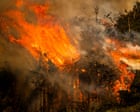
Federal firefighters say Trump administration staffing gaps are endangering crews
Topic: climate & environmentRegion: North AmericaUpdated: i1 outletsSources: 1Spectrum: Left Only⏱ 3 min read⚠ 48h+ old
Story Summary
SITUATION
Federal firefighters say the Trump administration is leaving crews understaffed and operating with persistent management vacancies during an intense wildfire season. Firefighters and retired federal fire managers warn those shortfalls and political pressure have increased risks to crews (per theguardian.com).
Coveragetap to expand ▾Spectrum: Left Only🌍Europe: 1
Political Spectrum
Position is inferred from coverage mix.
i1 outlets · Left
Left
Center
Right
Left: 1
Center: 0
Right: 0
Geography Coverage
Distribution of where coverage is coming from.
i1 unique outlets · Dominant: Europe
KEY FACTS
- Federal firefighters report crews are understaffed during an intense wildfire season (per theguardian.com)
- Firefighters and retired federal fire managers warned that persistent management vacancies have increased risks to crews (per theguardian.com)
- Sources say political pressure within the Trump administration is contributing to operational strain on wildfire crews (per theguardian.com)
HISTORICAL CONTEXT
The immediate backdrop is an unusually intense wildfire season across the United States in 2026 that has placed federal wildland firefighting resources under heavy sustained pressure at the same time the country is confronting a separate international crisis: in March 2026 the United States and Israel launched coordinated strikes on Iranian infrastructure and military targets, an operation that followed a period of escalating exchanges between Iran and U.S. and allied forces earlier that year.
The combination of expanded domestic fire activity and heightened national-security commitments has intensified demands on the Department of the Interior, the U.S. Forest Service and interagency fire suppression networks that coordinate national incident response.
Brief
Federal firefighters told the Guardian that the Trump administration’s staffing gaps and persistent management vacancies are stretching crews thin and increasing danger during an intense wildfire season.
Frontline firefighters and several retired federal fire managers described the problem as systemic: they said daily operations now run with fewer staff and unfilled leadership posts, creating greater risk for on-the-ground crews and complicating incident management (per theguardian.com).
Those sources attributed part of the strain to political pressure from the administration, saying it has hindered hiring and left key positions vacant; the Guardian reports that firefighters are calling for sustained funding and for vacant management roles to be filled to reduce operational risk (per theguardian.com).
The account distinguishes between confirmed operational shortfalls — vacancies and staffing levels — and claims about political motives; the staffing numbers themselves and the existence of vacancies are reported, while attribution of motive to political pressure is presented as the firefighters’ and retirees’ assessment (per theguardian.com).
Why now: the combination of a heightened wildfire season and the reported unfilled leadership posts has tightened margins for safe operations, prompting veteran managers and active crews to issue public warnings and demand concrete staffing fixes (per theguardian.com).
The piece closes with a policy prescription voiced by those sources — sustained investment in wildfire staffing and prompt filling of management vacancies — presented as the necessary step to lower risks for federal crews operating amid heavy fire activity (per theguardian.com).
Why it matters
- Federal firefighters bear the concrete cost: understaffing and vacant management posts increase operational risk to crews fighting wildfires (per theguardian.com).
- Crews on the line face higher safety hazards because reported vacancies reduce supervisory capacity and surge staffing during peak fire activity (per theguardian.com).
- The Trump administration benefits politically by resisting staffing or spending changes critics blame for vacancies, according to firefighters and retirees who link political pressure to hiring delays (per theguardian.com).
What to watch next
- Whether the Trump administration fills the reported management vacancies in federal wildfire agencies within the coming weeks (per theguardian.com).
- Whether Congress or the administration approves sustained funding increases for wildfire staffing and hiring, as demanded by firefighters (per theguardian.com).
- Whether retired federal fire managers and active crews follow up with public statements or legal actions if vacancies and staffing shortfalls persist (per theguardian.com).
Where sources differ
7 dimensionsFraming differences
?- Only theguardian.com is in this pack; it frames the issue as administration-driven staffing and vacancy failures increasing risk to crews.
Disputed or unclear
?- No source in this pack disputes the existence of vacancies or understaffing, but the causal link to 'political pressure' is presented as the firefighters' and retirees' claim rather than independently verified fact (per theguardian.com).
Omitted context
?- No source in this pack provides specific numbers on how many vacancies exist or exact staffing shortfalls.
- No source in this pack details which specific federal agencies or leadership posts are vacant.
- No source in this pack cites concrete incident-level safety outcomes (injuries or deaths) tied directly to the reported vacancies.
- No source in this pack includes administration statements or data rebutting the firefighters' claims.
Conflicting figures
?- No differing numerical figures appear in this source pack; theguardian.com does not give exact vacancy or staffing counts.
Disputed causality
?- Theguardian.com reports firefighters and retired managers saying political pressure is contributing to vacancies; no alternate causal explanation is offered in this pack.
Attribution disputes
?- Theguardian.com attributes claims about political pressure and increased risk to firefighters and retired federal fire managers.
Sources
1 of 1 linked articles