
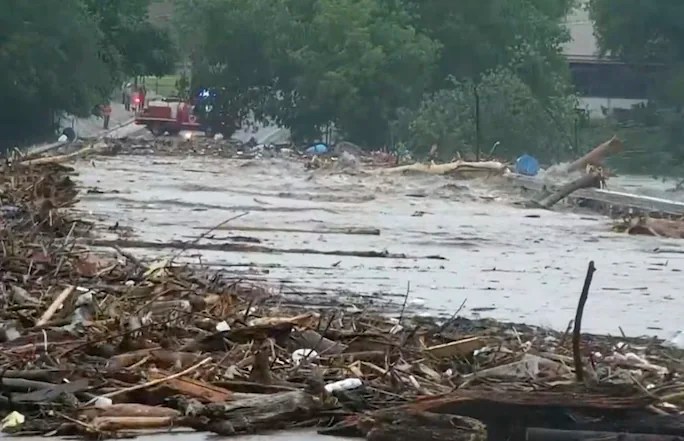
Former FEMA chief: NFIP subsidizes wealthy coastal living in Texas, book argues
Topic: generalRegion: north americaUpdated: i2 outletsSources: 2⚠ Bias gap — sources divergeSpectrum: Mixed⏱ 3 min read
Story Summary
SITUATION
The former head of the Federal Emergency Management Agency says the National Flood Insurance Program funnels taxpayer money to scenic coastal communities and effectively subsidizes wealthy beachfront living (per Washington Examiner). His new book, Texas Flood: Power, Money, Politics, History, Bureaucracy and Tragedy, frames that claim and recounts his time leading FEMA, including actions he says he would have changed (per Washington Examiner).
Coveragetap to expand ▾Spectrum: Mixed🌍US: 1 · Other: 1
Political Spectrum
Position is inferred from coverage mix.
i2 outlets · Center
Left
Center
Right
Left: 0
Center: 1
Right: 1
Geography Coverage
Distribution of where coverage is coming from.
i2 unique outlets · Dominant: US/Canada
KEY FACTS
- The author led the Federal Emergency Management Agency (FEMA) (per Washington Examiner)
- The author says he would have shut down or radically transformed FEMA (per Washington Examiner)
HISTORICAL CONTEXT
The immediate backdrop is a U.S.-centered foreign policy crisis: in March 2026 the United States and Israel launched coordinated strikes on Iranian nuclear and military infrastructure, and Iranian forces have conducted retaliatory actions in response, straining federal budgets and emergency resources.
Domestically, repeated catastrophic floods in Texas have driven political attention to federal flood policy. The National Flood Insurance Program (NFIP) was created by the National Flood Insurance Act of 1968 to provide federal-backed flood insurance where private markets withdrew.
Brief
The former head of the Federal Emergency Management Agency argues in a new book that the National Flood Insurance Program channels federal dollars to scenic coastal communities, effectively subsidizing wealthy beachfront living.
In Texas Flood: Power, Money, Politics, History, Bureaucracy and Tragedy, the author uses his tenure running FEMA to argue the program’s structure produces inequitable outcomes and that the agency systemically supports high-value coastal real estate with taxpayer-backed insurance (per Washington Examiner).
The book is being published Tuesday and is available on Amazon, and the author recounts operational decisions from his FEMA tenure, including asserting he overrode the Department of Homeland Security to prioritize aid to Texans after what he calls one of six major fatal flash floods in American history (per Washington Examiner).
He frames the NFIP as a political and bureaucratic construct that preserves coastal development patterns that benefit wealthier property owners, and he says he would have either shut down FEMA or implemented radical reforms to break those subsidy pathways (per Washington Examiner).
The Washington Examiner excerpt foregrounds his personal responsibility for decisions in crises and his broader policy critique; the piece emphasizes the book’s claim that taxpayers are effectively underwriting lifestyle choices by insuring expensive coastal homes (per Washington Examiner).
The account in the excerpt is an argument based on the author’s experience and perspective rather than a presentation of new empirical NFIP payout data; the outlet does not provide independent figures on payouts, the number or value of subsidized coastal policies, or legislative proposals to change the program (per Washington Examiner).
Readers seeking corroborating data on NFIP payouts, the distribution of policies by income or property value in Texas, or the specific reforms the author would enact will need additional reporting beyond this excerpt, which centers on the author’s thesis and memoirized actions while at FEMA (per Washington Examiner).
Why it matters
- Taxpayers in the United States bear the fiscal cost of the NFIP through federal funding for flood insurance payouts and program administration, and the author argues those funds disproportionately support owners of coastal properties (per Washington Examiner).
- Homeowners of scenic coastal communities in Texas benefit from federally backed insurance that the book contends functions as an implicit subsidy for higher-value beachfront living (per Washington Examiner).
- FEMA’s internal decision-making and its relationship with the Department of Homeland Security matter because the author says he overrode DHS to direct aid after a major Texas flash flood, illustrating how agency leadership choices affect disaster response (per Washington Examiner).
- Policy reforms or abolition of FEMA or major NFIP changes, which the author says he would have pursued, would shift who pays for flood risk and could reallocate federal spending away from supporting coastal development (per Washington Examiner).
What to watch next
- Whether Congress receives or debates empirical NFIP payout and policy-distribution data after the book’s publication (per Washington Examiner).
- Whether the author or FEMA officials publish specific reform proposals or legislative language to shut down or radically transform FEMA or the NFIP within the next six months (per Washington Examiner).
- Whether state officials in Texas respond to the book’s claims by releasing data on coastal policyholders or by proposing state-level insurance or land-use changes by year-end (per Washington Examiner).
Where sources differ
7 dimensionsBias gap0.50 / 2.0
Left- and right-leaning outlets are covering this story differently — in which facts to emphasize, which context to include, and how to frame causes and consequences.
Center (1)
hstoday.us
Right-leaning (1)
washington_examiner+0.70
The author, who led the Federal Emergency Management Agency (FEMA), says the federally funded National Flood Insurance Program (NFIP) unfairly transfers wealth to scenic coastal co…
7 specific areas where coverage diverges — see below.
Framing differences
?- Only the Washington Examiner source is available; it frames the NFIP as a taxpayer subsidy for wealthy coastal living and foregrounds the author’s FEMA-era actions (per Washington Examiner).
Disputed or unclear
?- No other outlet in this pack disputes or corroborates the author’s central claim about NFIP subsidies or his account of overriding DHS; the claim remains an asserted position in the book excerpt (per Washington Examiner).
Omitted context
?- No source in this pack provides NFIP payout totals, the number or value of coastal policies in Texas, or data on policyholder income—information needed to quantify the claimed subsidy (per Washington Examiner).
- No source here mentions specific congressional actors, bills, or votes related to NFIP reform that would be the legislative avenue for the changes the author advocates (per Washington Examiner).
- No source cites independent analyses (GAO, CRS, or academic studies) that would confirm or counter the book’s central assertion about distributional effects of NFIP funding (per Washington Examiner).
Conflicting figures
?- The Washington Examiner source names 'one of six major fatal flash floods in American history' but does not provide dates or casualty numbers for that event (per Washington Examiner).
Disputed causality
?- The author claims he overrode the Department of Homeland Security to ensure aid to Texans after a major flash flood; no other source in this pack confirms the sequence or DHS’s account (per Washington Examiner).
Attribution disputes
?- Responsibility for the NFIP’s structure is attributed by the author to federal policy and bureaucracy; the Washington Examiner presents this as the author’s argument rather than an independently attributed fact (per Washington Examiner).
Sources
2 of 2 linked articles