
U.S. and Iran Fail to Reach Agreement on Hormuz Reopening Amid Oil Crisis
Coveragetap to expand ▾Spectrum: Center Only🌍Other: 20 · US: 6 · Europe: 1 · ME: 1 · Asia: 1
- President Donald Trump returned from a two-day summit with China's Xi Jinping, where both leaders agreed the Strait of Hormuz should be open but made no progress toward that goal (per Fortune).
- Iran has shown little interest in loosening its hold on the Strait of Hormuz, insisting it wants to maintain control even after the end of the war (per Strait Times).
- Iran's threats against ships in the Persian Gulf have brought oil exports from the region to a near standstill, significantly increasing energy prices (per Fortune).
- Brent crude prices have jumped approximately 50% since the start of the conflict, reflecting the impact of Iran's control over the Strait of Hormuz (per Strait Times).
- The U.S. and China agreed to postpone discussions on Iran's highly enriched uranium, a major obstacle in negotiations (per Strait Times).
- Oil prices have fluctuated significantly, with recent reports indicating a drop of 5.8% to $103.54 per barrel amid hopes for a reopening of the Strait (per Washington Examiner).
The ongoing standoff between the United States and Iran over the reopening of the Strait of Hormuz continues to impact global oil supplies and prices. Following a recent summit between President Donald Trump and China's Xi Jinping, both leaders expressed support for reopening the vital waterway, yet no concrete steps have been taken to resolve the impasse.
Iran remains firm in its stance, insisting on maintaining control over the strait, which has led to significant disruptions in oil exports from the Persian Gulf. As a result, Brent crude prices have surged by approximately 50% since the onset of the conflict, reflecting the heightened tensions and uncertainty in the region.
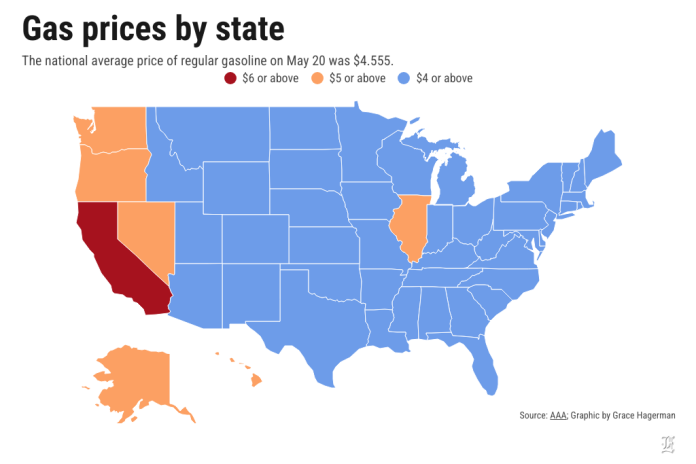
The U.S. and China have also agreed to delay discussions regarding Iran's nuclear program, further complicating the negotiations. Meanwhile, the rising oil prices have led to all U.S. states experiencing average gas prices above $4 per gallon for the first time in years, straining consumers ahead of the summer driving season.
The situation remains critical as both sides appear no closer to finding a resolution, leaving the global economy vulnerable to further fluctuations in energy prices.
- Consumers in the U.S. face rising gas prices, with averages exceeding $4 per gallon, impacting household budgets (per Washington Examiner).
- The ongoing conflict has caused Brent crude prices to increase by approximately 50%, affecting global energy markets and inflation (per Strait Times).
- Iran's control over the Strait of Hormuz gives it significant leverage in negotiations with the U.S., impacting international oil supply chains (per Fortune).
- Whether President Donald Trump and Xi Jinping make further attempts to facilitate a deal by June 2026.
- Any new developments in U.S.-Iran negotiations regarding the Strait of Hormuz by the end of May 2026.
- Monitoring of Brent crude prices for potential fluctuations as negotiations progress.
Left- and right-leaning outlets are covering this story differently — in which facts to emphasize, which context to include, and how to frame causes and consequences.
2 specific areas where coverage diverges — see below.
- Fortune emphasizes Iran's lack of interest in negotiations, while Washington Examiner highlights the potential for a deal if Iran complies.
- No source mentions the specific military actions or sanctions that have contributed to the current tensions in the Strait of Hormuz.