
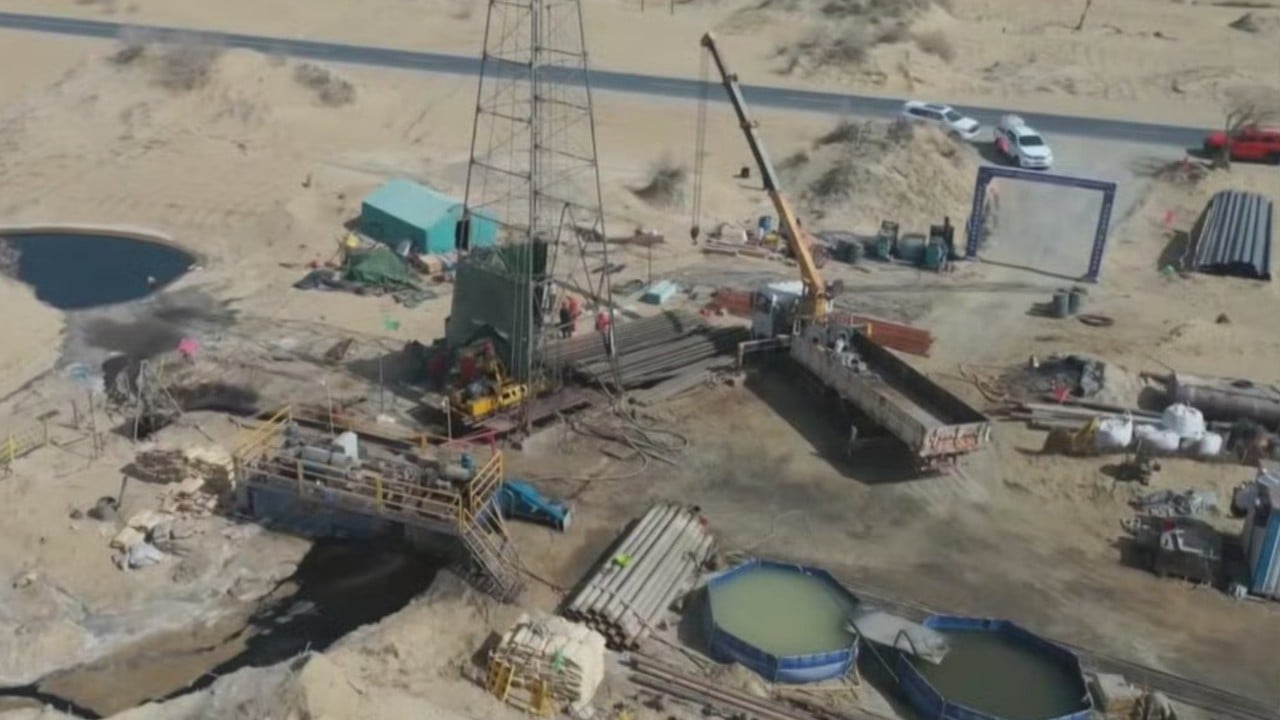
Geologists find two large groundwater sources under Taklamakan Desert, aiding Xinjiang
Topic: geopoliticsRegion: asiaUpdated: i2 outletsSources: 2Spectrum: Mixed⏱ 3 min read
Story Summary
SITUATION
Geologists with the Xinjiang geological bureau discovered two large groundwater sources beneath the Taklamakan Desert (per scmp.com). The finding could give Xinjiang fresh water for sand-control projects and agriculture, challenging the view that underground desert water is only stagnant or saline (per scmp.com).
Coveragetap to expand ▾Spectrum: Mixed🌍Asia: 2
Political Spectrum
Position is inferred from coverage mix.
i2 outlets · Center
Left
Center
Right
Left: 0
Center: 1
Right: 1
Geography Coverage
Distribution of where coverage is coming from.
i2 unique outlets · Dominant: Asia
KEY FACTS
- Geologists discovered two large water sources beneath the Taklamakan Desert (per scmp.com).
- The discovery challenges the view that underground desert water is only stagnant or saline (per scmp.com).
HISTORICAL CONTEXT
The immediate backdrop is a long-running water and desertification crisis in China’s Tarim Basin and Xinjiang region, where decades of upstream irrigation, reservoir construction and expanding agriculture reduced river flows and lowered groundwater levels, prompting a succession of government restoration programs from the late 1990s through the 2010s.
Officials have repeatedly framed new hydrological findings in Xinjiang against that crisis: large-scale ecological water transfers and sand-control engineering were launched to halt desertification after authorities documented contracting river channels and dying poplar forests along the Tarim in the 1990s.
Brief
Geologists with the Xinjiang geological bureau discovered two sizable groundwater sources beneath the Taklamakan Desert, a finding reported by CCTV Finance and summarized by the South China Morning Post.
Officials and state media presented the reservoirs as potential new water supplies that could support sand-control projects and agricultural expansion in Xinjiang, countering the long-held view that subsurface desert water is only saline or stagnant.
The report cited by scmp.com does not publish volumetric estimates or immediate deployment plans; it focuses on the discovery itself and the technical implication that the aquifers may be usable.
Local authorities framed the find as a practical resource for anti-desertification work and farming, but the coverage contains no independent verification, hydrological data, or environmental assessment.
The only source in the package — scmp.com relaying CCTV Finance and the regional geological bureau — leaves open key operational questions: whether the water is fresh enough for irrigation without treatment, how quickly extraction might proceed, and what ecological trade-offs extraction could cause.
If the aquifers are exploitable, Xinjiang authorities could deploy them for sand-control irrigation projects and to expand agricultural land, but current reporting does not document any planned extraction permits, timelines, or environmental reviews.
Independent hydrologists or groundwater quality tests are not cited in the story; the discovery is presented as a promising technical development rather than a confirmed, immediately deployable resource. The most documented fact remains the discovery itself; what comes next — testing, permits, and scale of use — was not reported in the source material.
Why it matters
- Xinjiang farmers and sand-control crews stand to benefit if the groundwater proves usable: the article links the find to sand-control projects and agriculture (per scmp.com).
- Local governments bear the operational costs and environmental risk of any extraction because the source does not report on water quality or required treatment (per scmp.com).
- Researchers and independent hydrologists would need to provide groundwater quality and recharge-rate data to confirm usability; the source did not cite such data (per scmp.com).
What to watch next
- Whether the Xinjiang geological bureau publishes groundwater quality and volumetric tests within the next 90 days (per scmp.com).
- Whether local Xinjiang authorities issue extraction permits or project plans for sand-control irrigation by the end of the year (per scmp.com).
- Whether independent hydrological studies are commissioned or released to assess recharge rates and ecological impact within six months (per scmp.com).
Where sources differ
7 dimensionsFraming differences
?- Only scmp.com (relaying CCTV Finance and the Xinjiang geological bureau) reports the discovery; there are no other outlets in this pack to provide differing frames.
Disputed or unclear
?- Whether the groundwater is fresh and economically extractable is unverified; no source in this pack provides water quality, volume, or extraction feasibility data (per scmp.com).
Omitted context
?- No source mentions independent hydrological verification or specific water-quality test results needed to assess usability.
- No source in this pack discusses potential environmental impacts of extracting deep aquifers beneath the Taklamakan Desert.
- No source cites timelines, permits, or officials' decisions about when extraction or pilot projects would begin.
Conflicting figures
?- No differing numerical figures appear in the sources; the report gives no volumetric or numeric estimates (per scmp.com).
Disputed causality
?- There is no dispute about cause-and-effect in the pack: the geological bureau reported a discovery; the pack contains no claims that discovery resulted from a specific prior action.
Attribution disputes
?- scmp.com attributes the discovery to the Xinjiang geological bureau and reports it via CCTV Finance (per scmp.com).
Sources
2 of 2 linked articles