
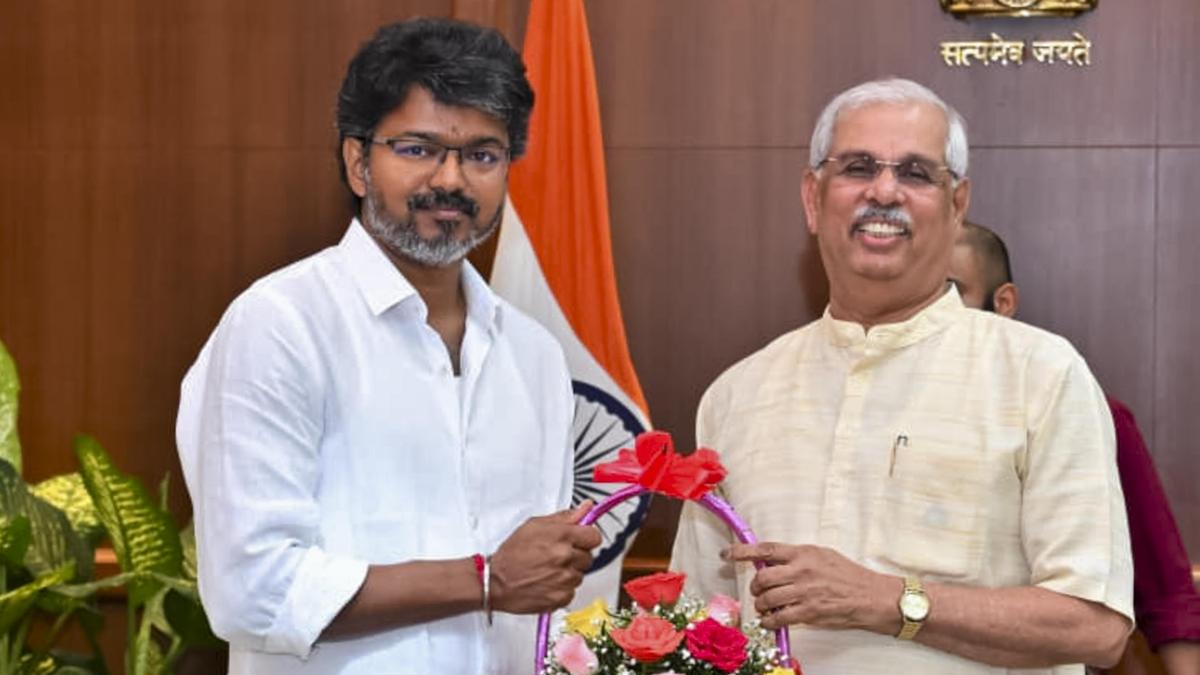
Governor Arlekar delays swearing in of Chief Minister after hung Assembly in Tamil Nadu
Coveragetap to expand ▾Spectrum: Center Only🌍Asia: 1
- Governor Rajendra Arlekar has not sworn in C. Joseph Vijay as Chief Minister following the elections (per The Hindu).
- The demand for majority proof from the Governor has delayed the swearing-in process (per The Hindu).
In the aftermath of the 2026 Assembly elections in Tamil Nadu, the Tamilaga Vettri Kazhagam (TVK) has emerged as the single largest party, yet Governor Rajendra Arlekar has delayed swearing in C. Joseph Vijay as Chief Minister.
This delay stems from the Governor's insistence that Vijay provide physical letters of support from at least 118 MLAs, a requirement that underscores the complexities of forming a government in a hung Assembly.
The Tamil Nadu Legislative Assembly, with its 234 seats, presents a challenging landscape for political maneuvering, especially when no party secures an outright majority. The Governor's role, as outlined in Article 164 of the Constitution, is to appoint the Chief Minister, but this process can be contentious in situations where the majority is unclear.
The demand for proof of majority support has led to a stalemate, leaving the political future of the state uncertain. Observers note that such scenarios are not uncommon in Indian politics, where hung Assemblies can lead to prolonged negotiations and political instability.
As the situation develops, the implications for governance in Tamil Nadu remain significant, with potential impacts on policy and administration depending on how quickly a new government can be formed.
- The delay in swearing in C. Joseph Vijay as Chief Minister affects governance in Tamil Nadu, potentially stalling policy initiatives (per The Hindu).
- The requirement for majority proof from the Governor complicates the political landscape, impacting the TVK's ability to govern effectively (per The Hindu).
- The hung Assembly situation highlights the challenges of coalition politics in India, which can lead to instability and uncertainty for citizens (per The Hindu).
- Whether Governor Rajendra Arlekar swears in C. Joseph Vijay as Chief Minister by the end of May 2026.
- The response from the Tamilaga Vettri Kazhagam regarding the Governor's demand for majority proof.
- Any potential negotiations between parties in the Tamil Nadu Legislative Assembly to secure the necessary support.
- {"framing":[],"numbers":[],"causality":[],"attribution":[],"omitted_context":[],"disputed_or_unclear":[],"notable_quotes_or_claims":[]}