
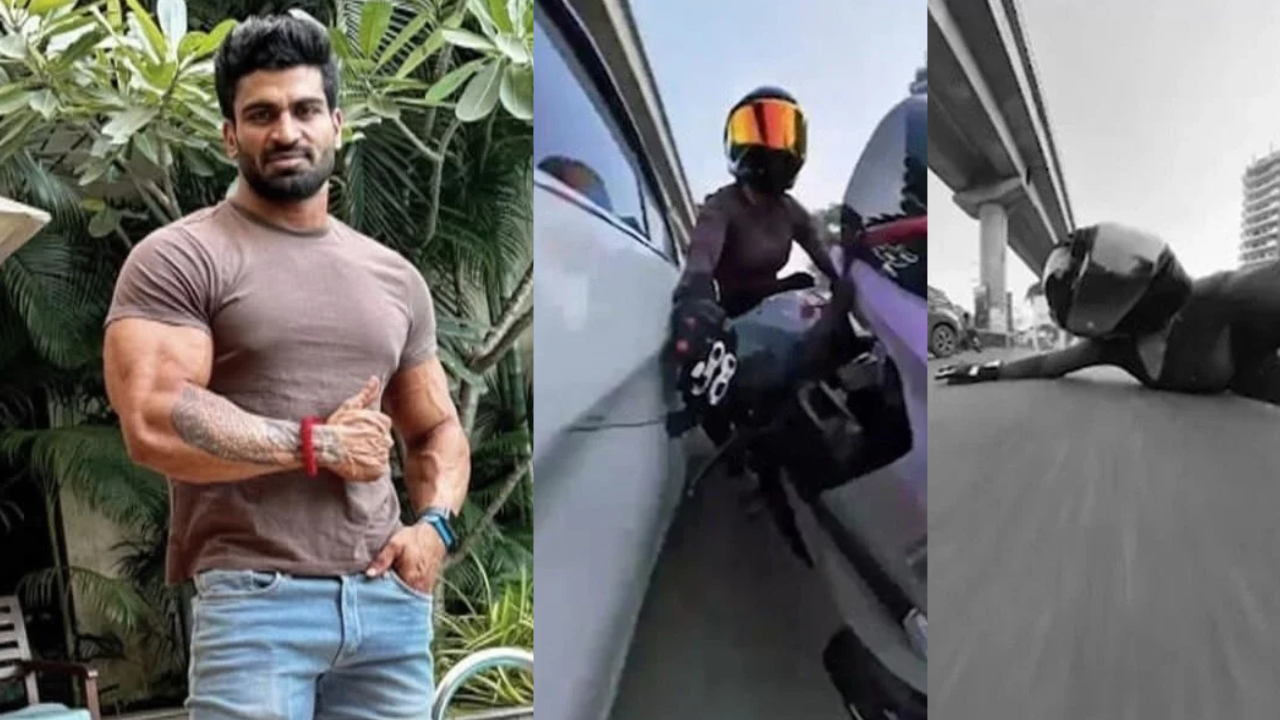
Gurgaon hit-and-run: Court sends accused Kalyan Singh Bainsla and cousin to 14-day judicial custody
Topic: defense & securityRegion: asia pacificUpdated: i2 outletsSources: 5Spectrum: Mostly Center⏱ 3 min read
Story Summary
SITUATION
A Gurgaon court sent hit-and-run accused Kalyan Singh Bainsla and his cousin Lavnish to 14 days' judicial custody after a video of the Golf Course Road incident went viral (per timesofindia). Police said a group later rallied in cars in apparent support of Bainsla and investigators are probing alcohol use and the roles of associates seen in the footage (per timesofindia).
Coveragetap to expand ▾Spectrum: Mostly Center🌍Asia: 1 · Other: 1
Political Spectrum
Position is inferred from coverage mix.
i2 outlets · Center
Left
Center
Right
Left: 1
Center: 1
Right: 0
Geography Coverage
Distribution of where coverage is coming from.
i2 unique outlets · Dominant: Asia
KEY FACTS
- A Gurgaon court sent accused Kalyan Singh Bainsla and his cousin Lavnish to 14 days' judicial custody (per timesofindia).
- Police say Bainsla chased and rammed the motorcycle of Gurgaon biker Sia, whose real name is Shivani Chauhan (per timesofindia).
- Investigators say the accused followed Shivani Chauhan for around 2km before the collision (per timesofindia).
- Police said Bainsla had been returning from a club with friends and had borrowed a Maruti Ciaz for the outing; he, Lavnish and other friends had gone to The Empire club at MGF Metropolitan Mall on MG Road (per timesofindia).
- A group of men later rallied in cars on a Haryana flyover in apparent support of Bainsla, and police are investigating whether the accused were drunk and the roles of associates including a man named Shrikant (per timesofindia).
HISTORICAL CONTEXT
The immediate backdrop to the Gurgaon case is a period of heightened domestic and international security attention: since March 2026 the United States and Israel have conducted coordinated strikes on Iranian infrastructure and air defenses, triggering a regional security crisis and increased scrutiny of public-order responses across South Asia as governments balance civil policing with counterterrorism posture.
Domestically, Indian law enforcement has been operating under statutory and procedural frameworks that govern traffic offences, custodial remand and evidence collection: the Indian Penal Code (enacted 1860) defines offences such as culpable driving and criminal negligence; the Code of Criminal Procedure, 1973 (enacted 25 April 1973) prescribes arrest, police remand and judicial custody processes; and the Motor Vehicles Act, 1988 (enacted 1988) — substantially amended by the Motor Vehicles (Amendment) Act, 2019 (assented 9 August 2019) — tightened penalties and procedural requirements for hit-and-run, drunken driving and vehicle licensing.
Brief
A Gurgaon court on Friday sent accused hit-and-run driver Kalyan Singh Bainsla and his cousin Lavnish to 14 days' judicial custody after a video of the Golf Course Road incident circulated online, police said.
Video and police statements show Bainsla chased and then struck the motorcycle of Gurgaon rider Sia, named in police records as Shivani Chauhan, after following her for about 2km (per timesofindia).
Authorities say Bainsla had borrowed a Maruti Ciaz and had been at The Empire club in MGF Metropolitan Mall with Lavnish and other friends earlier the night investigators are probing (per timesofindia).
Police identify an associate, Shrikant, as also present in the car during the incident and say they are investigating whether alcohol played a role and who instigated the chase; sources alleged Lavnish instigated Bainsla and abused Chauhan during the encounter (per timesofindia).
Footage that circulated after the crash also shows several cars rallying together on a Haryana flyover in apparent support of Bainsla; police described that convoy as a separate public-order matter under inquiry (per timesofindia).
Court custody followed police remand requests and the viral spread of the video, which prompted public outrage and on-scene attention; the immediate consequence is that formal custody gives investigators two weeks to question the accused while charges proceed to the next judicial stage (per timesofindia).
The facts of whether the accused were intoxicated, the exact sequence inside the vehicle, and how the altercation began remain under investigation, with police naming participants seen in videos but not yet filing final charges beyond the custody record (per timesofindia).
Why it matters
- Victims: Shivani Chauhan, the motorcycle rider struck on Golf Course Road, faces physical harm and legal recourse; the mechanism is a motor-vehicle collision after a documented 2km chase (per timesofindia).
- Public order: Local commuters on Golf Course Road and the Haryana flyover were exposed to dangerous driving and a subsequent car rally that police assessed as a public-order risk (per timesofindia).
- Law enforcement capacity: Gurgaon police now hold the accused in 14 days' judicial custody, giving investigators a fixed two-week window to gather evidence on alcohol use and associates' roles, which will shape any formal charges (per timesofindia).
- Reputational and social costs: The viral video prompted a public rally in support of the accused, benefiting supporters who mobilized visibly while increasing scrutiny on nightlife behavior tied to The Empire club at MGF Metropolitan Mall (per timesofindia).
What to watch next
- Whether Gurgaon police file formal charges against Kalyan Singh Bainsla, Lavnish, and Shrikant by the end of the 14-day custody period (per timesofindia).
- Whether investigators produce toxicology results confirming or refuting police questions about alcohol use in the borrowed Maruti Ciaz during the incident (per timesofindia).
- Whether prosecutors seek extended custody or move to a magistrate for framing of charges before the 14-day period lapses (per timesofindia).
- Whether any additional victims or witnesses emerge from video evidence of the car rally on the Haryana flyover who can identify participants and alter legal outcomes (per timesofindia).
Where sources differ
7 dimensionsFraming differences
?- Only one outlet provided the account; no cross-outlet framing differences are available in this pack (per timesofindia).
Disputed or unclear
?- Whether the accused were drunk is unverified; police said they are yet to ascertain intoxication (per timesofindia).
- The precise roles of associates, including allegations that Lavnish instigated the chase and abused Shivani Chauhan, are reported as source allegations and remain under investigation (per timesofindia).
Omitted context
?- No source in this pack mentions prior police complaints, traffic-stop attempts, or any sequence of interactions before the 2km chase that would clarify why the pursuit began.
- No source provided medical details or official casualty/injury figures for Shivani Chauhan after the collision.
- No source cited CCTV time stamps, vehicle-forensic reports, or toxicology results that would establish intoxication or vehicle ownership beyond the borrowed Maruti Ciaz claim.
- No source referenced any legal history for the accused or prior similar incidents that might contextualize the court's custody decision.
Conflicting figures
?- Times of India reports the judicial custody length as 14 days and the stated following distance as around 2km (per timesofindia).
Disputed causality
?- Times of India reports Bainsla chased and then rammed Shivani Chauhan's motorcycle; investigators are probing alleged instigation by Lavnish but have not established a definitive trigger beyond the reported club outing and pursuit (per timesofindia).
Attribution disputes
?- Times of India attributes the custody order, the viral video, the 2km chase, the borrowed Maruti Ciaz, the club outing, and the car rally details to police statements and source accounts (per timesofindia).
Sources
5 of 5 linked articles
Gurgaon hit-and-run: Court sends accused Kalyan Singh Bainsla and cousin to 14-day judicial custody
timesofindia.indiatimes.com15h agoLeft
↗
Gurugram hit-and-run case: Court remands Kalyan Bainsla, cousin to two-day police custody
indialegallive.comSep 16Left
↗
Gurugram Woman Biker Case: Court Remands Kalyan Bainsla And His Cousin To Two Days' Police Custody
lawchakra.inSep 16Left
↗
Gurugram Hit-And-Run: Court Sends Kalyan Bainsla To 2-Day Police Custody
dynamitenews.comSep 16Left
↗
Gurugram hit and run: Court remands accused Kalyan Bainsla to police custody for two days
barandbench.comSep 16Left
↗