
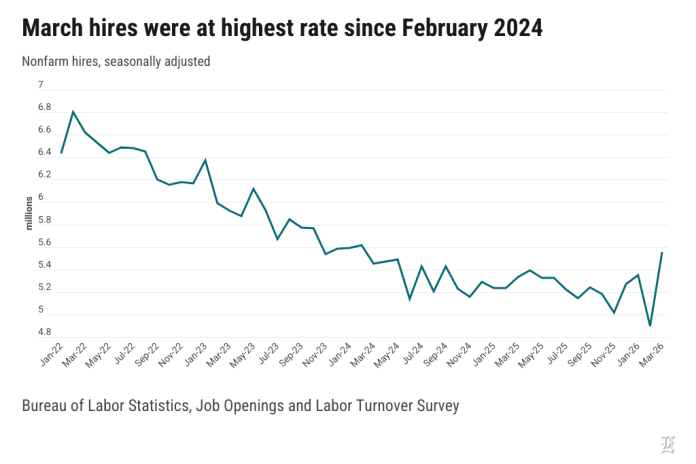
Hiring Surges to Highest Rate Since 2024, Defying Economic Expectations
Coveragetap to expand ▾Spectrum: Mixed🌍US: 1 · Other: 1
- Hiring in March increased to the highest rate since February 2024 (per washingtonexaminer.com).
- The unemployment rate has not significantly increased despite the low-hiring environment (per washingtonexaminer.com).
In a surprising turn for the U.S. economy, hiring in March surged to its highest rate since February 2024, marking a significant deviation from the recent 'low-hire, low-fire' trend that has characterized the labor market.
According to the Bureau of Labor Statistics’ Job Openings and Labor Turnover Survey, the number of hires increased by 655,000, reaching a total of 5.6 million, with the hiring rate rising to 3.5%. This unexpected uptick suggests a potential revitalization of the labor market, despite ongoing challenges.
Federal Reserve Chairman Jerome Powell has previously described the labor market as being in a 'low-firing, low-hiring environment,' a characterization that has held true as both hiring and layoffs have remained below pre-pandemic levels. However, the recent increase in hiring may indicate a shift in this pattern, offering a glimmer of hope for economic recovery.
Despite the positive news on hiring, the Job Openings and Labor Turnover Survey also revealed a decline in job openings, which fell from 7.2 million in January to 6.9 million in March. This decrease in job openings suggests that while companies are hiring more, they may also be becoming more selective or cautious in their recruitment strategies.
Carl Weinberg, chief economist at High Frequency Economics, highlighted the increase in hires as a positive sign for the economy, suggesting that the labor market may have more dynamism than previously thought. This sentiment is echoed by other economists who view the hiring surge as a potential indicator of economic resilience.
The unemployment rate has remained stable, not experiencing a significant rise despite the low-hiring environment. This stability is partly attributed to the balance between hiring and layoffs, which have both been subdued in recent months. As the economy continues to navigate post-pandemic challenges, the labor market's performance will be closely monitored.
The recent hiring surge could signal a turning point, but the decrease in job openings indicates that uncertainties remain. Policymakers and economists alike will be watching for further developments to assess the sustainability of this positive trend.
Overall, the labor market's unexpected dynamism in March provides a cautiously optimistic outlook for the U.S. economy, with the potential for further growth if hiring trends continue to improve.
- The U.S. labor market's unexpected hiring surge benefits job seekers by increasing employment opportunities, potentially reducing unemployment rates.
- Companies may face challenges in filling positions due to the decrease in job openings, impacting their operational capacity and growth potential.
- The Federal Reserve's monetary policy decisions could be influenced by these labor market dynamics, affecting interest rates and economic stability.
- Economic resilience indicated by the hiring surge could bolster consumer confidence, leading to increased spending and economic growth.
- Whether the hiring trend continues in the coming months, indicating sustained economic recovery.
- Federal Reserve's response to labor market changes in its upcoming policy meetings.
- Potential adjustments in company recruitment strategies due to the decrease in job openings.
Left- and right-leaning outlets are covering this story differently — in which facts to emphasize, which context to include, and how to frame causes and consequences.
7 specific areas where coverage diverges — see below.
- No significant framing differences noted as only one source was provided.
- No disputes or unclear facts noted from the single source.
- No source mentions the specific industries driving the hiring surge, which could provide insight into economic sectors leading the recovery.
- No differing figures noted as only one source was provided.
- No causality disagreements noted from the single source.
- No differing attributions noted as only one source was provided.