
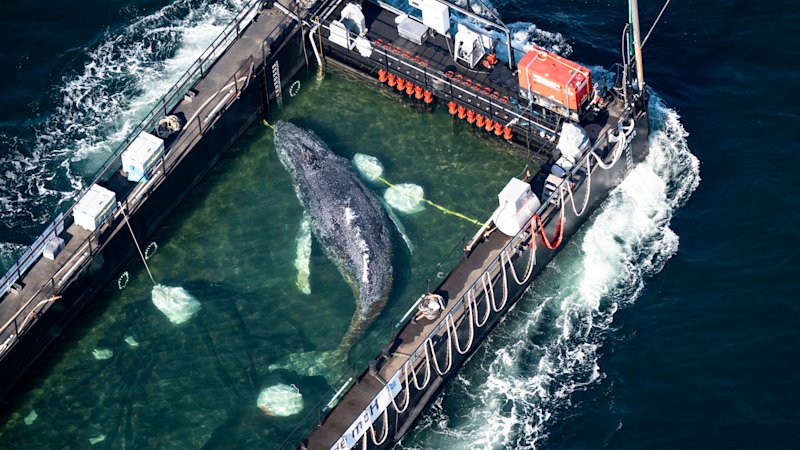
The agency reported that the whale was released 70 kilometres from the coast of Skagen, Denmark.
Coveragetap to expand ▾Spectrum: Mostly Center🌍Asia: 2 · Other: 2 · US: 1 · Europe: 1
- The humpback whale, nicknamed 'Timmy', was released into the North Sea after being stranded near Germany since March (per smh.com.au).
- Timmy was first spotted near Germany's Baltic Sea coast on March 3, far from its natural habitat in the Atlantic Ocean (per smh.com.au).
- The whale was released approximately 70 kilometers from the coast of Skagen, Denmark, at around 9am German time (per smh.com.au).
- Jens Schwarck, a member of the rescue initiative, confirmed the release details to the German news agency dpa (per smh.com.au).
A juvenile humpback whale, affectionately named 'Timmy' by the German media, has been successfully released into the North Sea after being stranded in shallow waters near Germany for several weeks. The whale was first spotted on March 3 near Germany's Baltic Sea coast, far from its typical Atlantic Ocean habitat.
Over time, Timmy's health began to decline as it repeatedly became stranded in the shallow waters near the coastal city of Wismar. Despite numerous attempts to coax the whale into deeper waters, the rescue efforts faced significant challenges, which were broadcasted live to a global audience.
The rescue operation culminated in a complex maneuver involving the creation of a newly dredged channel. Timmy was carefully guided through this channel onto a water-filled barge, a vessel typically used for transporting ships. This innovative approach allowed the rescue team to transport the whale safely to the North Sea.
Jens Schwarck, a member of the rescue initiative, reported that the whale was released at approximately 9am German time, 70 kilometers from the coast of Skagen, Denmark. The successful release of Timmy marks the end of a challenging rescue operation that captured international attention.
The operation's success was attributed to the coordinated efforts of the rescue team and the innovative use of maritime resources. The release location was strategically chosen to ensure that Timmy could safely return to its natural habitat in the Atlantic Ocean.
The story of Timmy's rescue highlights the complexities and challenges involved in marine animal conservation efforts. It underscores the importance of international cooperation and innovative solutions in addressing wildlife emergencies.
As Timmy swims freely in the North Sea, the rescue team remains hopeful that the whale will successfully navigate its way back to the Atlantic. This rescue operation not only saved a life but also served as a reminder of the delicate balance between human activities and marine ecosystems.
The global attention garnered by Timmy's plight may inspire further efforts to protect marine life and address the environmental challenges facing our oceans today.
- The successful rescue of Timmy highlights the importance of international cooperation in wildlife conservation, demonstrating effective cross-border collaboration.
- The operation underscores the challenges faced by marine animals due to human activities, emphasizing the need for innovative solutions in conservation efforts.
- The global attention on Timmy's rescue may lead to increased awareness and support for marine conservation initiatives.
- Whether Timmy successfully returns to its natural habitat in the Atlantic Ocean.
- Potential follow-up conservation efforts inspired by the global attention on Timmy's rescue.
- Monitoring of similar marine animal stranding incidents and the response strategies employed.
- news.google.com focuses on the release of Timmy, while smh.com.au provides detailed context on the rescue operation.
- No significant disputes or unclear facts were noted between the sources.
- No source mentions the specific environmental factors that may have contributed to Timmy's stranding.
- Both sources agree on the release location being 70 kilometers from Skagen, Denmark.
- Sources agree on the sequence of events leading to Timmy's release.
- Both sources attribute the release details to Jens Schwarck and the German news agency dpa.