
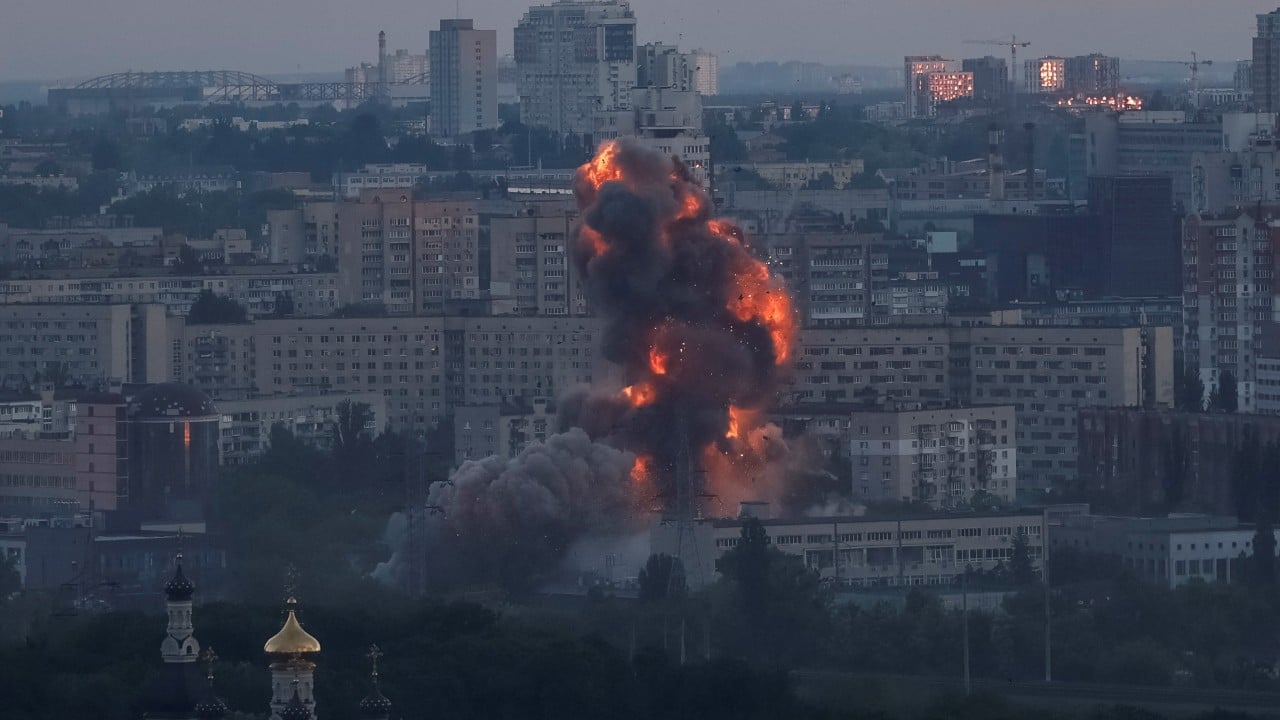
Russia Hits Kyiv With Deadly Attack After Vowing Retaliation
Topic: defense & securityRegion: EuropeUpdated: i4 outletsSources: 26⚠ Bias gap — sources divergeSpectrum: Mostly Center⏱ 4 min read📡 Wire pickup: 4⚠ 3d+ old
Story Summary
SITUATION
After a dormitory attack in Russian-occupied eastern Ukraine that killed 18, Russia launched a missile barrage on Kyiv, killing one person and injuring at least 20. The Ukrainian air force had warned of a potential missile strike shortly before the attack occurred.
Coveragetap to expand ▾Spectrum: Mostly Center🌍Other: 8 · US: 7 · Asia: 5 · Europe: 4 · ME: 1
Political Spectrum
Position is inferred from coverage mix.
i4 outlets · Center
Left
Center
Right
Left: 8
Center: 17
Right: 0
Geography Coverage
Distribution of where coverage is coming from.
i4 unique outlets · Dominant: Global
KEY FACTS
- Russian missiles strikes Kyiv in retaliation for dorm attack that killed 18
- Russian missiles pummel Kyiv in retaliation for dorm attack that killed 18 - South China Morning Post
- Russian drones attack Odesa region: 2 injured, port infrastructure damaged
- Russian drones attack Odesa region: 2 injured, port infrastructure damaged - Interfax-Ukraine
HISTORICAL CONTEXT
The recent Russian drone attack on the port infrastructure in Ukraine's Odesa region is a significant development in the ongoing conflict that has been unfolding since February 2022. This conflict, rooted in a complex history of geopolitical tensions, territorial disputes, and issues of national sovereignty, has seen numerous escalations over the years.
The immediate backdrop to this attack is the full-scale invasion of Ukraine by Russia on February 24, 2022, which marked a dramatic escalation of hostilities that had been simmering since 2014. In 2014, following Ukraine's Euromaidan protests and the ousting of pro-Russian President Viktor Yanukovych, Russia annexed Crimea.
Brief
In a significant escalation of hostilities, Russia launched a barrage of Oreshnik missiles at Kyiv early on May 24, 2026, killing one person and injuring at least 20 others. This attack was reportedly in retaliation for a prior strike on a dormitory in Russian-occupied eastern Ukraine that resulted in 18 fatalities.
Ukrainian officials confirmed that several residential buildings were damaged, and debris ignited a fire at a school in the city center. The Ukrainian air force had warned residents of a potential missile strike shortly before the attack, indicating that the threat was anticipated.
While Russian sources have framed the missile strike as a necessary response to Ukrainian aggression, Ukrainian officials have condemned the attack as an act of terror against civilians. This incident underscores the ongoing cycle of violence in the region, with both sides accusing each other of escalating the conflict.
The situation remains tense as military actions continue to unfold, with significant implications for civilian safety in urban areas.
Why it matters
- One civilian was killed and at least 20 were injured in the missile strike on Kyiv, highlighting the immediate human cost of the ongoing conflict (per South China Morning Post).
- The attack on Kyiv follows a deadly strike on a dormitory in eastern Ukraine, which killed 18, indicating a cycle of retaliatory violence that affects civilians on both sides (per South China Morning Post).
- The damage to residential buildings and a school in Kyiv raises concerns about the safety of urban populations amid ongoing military actions (per ABC News).
What to watch next
- Whether Russia conducts further missile strikes against Ukrainian cities in the coming days.
- The response from Ukrainian military forces to the recent missile attack on Kyiv.
- Any statements from international bodies regarding the escalation of violence in Ukraine.
Where sources differ
7 dimensionsBias gap0.85 / 2.0
Left- and right-leaning outlets are covering this story differently — in which facts to emphasize, which context to include, and how to frame causes and consequences.
Left-leaning (8)
scmp.com-0.80
Russian missiles strikes Kyiv in retaliation for dorm attack that killed 18 Russian missiles pummel Kyiv in retaliation for dorm attack that killed 18 - South China Morning Post
scmp_world-0.80
Russian missiles pummel Kyiv in retaliation for dorm attack that killed 18 Russian missiles pummel Kyiv in retaliation for dorm attack that killed 18 Russia pounded Kyiv with a lar…
straits_times-0.80
local time after the air force announced a threat of an Oreshnik launch on its Telegram channel. Ukraine’s capital Kyiv hit by massive missile, drone attack KYIV, May 24 - Ukraine'…
trtworld.com-0.70
Kiev hit by mass ballistic missile attack following Russian retaliation vows Kiev hit by mass ballistic missile attack following Russian retaliation vows - TRT World. Reporting is …
theguardian.com-0.50
Ukraine war briefing: Zelenskyy sounds warning after Russia strikes Kyiv with Oreshnik missile - The Guardian
english.alarabiya.net-0.30
Russian attack hit port infrastructure in Ukraine’s Odesa region, officials say Russian attack hit port infrastructure in Ukraine’s Odesa region, officials say - Al Arabiya English…
nytimes.com-0.30
Russia strikes Kyiv in Major Missile and Drone Attack Russia Pummels Kyiv in Major Missile and Drone Attack - The New York Times. Reporting is limited at this stage.
cbsnews.com-0.20
Russia launches heavy missile strikes on Kyiv after Ukraine drone attack - CBS News. Reporting is limited at this stage.
Center (17)
themoscowtimes.comwionews.comabc_australiafrance24.comnews.inbox.eureuters.comnst.com.mymsn.comnews.inbox.lvglobalbankingandfinance.comnews.liga.netapnews.comcnn.comreuters.comen.interfax.com.uareuters.commoderndiplomacy.eu
7 specific areas where coverage diverges — see below.
Framing differences
?- The Guardian emphasizes President Zelenskyy's warning following the attack, while WION focuses on the missile barrage itself.
Disputed or unclear
?- The exact number of injuries reported varies, with some sources stating at least 20 while others mention three.
Omitted context
?- No source mentions the broader context of ongoing military operations in eastern Ukraine that may have contributed to the dormitory attack.
Conflicting figures
?- South China Morning Post reports 20 injuries, while ABC News states at least three injuries.
Disputed causality
?- Sources agree that the missile strike was a retaliation for the dormitory attack, but the specifics of the triggering events are not uniformly detailed.
Attribution disputes
?- Ukrainian officials attribute the casualties and damage to Russian missile strikes, while Russian sources frame their actions as defensive.
Sources
25 of 25 linked articles
Kyiv, Ukraine, Hit in Russian Missile Attack
nytimes.comMay 25Left
↗
Russia Hits Kyiv With Deadly Attack After Vowing Retaliation
themoscowtimes.comMay 24Center
↗
Russia launches barrage of Oreshnik missiles at Ukrainian capital Kyiv after vowing retaliation
wionews.comMay 24Left
↗
Kiev hit by mass ballistic missile attack following Russian retaliation vows
trtworld.comMay 24Left
↗
Russian missiles strikes Kyiv in retaliation for dorm attack that killed 18
scmp.comMay 24Left
↗
Russian drones, missiles pummel Kyiv in retaliation for dorm attack that killed 18
scmp.comMay 24Left
↗