
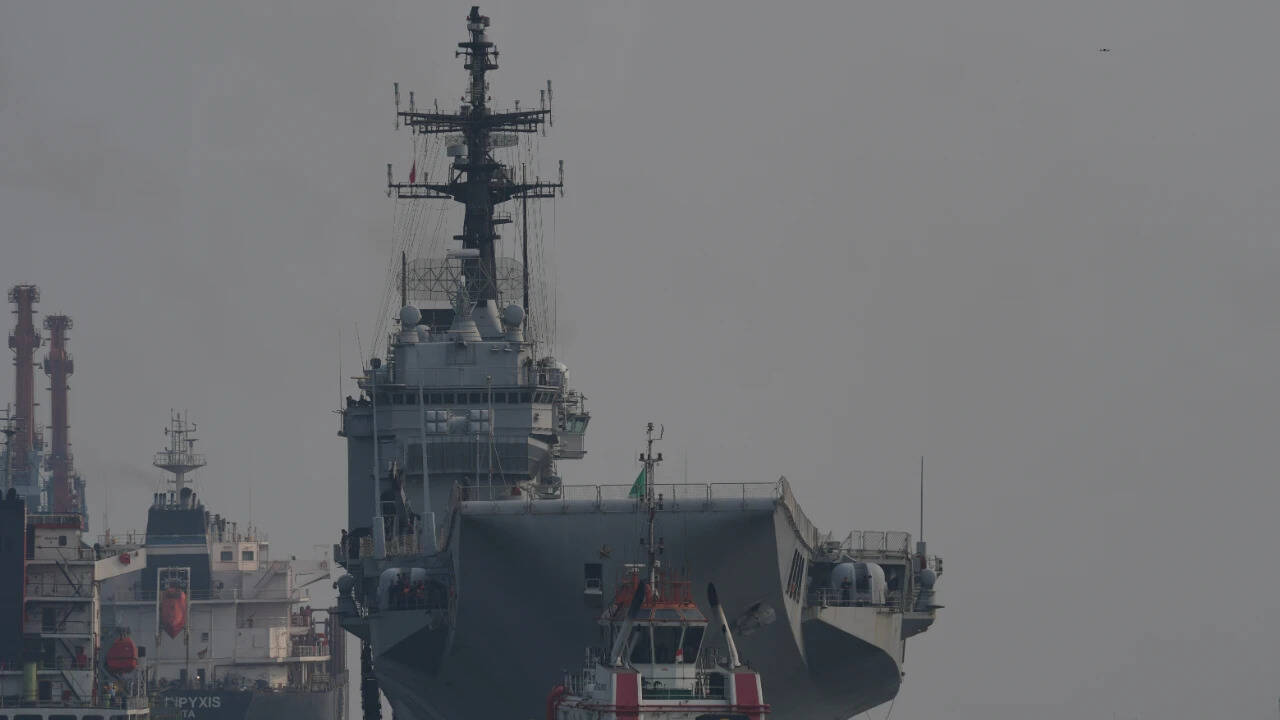
Indonesia commissions former ITS Giuseppe Garibaldi as KRI Sriwijaya for helicopter and drone refit
Topic: defense & securityRegion: asiaUpdated: i2 outletsSources: 5Spectrum: Center Only⏱ 3 min read
Story Summary
SITUATION
Indonesia welcomed the former ITS Giuseppe Garibaldi into North Jakarta’s Tanjung Priok port and will rename the vessel KRI Sriwijaya after a military ceremony (per timesofindia). The government plans to refurbish the carrier to operate helicopters and drones for disaster response, a decision that has prompted debate over costs after the finance ministry approved $450 million in 2025 (per timesofindia).
Coveragetap to expand ▾Spectrum: Center Only🌍Asia: 1 · Other: 1
Political Spectrum
Position is inferred from coverage mix.
i2 outlets · Center
Left
Center
Right
Left: 0
Center: 2
Right: 0
Geography Coverage
Distribution of where coverage is coming from.
i2 unique outlets · Dominant: Asia
KEY FACTS
- The former ITS Giuseppe Garibaldi arrived at North Jakarta’s Tanjung Priok port and was welcomed by Indonesia’s authorities (per timesofindia).
- Indonesia will rename the ship KRI Sriwijaya following a military ceremony (per timesofindia).
- The vessel is described in the source as Indonesia’s first aircraft carrier (per timesofindia).
HISTORICAL CONTEXT
The immediate backdrop is the broader regional security shock that followed the March 2026 US–Israeli coordinated strikes on Iranian infrastructure and the subsequent intensification of naval and aerial operations across multiple theaters; that crisis has sharpened Southeast Asian interest in maritime capability, disaster-response endurance and the signaling value of large surface vessels.
Structurally, the current environment rests on the United Nations Convention on the Law of the Sea (UNCLOS, 1982), which framed coastal-state jurisdiction and maritime rights, and on Indonesia’s post-2004 policy shift toward integrated maritime security and humanitarian response after the Indian Ocean tsunami highlighted gaps in national surge capacity.
Brief
Indonesia received the former ITS Giuseppe Garibaldi at North Jakarta’s Tanjung Priok port and will recommission the ship as KRI Sriwijaya after a military naming ceremony, the government announced (per timesofindia).
Officials say they will refit the carrier to operate helicopters and drones so Jakarta can deploy the vessel for disaster-response missions; the plan and the ceremony mark the country’s first entry into carrier operations (per timesofindia).
The move has drawn scrutiny because the finance ministry approved $450 million in 2025 for the acquisition and refit, and commentators cited by the report have raised questions about whether that level of spending is the best use of funds for disaster preparedness (per timesofindia).
Supporters argue the platform will extend Indonesia’s ability to move helicopters and unmanned aircraft over wide maritime distances during floods, earthquakes and other emergencies, while critics warn of maintenance, crewing and long-term operational costs that accompany carrier ownership (per timesofindia).
The government frames the refit as primarily humanitarian and logistical — enhancing airlift and maritime coordination via helicopters and drones — rather than as a power-projection asset, a description the source highlights (per timesofindia).
Implementation now shifts to technical work: refitting flight decks, adapting hangars and integrating drone systems, tasks that will determine whether the ship meets the disaster-response role officials describe (per timesofindia).
Why it matters
- Concrete fiscal cost to Indonesian taxpayers: the finance ministry approved $450 million in 2025 to acquire and refit the carrier, a sum critics say could be spent on alternative disaster-preparedness measures (per timesofindia).
- Specific beneficiaries: Indonesia’s military and disaster-management agencies gain a maritime platform able to launch helicopters and drones for search-and-rescue and logistics across the archipelago (per timesofindia).
- Operational burden falls on Indonesian sailors and maintenance crews who must sustain a former foreign carrier’s systems, driving ongoing personnel and upkeep costs rather than a one-time purchase (per timesofindia).
What to watch next
- Whether Indonesia proceeds with the helicopter-and-drone refit contract and begins technical conversion work on KRI Sriwijaya within the next fiscal year (per timesofindia).
- Whether the government allocates further budget lines beyond the $450 million approved in 2025 to cover lifecycle costs, maintenance and crewing (per timesofindia).
- Whether operational trials will demonstrate the carrier’s effectiveness for disaster-response missions, including helicopter and drone integration tests (per timesofindia).
Where sources differ
7 dimensionsFraming differences
?- Only timesofindia is available; it frames the vessel’s role as primarily for disaster response and highlights domestic debate over cost.
Disputed or unclear
?- No source disputes facts in the pack; the scale of debate and which stakeholders oppose the plan beyond unnamed commentators is unclear (per timesofindia).
Omitted context
?- No source in this pack details the carrier’s age, prior Italian service record, or technical condition, which would affect refit scope and cost.
- No source mentions specific timelines for the refit, contractor names, or operational-readiness milestones.
- No source provides projected annual operating or maintenance costs after the $450 million initial approval.
Conflicting figures
?- Only one figure appears: $450 million approved by the finance ministry in 2025 (per timesofindia).
Disputed causality
?- timesofindia reports the finance ministry approved $450 million in 2025 and that this approval prompted public debate over costs; no alternate causal claims are offered.
Attribution disputes
?- timesofindia attributes the arrival, renaming plan, intended refit for helicopters and drones, and the $450 million approval to Indonesian government reporting and coverage in its article (per timesofindia).
Sources
5 of 5 linked articles
Indonesia gets first aircraft carrier, sparks debate over cost & military ambitions
timesofindia.indiatimes.com13h agoLeft
↗
Indonesia welcomes its first aircraft carrier, prompting debate over cost and military ambitions - thehour.com
thehour.com13h agoLeft
↗
Indonesia welcomes its first aircraft carrier, prompting debate over cost and military ambitions - News-Press NOW
newspressnow.com19h agoLeft
↗
Indonesia welcomes its first aircraft carrier, prompting debate over cost and military ambitions
oskaloosa.com22h agoLeft
↗
Indonesia’s First Aircraft Carrier: Former Italian Ship ‘Garibaldi’ Reaches Domestic Waters - navalnews.com
navalnews.comSep 17Left
↗