
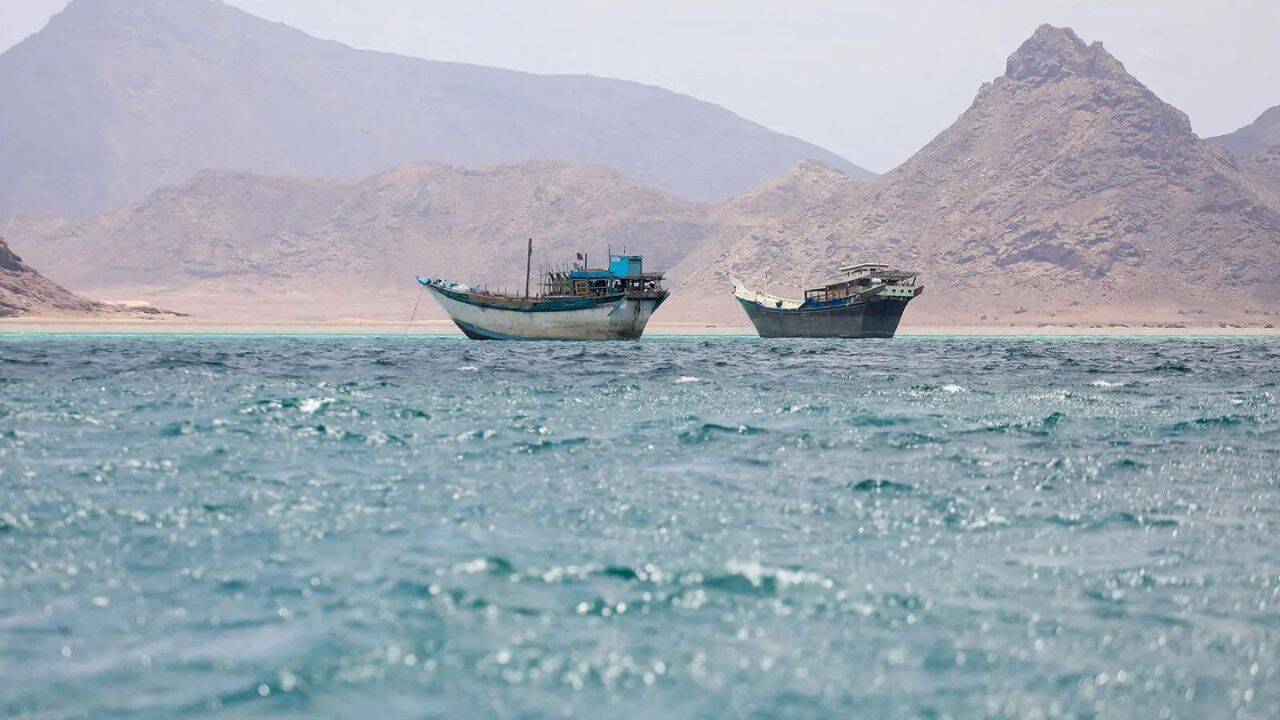
Iran and Oman agree Strait of Hormuz entry and exit lanes, briefing Gulf ministers in Muscat
Coveragetap to expand ▾Spectrum: Mostly Center🌍Asia: 1 · Other: 1
- Iran and Oman agreed on details of new entry and exit routes for the Strait of Hormuz (per Times of India)
- Iran and Oman will brief Gulf countries at a regional meeting in Muscat on Monday (per Times of India)
- Iran says the strait will remain closed unless the United States implements seven conditions it set (per Times of India)
Iran and Oman have finalized coordinates for new entry and exit lanes through the Strait of Hormuz that place the entire entry lane inside Iranian territorial waters and part of the exit lane likewise inside Iran’s maritime zone, officials said (per Times of India).
The two governments plan to present those route details to Gulf ministers at a regional meeting in Muscat on Monday, and Iran has signaled a hard line: the waterway will remain closed unless the United States implements seven conditions Tehran has outlined (per Times of India).
Oman’s role in negotiating navigational details underlines its position as a Gulf interlocutor willing to discuss maritime rules with Tehran; Iran’s insistence on routes inside its territorial sea reflects Tehran’s effort to translate control at sea into formal navigation arrangements (per Times of India).
Times of India reports the agreement covers both entry and exit corridors but specifies that only the entry corridor is wholly within Iran’s waters, with the exit corridor only partly so (per Times of India).
The ministers’ briefing in Muscat will allow neighbouring Gulf governments to review the coordinates and the operational implications; the source notes the meeting is scheduled for Monday but does not quote participating states beyond ‘Gulf countries’ (per Times of India).
Tehran’s public linkage of the routes to its seven conditions for keeping the strait open frames the maritime plan as tied to broader political demands on the United States rather than as a purely technical shipping safety measure (per Times of India).
The reporting does not include the seven conditions’ text, the legal basis for routing ships wholly within one state’s territorial sea, or any comment from the United States, Oman, or other Gulf capitals; those gaps leave unresolved how commercial shipping, naval transits, and coastal state rights will be reconciled (per Times of India).
The agreement between Iran and Oman marks a tactical advance in maritime arrangements but also raises questions about how other Gulf states and Washington will respond when ministers convene in Muscat to review the routes (per Times of India).
- Coastal populations along Iran’s southern provinces could face increased state control over commercial ship movement because the entry lane lies entirely in Iranian territorial waters (per Times of India).
- Oman benefits politically by positioning itself as the convenor and interlocutor for Gulf ministers in Muscat, enhancing its diplomatic role (per Times of India).
- The United States bears diplomatic pressure: Iran conditions keeping the Strait open on seven demands to Washington, which could translate into leverage against U.S. naval freedom-of-navigation practices (per Times of India).
- Whether Gulf ministers at the Muscat meeting on Monday accept or reject the Iran-Oman route coordinates presented (per Times of India).
- Whether Iran publicly releases the text of its seven conditions for keeping the Strait open and the timetable for their implementation (per Times of India).
- Whether the United States issues a formal response to Iran’s seven conditions or to the routing proposal before or after the Muscat briefing (per Times of India).
- Only Times of India is in this source pack; it frames the agreement as both technical (routes) and political (tied to Iran’s seven conditions).
- No source disputes the routing details, but the legality and acceptance by other Gulf states and the United States remain unclear (per Times of India).
- No source text in the pack provides the text of Iran’s seven conditions or their legal or operational specifics.
- No source mentions prior triggering actions that led Iran and Oman to negotiate these routes (e.g., recent incidents or diplomatic demands).
- No source provides statements from the United States, Oman, or other Gulf states reacting to the agreement.
- No source provides data on civilian or commercial shipping impact (e.g., ship counts or economic cost estimates) stemming from the proposed lanes.
- Sources do not provide differing numerical figures in this pack.
- The pack states Iran conditions keeping the strait open on seven U.S.-targeted demands but does not document what triggered Iran to set those conditions or link them to a specific prior U.S. action.
- Times of India attributes the routing agreement and the planned Muscat briefing to Iran and Oman, and attributes the seven-conditions demand to Iran.