
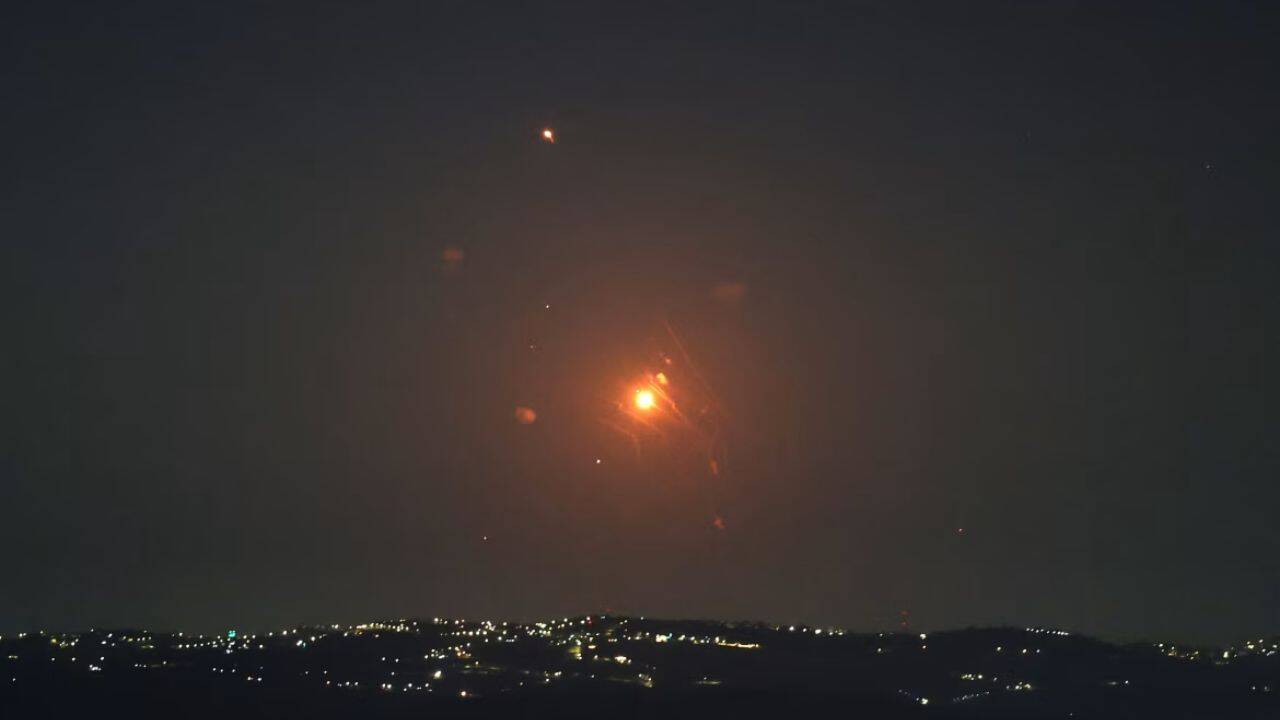
Iran fires about 20 missiles at Jordanian Muwaffaq Salti Air Base; US, Jordan expend 70+ interceptors
Topic: geopoliticsRegion: Middle EastUpdated: i1 outletsSources: 1Spectrum: Center Only⏱ 3 min read⚠ 48h+ old
Story Summary
SITUATION
Iran fired about 20 ballistic missiles at Muwaffaq Salti Air Base near Azraq, striking the base and damaging U.S. aircraft.
Coveragetap to expand ▾Spectrum: Center Only🌍Asia: 1
Political Spectrum
Position is inferred from coverage mix.
i1 outlets · Center
Left
Center
Right
Left: 0
Center: 1
Right: 0
Geography Coverage
Distribution of where coverage is coming from.
i1 unique outlets · Dominant: Asia
KEY FACTS
- Iran fired about 20 ballistic missiles at Muwaffaq Salti Air Base near Azraq (per timesofindia.indiatimes.com).
- The interceptors included about 60–70 Patriot missiles and over a dozen THAAD interceptors (per timesofindia.indiatimes.com).
- Some Iranian missiles struck the base and damaged American aircraft, including an A-10 that lost a wing (per timesofindia.indiatimes.com).
HISTORICAL CONTEXT
The immediate backdrop is the active March 2026 US–Israel military campaign against Iran: in early March 2026 the United States and Israel began coordinated strikes on Iranian power plants, air defenses and military infrastructure; Iranian military actions in 2026 have been framed by US and Israeli officials as responses to that campaign.
Tensions accelerated after a series of tit‑for‑tat clashes across 2024–2025, during which Iran and Israeli forces traded strikes; those 2024 exchanges were set off by Israeli strikes on Iranian-backed positions and facilities that Iran subsequently retaliated against.
Brief
Iran launched roughly 20 ballistic missiles at Jordan’s Muwaffaq Salti Air Base near Azraq, and U.S. and Jordanian forces expended an unusually large number of interceptors to stop most of them (per timesofindia.indiatimes.com).
U.S. and Jordanian batteries fired more than 70 interceptors in total — described in the reporting as about 60–70 Patriot missiles plus over a dozen THAAD interceptors — while some Iranian missiles nonetheless struck the base and damaged American aircraft, including an A-10 fighter that reportedly lost a wing (per timesofindia.indiatimes.com).
The strike and the scale of the defensive response have immediate logistical consequences: officials cited by the report warned that the high interceptor expenditure strained U.S. stocks and will increase demands on regional air defenses (per timesofindia.indiatimes.com).
The account in the source is principally operational: it lists the number of incoming missiles, the type and quantity of interceptors fired, and the damage to U.S. aircraft at Muwaffaq Salti; it does not publish casualty figures, nor does it attribute this strike to a named trigger in the text provided (per timesofindia.indiatimes.com).
U.S. forces operating at the base sustained equipment damage, and the reported loss of an A-10’s wing underscores both the penetration of some warheads and the risk to forward-deployed aircraft (per timesofindia.indiatimes.com).
The reporting frames the event as a stress test on allied air defenses in the region by emphasizing interceptor consumption and inventory strain; it does not provide statements from Jordanian or Iranian officials in the excerpt provided, nor does it report any civilian casualties or broader political statements (per timesofindia.indiatimes.com).
Absent from the single-source account are any dates in calendar form for the strike, casualty totals, or detailed descriptions of the missiles’ origins beyond attribution to Iran — gaps that matter for tracking sequences of action and for assessing whether the strike was a response to a prior incident (per timesofindia.indiatimes.com).
Why it matters
- U.S. forward-deployed aircrews at Muwaffaq Salti Air Base face direct equipment loss — American aircraft were damaged, including an A-10 that lost a wing — increasing repair and replacement costs for the U.S. military (per timesofindia.indiatimes.com).
- U.S. and Jordanian air-defense inventories are the concrete mechanism of harm: more than 70 interceptors were fired, which officials say strained U.S. stocks and raises the risk that future missile salvos could exceed available defenses (per timesofindia.indiatimes.com).
- Jordanian forces at Muwaffaq Salti bear operational burdens of defending the base alongside U.S. forces, absorbing interceptor expenditure and air-defense management responsibilities (per timesofindia.indiatimes.com).
- Iran benefits tactically by demonstrating the ability to penetrate defenses and inflict equipment damage despite large allied interceptor use, signaling pressures on U.S. logistics and regional defense posture (per timesofindia.indiatimes.com).
What to watch next
- Whether U.S. officials quantify interceptor stockpile losses and announce resupply shipments to forward bases within 30 days (per timesofindia.indiatimes.com).
- Whether Jordan issues a public operational statement about damage at Muwaffaq Salti Air Base or changes its air-defense posture at Azraq (per timesofindia.indiatimes.com).
- Whether U.S. Central Command or the Pentagon releases detailed damage assessments for the damaged A-10 and other aircraft at the base within the next week (per timesofindia.indiatimes.com).
- Whether allied air-defense deployments (Patriot or THAAD batteries) are repositioned or augmented in neighboring states in response to the interceptor expenditure (per timesofindia.indiatimes.com).
Where sources differ
7 dimensionsFraming differences
?- Only one outlet is provided; the timesofindia piece emphasizes interceptor counts, equipment damage, and inventory strain (per timesofindia.indiatimes.com).
Disputed or unclear
?- No source in this pack disputes any fact, but the single-source nature of the report leaves verification gaps about casualties, Iranian statements, and precise missile types (per timesofindia.indiatimes.com).
Omitted context
?- No source mentions any prior triggering action that provoked Iran’s missile strike; the reporting omits any antecedent event that would explain motive (per timesofindia.indiatimes.com).
- No source provides civilian casualty figures or confirms whether any non-combatants were harmed at or near Muwaffaq Salti Air Base (per timesofindia.indiatimes.com).
- No source cites any statements from Jordanian or Iranian officials, or mentions international legal or accountability processes relevant to cross-border strikes (per timesofindia.indiatimes.com).
- No source names specific logistics suppliers, budgets, or contracts related to interceptor stockpiles that would clarify the financial impact of the expenditure (per timesofindia.indiatimes.com).
Conflicting figures
?- timesofindia: about 20 ballistic missiles fired; more than 70 interceptors used; about 60–70 Patriot and over a dozen THAAD interceptors (per timesofindia.indiatimes.com).
Disputed causality
?- The source attributes the strike to Iran but does not identify a triggering action that preceded it, leaving the cause-and-effect sequence incomplete (per timesofindia.indiatimes.com).
Attribution disputes
?- timesofindia attributes missile launches to Iran and interceptor use to U.S. and Jordanian forces; no other outlet is present to offer different attributions (per timesofindia.indiatimes.com).
Sources
1 of 1 linked articles