
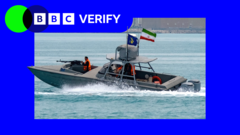
Iran accuses US of ‘reckless’ attacks after exchange of fire in Strait of Hormuz
Topic: geopoliticsRegion: Middle EastUpdated: i6 outletsSources: 31⚠ Bias gap — sources divergeSpectrum: Mostly CenterFiltered: US/Canada (5/34)· Clear⏱ 4 min read📡 Wire pickup: 3⚠ 3d+ old
Story Summary
SITUATION
After Iranian forces launched multiple missiles and drones at US ships, the US responded by striking Iranian military facilities. Iran condemned these actions as a 'reckless military adventure' amid ongoing tensions in the region.
Coveragetap to expand ▾Spectrum: Mostly Center🌍Other: 11 · Europe: 7 · ME: 6 · US: 5 · Asia: 5
Political Spectrum
Position is inferred from coverage mix.
i6 outlets · Center
Left
Center
Right
Left: 5
Center: 28
Right: 1
Geography Coverage
Distribution of where coverage is coming from.
i6 unique outlets · Dominant: Global
KEY FACTS
- Iran accused the US of a 'reckless military adventure' following US strikes on Iranian targets (per SMH).
- The US Central Command reported that Iranian forces launched multiple missiles, drones, and small boats at three US guided-missile destroyers (per SMH).
- The US intercepted these Iranian attacks, which did not hit their intended targets, and responded with airstrikes on Iranian military facilities (per SMH).
- Explosions were reported near the port of Bandar Abbas in southern Iran following the US strikes (per SMH).
- Iran has established a new authority to manage the Strait of Hormuz, requiring vessels to apply for transit permits (per France 24).
HISTORICAL CONTEXT
The confirmation by the United States that Iran adhered to the ceasefire agreement, despite recent clashes in the Strait of Hormuz, marks a critical juncture in the ongoing geopolitical tensions involving the U.S., Iran, and Israel.
These tensions have been exacerbated by the strategic importance of the Strait of Hormuz, a narrow passage that serves as a vital artery for global oil shipments, with about 20% of the world's oil supply passing through it.
Brief
Tensions escalated in the Strait of Hormuz as Iranian forces launched multiple missiles and drones at US naval vessels, prompting a retaliatory strike from the United States. The US Central Command reported that three guided-missile destroyers were targeted, but the attacks did not hit their marks.
In response, the US struck Iranian military facilities, which Iran condemned as a 'reckless military adventure.' This exchange of fire underscores the ongoing hostilities between the two nations, particularly as Iran has recently established a new authority to manage the Strait of Hormuz, a critical shipping route.
This new body will require vessels to apply for transit permits, disclosing ownership and cargo details, further tightening Iran's control over the strait. The backdrop to these developments includes stalled peace talks with the US, indicating a complex and deteriorating diplomatic situation.
As the situation stabilizes, with Iranian media reporting that conditions near the strait have returned to normal, the potential for further military engagements remains high, given the unresolved tensions and military posturing from both sides.
Why it matters
- Iran's military actions and the US response could lead to increased military engagements, impacting shipping routes critical for global oil supply.
- The establishment of a new authority by Iran to manage the Strait of Hormuz may restrict maritime trade, affecting international shipping companies and economies reliant on oil transport.
- The ongoing conflict could exacerbate humanitarian conditions in Iran, as military actions may lead to further sanctions and economic isolation.
What to watch next
- Whether Iran's new authority will implement strict regulations for vessels transiting the Strait of Hormuz by June 2026.
- Any further military engagements between US and Iranian forces in the Strait of Hormuz in the coming weeks.
- Developments in US-Iran peace talks, particularly any scheduled meetings or negotiations by the end of May 2026.
Where sources differ
4 dimensionsBias gap0.65 / 2.0
Left- and right-leaning outlets are covering this story differently — in which facts to emphasize, which context to include, and how to frame causes and consequences.
Left-leaning (5)
bloomberg.com-0.80
South Korean, Chinese Tankers Attempt Strait of Hormuz Exit - Bloomberg.com. Reporting is limited at this stage.
firstpost.com-0.80
Iran establishes new Strait of Hormuz authority, tightens control over key shipping route Iran establishes new Strait of Hormuz authority, tightens control over key shipping route …
ft_markets-0.70
Three supertankers attempt Hormuz crossing after Iran tightens controls Three supertankers attempt Hormuz crossing after Iran tightens controls. Reporting is limited at this stage.…
guardian_world-0.50
Iran says ships entering strait of Hormuz must cooperate after vessel seized Iran says ships entering strait of Hormuz must cooperate after vessel seized Iran says ships entering s…
sydney_morning_herald-0.15
Iran accuses US of ‘reckless’ attacks after exchange of fire in Strait of Hormuz Iran accuses US of ‘reckless’ attacks after exchange of fire in Strait of Hormuz Iran accuses US of…
Center (28)
bbc_worldenglish.aaj.tvupstreamonline.cominvestinglive.comtimesofisrael.comgcaptain.combastillepost.comenergynow.comfrance24.comnewsmobile.inagenzianova.comfrance24_enwionews.comaljazeera.comen.yenisafak.commiddleeasteye.nettimesofisrael.comhurriyetdailynews.commsn.comdw.commsn.comnytimes.comnewarab.comreuters.comsmh.com.aucnbc.comfrance24.commiddleeasteye.net
Right-leaning (1)
nypost.com+0.80
4 specific areas where coverage diverges — see below.
Framing differences
?- SMH emphasizes Iran's accusations of US recklessness, while other outlets focus on the military actions taken by both sides.
Disputed or unclear
?- The exact number of missiles and drones launched by Iran remains unspecified across sources.
Omitted context
?- No source mentions the broader context of US-Iran relations leading to this military exchange, including previous incidents in the Strait of Hormuz.
Notable claims
?- Iran described the US actions as a 'reckless military adventure' (per SMH).
Sources
5 of 34 linked articles · Filter: US/Canada
South Korean, Chinese Tankers Attempt Strait of Hormuz Exit
bloomberg.comMay 20Left
↗
Iran allows Chinese ships to sail through the Strait of Hormuz
nypost.comMay 14Left
↗
Iran Lets Chinese Ships Through Strait of Hormuz Amid Rising Tensions After Vessel Seizure
nytimes.comMay 14Left
↗
Iran allowing transit of Chinese vessels in Strait of Hormuz, Fars news reports
reuters.comMay 14Left
↗
U.S. and Iran trade fire in Strait of Hormuz; each claims other shot first
cnbc.comMay 7Left
↗