
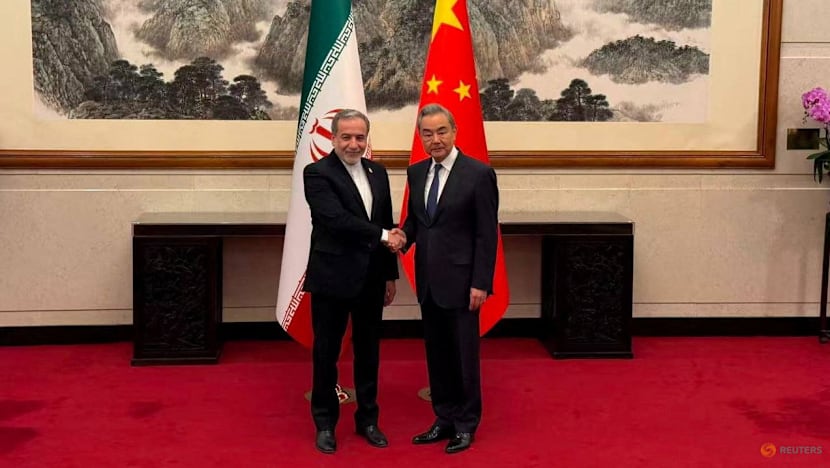
China says Iran's foreign minister will visit Beijing Wednesday for talks
Topic: geopoliticsRegion: Middle EastUpdated: i2 outletsSources: 5⚠ Bias gap — sources divergeSpectrum: Mixed⏱ 3 min read⚠ 48h+ old
Story Summary
SITUATION
China said Iran's foreign minister will visit Beijing on Wednesday for meetings with Chinese officials. Sources disagree on whether the trip signals a deepening strategic alignment or routine diplomatic contact (per news.google.com).
Coveragetap to expand ▾Spectrum: Mixed🌍Europe: 1 · Asia: 1
Political Spectrum
Position is inferred from coverage mix.
i2 outlets · Center
Left
Center
Right
Left: 0
Center: 2
Right: 0
Geography Coverage
Distribution of where coverage is coming from.
i2 unique outlets · Dominant: Europe
KEY FACTS
- China announced that the Iranian Foreign Minister will visit China on Wednesday (per news.google.com).
- The source did not provide a named date in Month Day Year form for when the visit will occur (per news.google.com).
HISTORICAL CONTEXT
The immediate backdrop is the active US–Israel military campaign against Iranian military infrastructure that began in March 2026, a coordinated series of strikes on Iranian power plants, air defenses and military sites that followed months of escalating Iranian attacks on regional shipping, strikes on forward bases hosting US personnel, and proxy operations across Iraq and Syria in late 2025 and early 2026.
Those US and Israeli strikes occurred amid a wider regional security breakdown that included repeated exchanges of missiles and drones between Iranian-backed groups and Israeli forces across 2024–early 2026 and intensified great-power diplomatic competition in the Persian Gulf.
Brief
China announced that the Iranian Foreign Minister will visit Beijing on Wednesday, describing the trip as a planned diplomatic engagement. The sole source for this brief, a China-Global South Project item republished on news.google.com, presented the visit as a scheduled bilateral exchange and did not attach the trip to any immediate crisis or list an agenda.
Iranian and Chinese spokespeople were not quoted in the source text; instead, the announcement was relayed as a Beijing statement without further detail. The article supplied no specific Month-Day-Year date for the visit, no names of accompanying officials, and no locations of meetings inside China, leaving the visit’s concrete objectives unclear.
Analysts and officials often use such ministerial visits to negotiate trade, energy, or security ties; however, the source did not specify whether the talks will cover energy contracts, regional diplomacy, or the ongoing wider regional conflict.
Because reporting in this pack is limited to the single cited item, confirmed facts are narrow: Beijing announced the visit and characterized it as a diplomatic meeting; unconfirmed elements include timing beyond 'Wednesday,' any signed agreements, and whether the meetings will address recent regional military actions.
Pending fuller reporting from the ministries involved, the visit should be read as formal diplomacy announced by China rather than as a publicly framed response to a specific external trigger.
Why it matters
- - Iranian diplomats and Chinese officials bear the immediate diplomatic burden: Tehran must decide whether to seek concrete pacts on trade or energy during the visit, and Beijing must allocate negotiating bandwidth without a disclosed agenda. - Citizens relying on Iranian energy exports are a specific affected population because ministerial talks often center on energy deals; the source did not state any committed energy contracts, leaving potential supply or pricing impacts unaddressed. - The Iranian government benefits from using a high-profile China visit to signal international partnerships in the face of regional pressure; the source documents Beijing hosting the ministerial trip. - Chinese state actors benefit by reinforcing China’s role as a diplomatic interlocutor with Iran, a relationship the announcement itself foregrounds.
What to watch next
Whether the Iranian Foreign Minister or the Chinese Foreign Ministry publishes a detailed joint communique naming agenda items or agreements by the end of the week. 2) Whether state media in Iran or China names specific accompanying ministers or agencies (e.g., energy, commerce) for the visit. 3) Whether an official Month Day Year for the trip appears in a ministry statement; the source provided only 'Wednesday.'
Where sources differ
7 dimensionsBias gap0.70 / 2.0
Left- and right-leaning outlets are covering this story differently — in which facts to emphasize, which context to include, and how to frame causes and consequences.
Center (4)
channel_news_asiaua.newschinadailyasia.comchinadaily.com.cn
Right-leaning (1)
chinaglobalsouth.com+0.20
Iranian Foreign Minister to Visit China on Wednesday: Beijing - The China-Global South Project
7 specific areas where coverage diverges — see below.
Framing differences
?- Only one source is in this pack: news.google.com republishing a China-Global South Project item; there are no differing outlet framings to contrast.
Disputed or unclear
?- The precise date in Month Day Year format is not stated in the source text and therefore cannot be confirmed.
Omitted context
?- No source mentions prior triggering diplomatic contacts that led to this visit (e.g., prior high-level calls) — that omission leaves the motive for timing unclear.
- No source in this pack provided any civilian casualty data or linked the visit to recent military actions in the region.
- No source mentioned any international legal, trade, or energy agreements that might be signed, nor did any source cite relevant economic figures or companies involved.
- No source cited statements from the Iranian Foreign Minister or China's Foreign Ministry directly; primary voices are absent.
Conflicting figures
?- There are no differing numerical figures in the available source material.
Disputed causality
?- The source presents the visit as a scheduled diplomatic event and does not assert it as a response to any prior action; therefore there is no causal claim to reconcile across sources.
Attribution disputes
?- The announcement of the visit is attributed to Beijing in the source; no alternative attributions appear.
Sources
5 of 5 linked articles
Iranian foreign minister to visit China: Beijing
channelnewsasia.comSep 15Center
↗
Iranian Foreign Minister Araghchi to visit Beijing for talks with Wang Yi - ua.news
ua.newsSep 15Left
↗
Iranian Foreign Minister Araghchi to visit China - chinadailyasia.com
chinadailyasia.comSep 15Left
↗
Iranian Foreign Minister to Visit China on Wednesday: Beijing - The China-Global South Project
chinaglobalsouth.comSep 15Center
↗
Iranian Foreign Minister Araghchi to visit China
chinadaily.com.cnSep 15Center
↗