
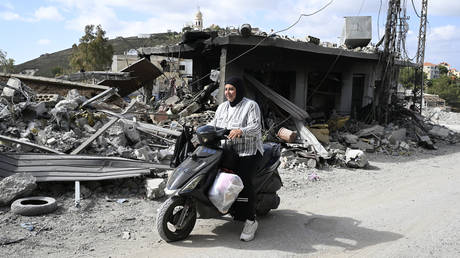
“And we know that an experimental zone must be occupied territory,” Bazzi said.
Topic: defense & securityRegion: middle eastUpdated: i5 outletsSources: 6⚠ Bias gap — sources divergeSpectrum: Mixed⏱ 4 min read
Story Summary
SITUATION
The recent U.S.-Iran memorandum of understanding marks a pivotal moment in Middle Eastern geopolitics, as it not only curtails immediate hostilities but also opens avenues for future diplomatic negotiations, potentially altering the longstanding U.S.-Israel-Iran rivalry. This agreement could redefine military strategies and alliances in the region.
Coveragetap to expand ▾Spectrum: Mixed🌍ME: 3 · Europe: 1 · Asia: 1 · Other: 1
Political Spectrum
Position is inferred from coverage mix.
i5 outlets · Center
Left
Center
Right
Left: 3
Center: 1
Right: 2
Geography Coverage
Distribution of where coverage is coming from.
i5 unique outlets · Dominant: Middle East
KEY FACTS
- The United States and Iran signed a memorandum of understanding (MOU) on October 10, 2026, effectively halting three months of direct conflict.
- The MOU includes the lifting of a US naval blockade that had been in place since June 2026.
- The agreement establishes a $300 billion reconstruction fund for Iran, aimed at rebuilding its military infrastructure and economy.
- The military conflict between the United States and Israel against Iran escalated significantly in July 2026 with coordinated strikes targeting Iranian military infrastructure.
- The U.S. and Israel targeted Iranian air defenses and power plants during the conflict, prompting Iranian military responses.
- Negotiations involving technical teams from the U.S., Iran, and Qatar are currently taking place in Doha to finalize the details of the MOU.
HISTORICAL CONTEXT
The ongoing military conflict between the United States and Israel against Iran, which began with coordinated strikes in March 2026, has significantly shaped the geopolitical landscape in the Middle East.
This campaign has seen the U.S. and Israel targeting Iranian military infrastructure, air defenses, and power plants, prompting a series of Iranian military responses aimed at countering these attacks. The escalation of hostilities marks a critical phase in a long-standing rivalry that has roots in decades of complex interactions between these nations.
Brief
The recent signing of a memorandum of understanding (MOU) between the United States and Iran has brought a halt to over three months of direct warfare, marking a significant shift in the geopolitical dynamics of the region.
This agreement includes provisions for lifting a US naval blockade and establishing a $300 billion reconstruction fund for Iran, raising questions about the future of Iran's regional deterrence capabilities.
While some analysts argue that Iran's deterrence has been permanently degraded, others suggest that its proxy network, often referred to as the 'axis of resistance,' is evolving into a more resilient force capable of adapting to these new circumstances.
The implications of this agreement extend beyond bilateral relations, as it fundamentally alters the balance of power in the Middle East. The MOU is seen as a critical step in reshaping US-Iran relations after a prolonged period of conflict, and
Why it matters
- The recent MOU between the United States and Iran marks a pivotal shift in the Middle East, directly impacting the lives of millions in Iran who stand to benefit from the proposed $300 billion reconstruction fund.
- This agreement not only alleviates the immediate threat of military escalation but also opens avenues for economic revitalization, potentially improving living conditions and infrastructure for Iranian citizens.
- Additionally, the lifting of the U.S. naval blockade could enhance trade opportunities, fostering a more stable environment that may reduce tensions in the region and provide a framework for future diplomatic engagements.
What to watch next
- Watch for the U.S. Congress to hold hearings on the proposed $300 billion reconstruction fund for Iran within the next two weeks, which could shape the trajectory of U.S.-Iran relations.
- Anticipate a statement from Iran's Foreign Ministry regarding the U.S. naval blockade's status within the next 72 hours, which may indicate Tehran's strategic military posture in the region.
- Keep an eye on the upcoming meeting between U.S. Secretary of State Antony Blinken and Iranian officials scheduled for next month, as it could lead to further diplomatic agreements or tensions.
- Expect Israel to announce its response to the U.S.-Iran agreement within the next week, particularly regarding its military operations in Syria and Lebanon.
- Look for the Gulf Cooperation Council (GCC) to convene an emergency summit within the next month to discuss the implications of the U.S.-Iran memorandum on regional security.
Where sources differ
Bias gap1.10 / 2.0
Left- and right-leaning outlets are covering this story differently — in which facts to emphasize, which context to include, and how to frame causes and consequences.
Left-leaning (3)
firstpost.com-0.80
'Persian negotiating tactic': Vance says Iran denying talks publicly while technical discussions continue - Firstpost 'Persian negotiating tactic': Vance says Iran denying talks pu…
middle_east_eye-0.35
Vance: Iran talks going ‘extremely well’, Trump has ‘options’ to respond to threats Vance: Iran talks going ‘extremely well’, Trump has ‘options’ to respond to threats Vance: Iran …
aljazeera_en-0.20
Evolution under fire: Iran’s ‘axis of resistance’ in a post-war era Evolution under fire: Iran’s ‘axis of resistance’ in a post-war era Evolution under fire: Iran’s ‘axis of resist…
Center (1)
today.lorientlejour.com
Right-leaning (2)
jerusalem_post+0.75
US-Iran talks 'going well' Vance claims, Iran's deputy FM says monitoring of MoU discussed - report US-Iran talks 'going well' Vance claims, Iran's deputy FM says monitoring of MoU…
rt_world+0.70
‘They haven’t set foot there’: Lebanese mayor questions Israeli withdrawal claim (VIDEO) ‘They haven’t set foot there’: Lebanese mayor questions Israeli withdrawal claim (VIDEO) ‘T…
Sources
6 of 6 linked articles
US-Iran talks 'going well' Vance claims, Iran's deputy FM says monitoring of MoU discussed - report
jpost.com8h agoRight
↗
Vance: Iran talks going ‘extremely well’, Trump has ‘options’ to respond to threats
middleeasteye.net13h agoLeft
↗
'Persian negotiating tactic': Vance says Iran denying talks publicly while technical discussions continue
firstpost.comJul 1Left
↗
Evolution under fire: Iran’s ‘axis of resistance’ in a post-war era
aljazeera.comJun 30Center
↗
“And we know that an experimental zone must be occupied territory,” Bazzi said.
rt.comJun 30Right
↗
Froun mayor says town lies outside Israeli-designated ‘pilot zones,’ denies occupation claims - L'Orient Today
today.lorientlejour.comJun 28Left
↗