
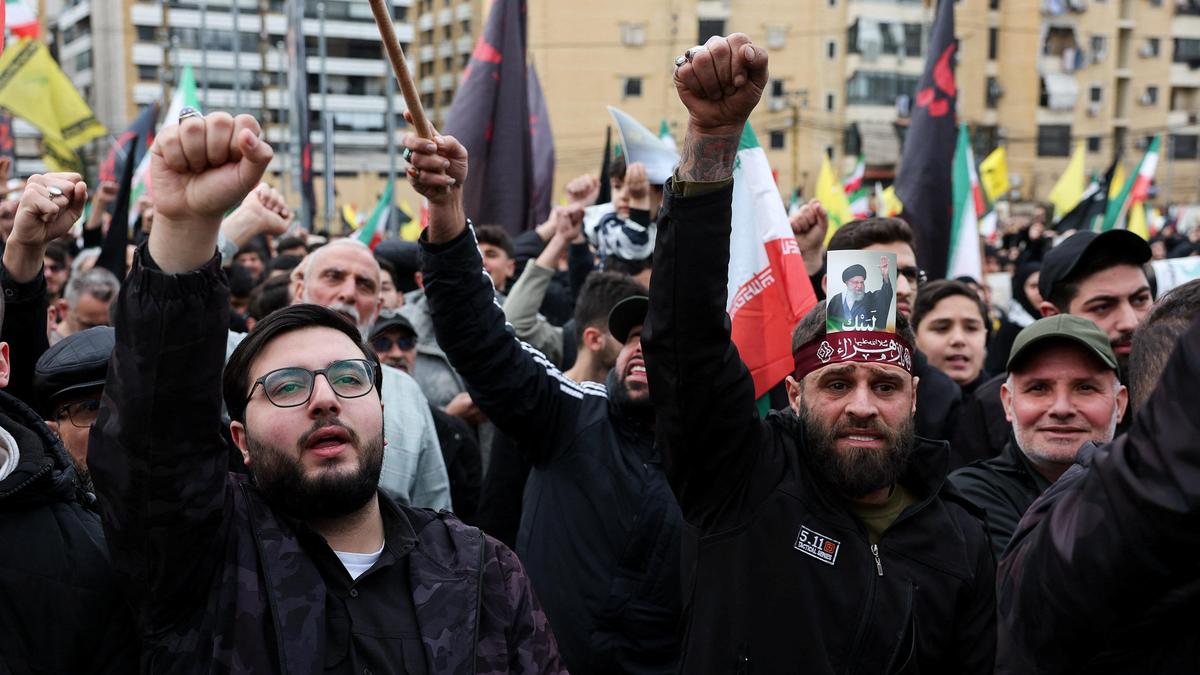
US 'does not expect Israel to absorb' Hezbollah attacks, signals green light for IDF escalation
Topic: defense & securityRegion: Middle EastUpdated: i7 outletsSources: 14⚠ Bias gap — sources divergeSpectrum: Mixed⏱ 4 min read📡 Wire pickup⚠ 3d+ old
Story Summary
SITUATION
After Hezbollah launched attacks on Israel, the US indicated it does not expect Israel to absorb these assaults. The US has proposed a framework for de-escalation, contingent on Hezbollah ceasing its attacks (per JPost).
Coveragetap to expand ▾Spectrum: Mixed🌍ME: 4 · Europe: 3 · Asia: 3 · US: 1 · Other: 1
Political Spectrum
Position is inferred from coverage mix.
i7 outlets · Center
Left
Center
Right
Left: 4
Center: 7
Right: 1
Geography Coverage
Distribution of where coverage is coming from.
i7 unique outlets · Dominant: Middle East
KEY FACTS
- Trump says Israel and Hezbollah have agreed to dial back fighting
- Trump says Hezbollah and Israel have agreed to ‘stop all shooting’
- The US president said in a social media post that he spoke to Israel’s prime minister, Benjamin Netanyahu, and representatives of Hezbollah and both agreed that “all shooting will stop”.
- Likewise, through highly placed representatives, I had a very good call with Hezbollah, and they agreed all shooting will stop,” Trump said in a post.
- According to a statement by Lebanon’s presidency, under the proposed arrangement Israel would not strike Beirut’s southern suburbs if Hezbollah did not launch attacks against Israel.
- The Hezbollah MP Hassan Fadlallah said the group refused a partial truce offer to spare Beirut in exchange for an end to Hezbollah attacks on Israel.
- Israel's prime minister has ordered attacks on the southern suburbs of Lebanon's capital, Beirut, as its conflict with the Iran-backed armed group Hezbollah escalates.
HISTORICAL CONTEXT
The ongoing conflict between Israel and Hezbollah has escalated significantly in recent months, particularly following the coordinated military strikes initiated by the United States and Israel against Iran in March 2026. These strikes targeted Iranian military infrastructure, air defenses, and power plants, marking a significant escalation in tensions in the region.
In response to these actions, Hezbollah has intensified its military engagement, launching rockets into northern Israel, which has prompted Israeli military responses, including recent strikes on Beirut’s southern suburbs.
Brief
The United States has made it clear that it does not expect Israel to absorb ongoing attacks from Hezbollah, indicating a potential green light for the Israel Defense Forces (IDF) to escalate their military operations.
This stance follows a series of rocket attacks launched by Hezbollah into northern Israel, which have prompted Israeli military responses, including recent strikes on the southern suburbs of Beirut ordered by Prime Minister Benjamin Netanyahu.
In a bid to de-escalate tensions, US Secretary of State Marco Rubio proposed a framework that calls for Hezbollah to cease its attacks in exchange for Israel refraining from further strikes on Beirut.
This proposal comes amid a backdrop of heightened military activity, with Netanyahu asserting that the IDF would target what they describe as 'terrorist positions' in response to Hezbollah's violations of a ceasefire that was previously established.
Meanwhile, former President Donald Trump has claimed that both Hezbollah and Israel have agreed to mutual de-escalation, suggesting that a temporary halt in hostilities could be on the horizon.
However, the situation remains precarious, as the Israeli military continues to prepare for potential further operations in Lebanon, underscoring the fragile nature of the current ceasefire efforts.
As the United Nations Security Council prepares to discuss the ongoing conflict, many governments watches closely to see if the proposed framework will lead to a lasting reduction in hostilities or if the cycle of violence will continue unabated.
Where sources differ
Bias gap1.25 / 2.0
Left- and right-leaning outlets are covering this story differently — in which facts to emphasize, which context to include, and how to frame causes and consequences.
Left-leaning (4)
scmp_world-0.80
Netanyahu orders strikes on Beirut’s southern suburbs, clouding Iran mediation Netanyahu orders strikes on Beirut’s southern suburbs, clouding Iran mediation Netanyahu orders strik…
guardian_world-0.50
Trump says Hezbollah and Israel have agreed to ‘stop all shooting’ Trump says Hezbollah and Israel have agreed to ‘stop all shooting’ European leaders condemn Israel’s deepening in…
theguardian.com-0.50
European leaders condemn Israel’s deepening incursion into Lebanon European leaders condemn Israel’s deepening incursion into Lebanon. Reporting is limited at this stage.
middle_east_eye-0.35
Israel orders strikes on Beirut suburbs ahead of UNSC meeting Israel orders strikes on Beirut suburbs ahead of UNSC meeting Israel orders strikes on Beirut suburbs ahead of UNSC me…
Center (7)
the_hinduapnews.combbc_worldidahostatejournal.comaljazeera.comaninews.ini24news.tv
Right-leaning (1)
jerusalem_post+0.75
US 'does not expect Israel to absorb' Hezbollah attacks, signals green light for IDF escalation US 'does not expect Israel to absorb' Hezbollah attacks, signals green light for IDF…
Sources
12 of 12 linked articles
Israel launches strikes on Lebanon’s Beirut after Hezbollah fires missiles to enter West Asia conflict
thehindu.comJun 2Center
↗
Trump says Israel and Hezbollah have agreed to dial back fighting
apnews.comJun 2Left
↗
Trump says Hezbollah and Israel have agreed to ‘stop all shooting’
theguardian.comJun 1Left
↗
Israel PM orders strikes on Beirut suburbs as Hezbollah conflict escalates
bbc.comJun 1Center
↗
Israel orders strikes on Beirut’s southern suburbs as Hezbollah rockets hit northern Israel
idahostatejournal.comJun 1Left
↗
Residents flee Beirut’s southern suburbs as Israel orders strikes
aljazeera.comJun 1Left
↗