
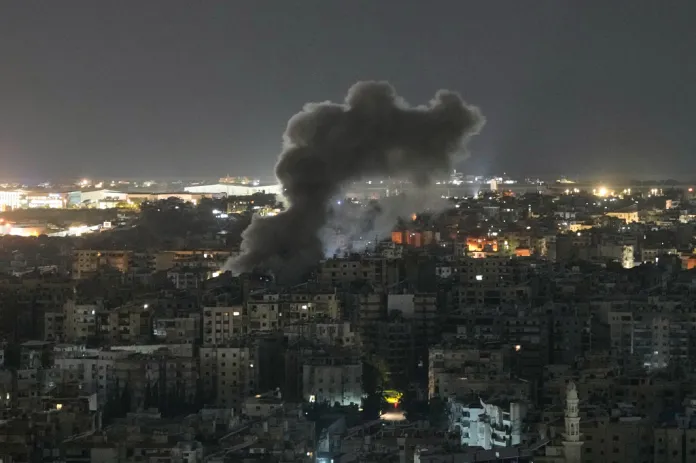
Israeli Airstrike Kills Senior Hezbollah Commander in Beirut Suburbs
Coveragetap to expand ▾Spectrum: Mixed🌍US: 1 · Asia: 1
- Israeli warplanes launched an attack on Ghobeiri in Beirut's southern suburbs, a Hezbollah stronghold, on May 6 (per straitstimes.com).
- The strike killed Malek Ballout, the operations commander of Hezbollah's Radwan force (per straitstimes.com).
- This was the first Israeli strike on the area in nearly a month (per straitstimes.com).
- Israeli Prime Minister Benjamin Netanyahu stated that the military targeted the commander of Hezbollah's Radwan force (per straitstimes.com).
- Lebanon’s state-run National News Agency reported the Israeli airstrike on Ghobeiri (per straitstimes.com).
On May 6, Israeli warplanes conducted a targeted airstrike in the southern suburbs of Beirut, killing Malek Ballout, a senior commander of Hezbollah's elite Radwan force. The strike, which hit an apartment in the Ghobeiri area, was aimed at a meeting of Radwan leaders, marking the first Israeli attack on this Hezbollah stronghold in nearly a month.
Israeli Prime Minister Benjamin Netanyahu confirmed that the military operation specifically targeted the commander of the Radwan force, underscoring Israel's ongoing efforts to counter Hezbollah's influence in the region. The Lebanese state-run National News Agency reported the airstrike, highlighting its significance given the relative calm in the area over the past weeks.
A Lebanese security source, speaking on condition of anonymity, corroborated the details of the strike, emphasizing the precision of the attack on the apartment where the meeting was held. Hezbollah, a powerful political and military organization in Lebanon, has been a longstanding adversary of Israel, with tensions frequently flaring into military confrontations.
The Radwan force, an elite unit within Hezbollah, plays a critical role in the group's military operations, making its leaders prime targets for Israeli military actions. This latest strike comes amid heightened regional tensions, as Israel continues to assert its military capabilities against perceived threats from Hezbollah and other groups aligned with Iran.
The killing of a high-ranking Hezbollah commander is likely to provoke a response from the group, potentially escalating the conflict further. The broader geopolitical context includes ongoing hostilities between Israel and Iran, with Hezbollah often acting as a proxy for Iranian interests in the region.
This dynamic complicates efforts to stabilize the Middle East, as each military action carries the risk of broader conflict.
Observers will be closely watching Hezbollah's response to this targeted killing, as well as any potential diplomatic repercussions for Lebanon, which is already grappling with political and economic challenges. many governments remains concerned about the potential for further escalation, which could destabilize the region further.
- The residents of Beirut's southern suburbs bear the immediate risk of further military actions, as the area is a known Hezbollah stronghold targeted by Israeli strikes.
- Hezbollah's leadership faces increased pressure and potential destabilization following the loss of a senior commander, impacting their operational capabilities.
- Israel benefits from demonstrating its military reach and capability to target high-value adversaries, reinforcing its strategic posture against Hezbollah and Iran.
- Whether Hezbollah retaliates against Israel for the killing of Malek Ballout in the coming weeks.
- Any statements or actions from the Lebanese government in response to the Israeli airstrike.
- Potential diplomatic engagements or condemnations from regional actors following the escalation.
- No significant framing differences noted in the single source provided.
- No disputes or unclear facts noted in the single source provided.
- No source mentions the broader context of Israeli-Iranian hostilities that frame Hezbollah's role as an Iranian ally.
- No differing figures noted in the single source provided.
- No causality disagreements noted in the single source provided.
- No differing attributions noted in the single source provided.