
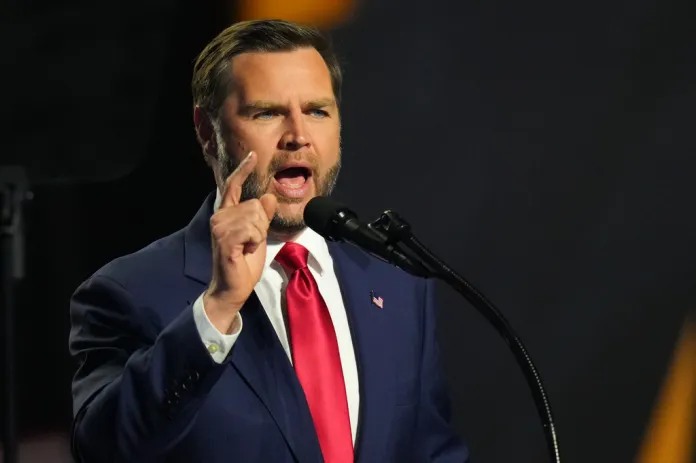
JD Vance pushes nationalist economic plan the Washington Examiner calls socialist
Topic: defense & securityRegion: north americaUpdated: i1 outletsSources: 1Spectrum: Right Only⏱ 3 min read⚠ 48h+ old
Story Summary
SITUATION
JD Vance is promoting a nationalist economic agenda that the Washington Examiner argues adopts big-government, 'socialist' policies while he publicly defends the Trump White House on the Iran war and rising costs. The Examiner says Vance is 'unofficially' beginning a 2028 presidential run and links his manufacturing-first pitch to those defenses (per Washington Examiner).
Coveragetap to expand ▾Spectrum: Right Only🌍US: 1
Political Spectrum
Position is inferred from coverage mix.
i1 outlets · Right
Left
Center
Right
Left: 0
Center: 0
Right: 1
Geography Coverage
Distribution of where coverage is coming from.
i1 unique outlets · Dominant: US/Canada
KEY FACTS
- JD Vance is described as 'second-in-line to the highest office in the land' (per Washington Examiner)
- The Washington Examiner reports Vance has been publicly defending the Trump White House’s policies on the Iran war and rising costs (per Washington Examiner)
- The column asserts Vance is 'unofficially' beginning his 2028 presidential run (per Washington Examiner)
HISTORICAL CONTEXT
The immediate backdrop is the active U.S.–Israel military campaign against Iran that began in March 2026, when coordinated strikes targeted Iranian power-generation sites, air defenses and military infrastructure after a period of sharp escalation in the region earlier that year.
That campaign followed weeks of increasingly hostile exchanges around the Gulf and Levant, including attacks on shipping and military outposts that both sides cited as part of a broader tit-for-tat confrontation. Domestically in the United States, the campaign has been conducted under the administration inaugurated on January 20, 2025.
Brief
The Washington Examiner argues that JD Vance is advancing an economic program it calls big-government 'socialism' while publicly aligning himself with the Trump White House on the Iran war and economic complaints over rising costs.
The Examiner labels Vance 'second-in-line to the highest office in the land' and says he has been defending administration policy as he 'unofficially' begins his 2028 presidential run.
The column frames Vance’s platform around reshoring manufacturing and stabilizing supply chains, quoting him on Meet the Press: 'if you don’t bring more manufacturing jobs back into this country, you don’t make our supply chains more stable, you’re going to cause higher prices over the long term.' That line sits at the center of the Examiner’s critique: the outlet accepts Vance’s diagnosis of economic pain but contends his remedies amount to expanded government intervention cloaked in nationalist rhetoric.
The piece ties Vance’s economic pitch to his public defense of the administration’s Iran policy and cost-of-living messages, presenting those positions as part of how he is shaping the post-Trump Republican Party and testing themes for a potential 2028 bid.
The article does not supply competing assessments from labor groups, economists, or other outlets; it centers a conservative pundit critique that labels the plan 'socialism' while acknowledging Vance’s populist appeal in Appalachia and the Rust Belt.
Readers are left with a clear portrait of how one conservative outlet reads Vance’s political positioning: a Republican leader marrying nationalist economic interventionism to hawkish foreign-policy alignment with the current White House as he quietly readies a national candidacy.
Why it matters
- Concrete costs borne by working-class voters in Appalachia and the Rust Belt: Vance’s manufacturing-first policy promises job reshoring but, according to the Examiner critique, would expand government intervention in the economy rather than deliver immediate private-sector wage gains (per Washington Examiner).
- Political benefits for JD Vance: framing himself as defending the Trump White House on Iran and rising costs helps Vance consolidate support among Republican primary voters and test themes for a 2028 presidential run (per Washington Examiner).
- Policy leverage for the Trump White House: Vance’s public alignments amplify administration messaging on the Iran war and economic policy, potentially broadening elite and voter acceptance of interventionist trade and industrial policy (per Washington Examiner).
What to watch next
- Whether JD Vance increases public defenses of the Trump White House’s Iran war policy in major interviews or speeches before the end of 2026, as the Examiner links those defenses to his national positioning (per Washington Examiner).
- Whether JD Vance makes formal campaign moves or announcements signaling a 2028 presidential run after his 'unofficial' start noted by the Washington Examiner (per Washington Examiner).
- Whether Vance presents detailed industrial-policy legislation or executive proposals to specify how he would bring manufacturing jobs back and stabilize supply chains (per Washington Examiner).
Where sources differ
7 dimensionsFraming differences
?- Only the Washington Examiner frames Vance’s economic agenda as 'socialism wrapped in a nationalist flag' and links his economic pitch to his public defense of the Trump White House (per Washington Examiner).
Disputed or unclear
?- No other outlets in this pack corroborate the Examiner’s characterization of Vance’s program as 'socialist' or his 'unofficial' 2028 campaign start; those claims are presented by the single source without outside verification (per Washington Examiner).
Omitted context
?- No source in this pack provides independent economic analysis or empirical projections of job gains or costs tied to Vance’s manufacturing proposals.
- No source mentions which specific industries, firms, or corporate executives would gain or lose under Vance’s plan.
- No source cites polling data showing voter reaction to Vance’s economic pitch across Appalachia or the Rust Belt.
- No source outlines legislative mechanisms (taxes, subsidies, tariffs) that would implement the described industrial policy.
Conflicting figures
?- The Washington Examiner provides no quantitative estimates for jobs, costs, or economic impacts tied to Vance’s proposals (per Washington Examiner).
Disputed causality
?- The Examiner links Vance’s public defenses of the Trump White House on the Iran war and rising costs to his national positioning for 2028, but no separate source confirms a causal sequence beyond the Examiner’s argument (per Washington Examiner).
Attribution disputes
?- The Washington Examiner attributes the 'socialist' charge to its columnist rather than to Vance or an opposing party; no other outlet in this pack attributes that label (per Washington Examiner).
Sources
1 of 1 linked articles