
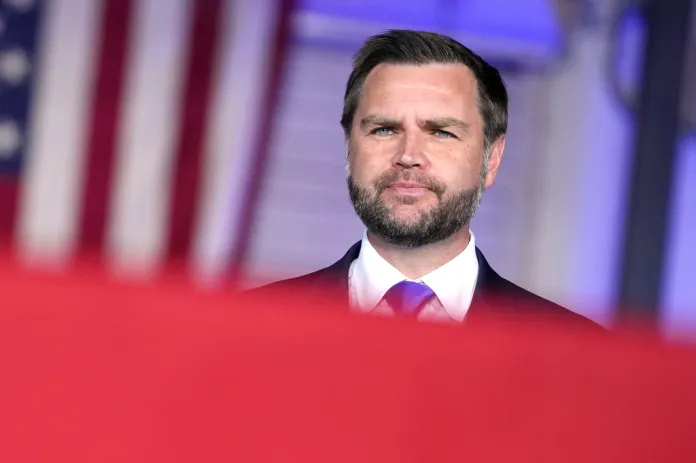
JD Vance says Trump willing to part ways with Bibi Netanyahu; column argues U.S. is Europe’s guard dog
Topic: geopoliticsRegion: North AmericaUpdated: i2 outletsSources: 4⚠ Bias gap — sources divergeSpectrum: Mixed⏱ 3 min read
Story Summary
SITUATION
Vice President J.D. Vance said at the All-In Podcast Summit that President Donald Trump has shown willingness to part ways with Bibi Netanyahu when U.S.
Coveragetap to expand ▾Spectrum: Mixed🌍US: 1 · Other: 1
Political Spectrum
Position is inferred from coverage mix.
i2 outlets · Center
Left
Center
Right
Left: 0
Center: 1
Right: 1
Geography Coverage
Distribution of where coverage is coming from.
i2 unique outlets · Dominant: US/Canada
KEY FACTS
- J.D. Vance said, “I think that, more than frankly any president in the last 40 years, [Trump] has shown a willingness to actually part ways with Bibi Netanyahu when he feels like the interests of the American people are different from the interests of the government of Israel.” (per Washington Examiner)
- The Washington Examiner published an opinion piece arguing Vance is 'half right' and that America functions as Europe’s 'guard dog' rather than as Israel’s puppet (per Washington Examiner)
HISTORICAL CONTEXT
The immediate backdrop is the active U.S.-Israel campaign against Iran that began with coordinated strikes in March 2026, an operation launched after months of escalating exchanges between Tehran and U.S. forces and regional partners tied to disputes over Iran’s nuclear program and regional proxy activity; Iranian military responses in 2026 have proceeded as countermeasures to that campaign.
Those operations occurred within a broader U.S. foreign-policy environment set by the Trump administration, which took office on January 20, 2025, and prioritized recalibrating U.S. commitments and confronting Iran’s regional influence.
Brief
Vice President J.D. Vance told attendees at the All-In Podcast Summit that President Donald Trump has shown a readiness to 'part ways with Bibi Netanyahu' when U.S. interests diverge, an assertion the Washington Examiner described as evidence that Washington’s ties to Israel are conditional.
The Examiner’s columnist endorses part of Vance’s contention but pivots to a broader thesis: the United States acts less as Israel’s unquestioning patron and more as Europe’s 'guard dog,' prioritizing NATO and European security commitments in ways that shape Washington’s posture toward Jerusalem.
Vance’s remark casts Trump’s Israel policy as transactional and situational; the Examiner uses that claim to argue the baseline assumption that America is Israel’s puppet is false and that European defense needs often determine U.S. strategy.
The commentary anchors its judgment in Vance’s on-stage quote and in a judgment about U.S. strategic priorities rather than new diplomatic actions or policy declarations.
Neither Vance nor the Examiner cited specific recent decisions by the Trump administration or Netanyahu’s government to illustrate an actual split, so the exchange stands as a political framing contest more than a report of a policy break.
That distinction matters now because Republican debates over Middle East policy and U.S. commitments to allies are active topics in Washington; Vance’s comments signal intra-administration leeway to distance from Israeli positions if senior U.S. leaders judge American interests to differ.
Readers should treat the column as opinion: it interprets Vance’s remark to recalibrate assumptions about why the United States sustains security burdens — emphasizing commitments to European defense as the operative explanation rather than unconditional fealty to Israeli leaders.
Why it matters
- Concrete costs to American credibility: U.S. policymakers and diplomats may face harder choices when Vance’s framing enables public breaks with Israeli positions, imposing diplomatic strain on U.S. envoys working with Israeli counterparts.
- Concrete costs to Israeli political leverage: If U.S. leaders follow Vance’s logic, Israeli government preferences under Benjamin Netanyahu could carry less automatic weight in Washington, reducing Israel’s direct influence on specific U.S. security decisions.
- Who benefits: European governments benefit from an American posture described as prioritizing NATO and European defense commitments, a point the Washington Examiner raises to explain current U.S. priorities.
- Who benefits politically domestically: Republican figures who argue for transactional allyship gain rhetorical space if Trump and his vice president publicly accept conditional ties with allies like Israel.
What to watch next
- Whether President Donald Trump publicly elaborates or qualifies his reported willingness to 'part ways with Bibi Netanyahu' in remarks or policy statements within the coming weeks.
- Whether Administration officials or the White House Counsels respond to J.D. Vance’s All-In Podcast Summit comments at the next major foreign-policy forum or briefing.
- Whether congressional hearings or Republican primary debates cite Vance’s framing when questioning aid or diplomatic commitments to Israel or NATO allies by the end of the current congressional session.
Where sources differ
7 dimensionsBias gap0.50 / 2.0
Left- and right-leaning outlets are covering this story differently — in which facts to emphasize, which context to include, and how to frame causes and consequences.
Center (2)
wowt.comfirstpost.com
Right-leaning (2)
jpost.com+0.75
washington_examiner+0.70
Vice President JD Vance said at the All-In Podcast Summit that President Donald Trump has shown a willingness to part ways with Bibi Netanyahu when U.S. interests diverge, challeng…
7 specific areas where coverage diverges — see below.
Framing differences
?- Only the Washington Examiner is present and it frames Vance’s remark as evidence the U.S. is Europe’s 'guard dog' rather than Israel’s puppet (per Washington Examiner).
Disputed or unclear
?- No source disputes Vance’s quoted remark, but neither presents evidence of an actual policy break between the Trump administration and Benjamin Netanyahu’s government (per Washington Examiner).
Omitted context
?- No source in this pack mentions any recent policy decisions, specific aid packages, or diplomatic actions that would demonstrate a concrete U.S. split from Israel.
- No source provides data on how U.S. military commitments to Europe compare numerically to commitments to Israel (troop levels, funding), which would clarify the 'guard dog' claim.
- No source mentions reactions from Israeli officials, including Benjamin Netanyahu, to Vance’s comment.
Conflicting figures
?- Only one date/time is given: publication date September 18, 2026 at 6:00am ET (per Washington Examiner).
Disputed causality
?- The Examiner presents Vance’s remark as evidence for a broader interpretation of U.S. priorities; no source documents a triggering U.S. or Israeli action that produced Vance’s statement.
Attribution disputes
?- The quoted attribution of the willingness to 'part ways' is directly attributed to J.D. Vance speaking about President Donald Trump (per Washington Examiner).
Sources
4 of 4 linked articles
JD Vance says Trump willing to part ways with Bibi Netanyahu; column argues U.S. is Europe’s guard dog
washingtonexaminer.com15h agoCenter
↗
Vice President JD Vance to visit Council Bluffs, address economic concerns
wowt.com23h agoLeft
↗
JD Vance: Donald Trump will cut ties with Benjamin Netanyahu if needed over US, Israel differences
jpost.comSep 17Left
↗
Vance says Trump can 'part ways' with Netanyahu when needed amid tensions in West Asia
firstpost.comSep 17Left
↗