
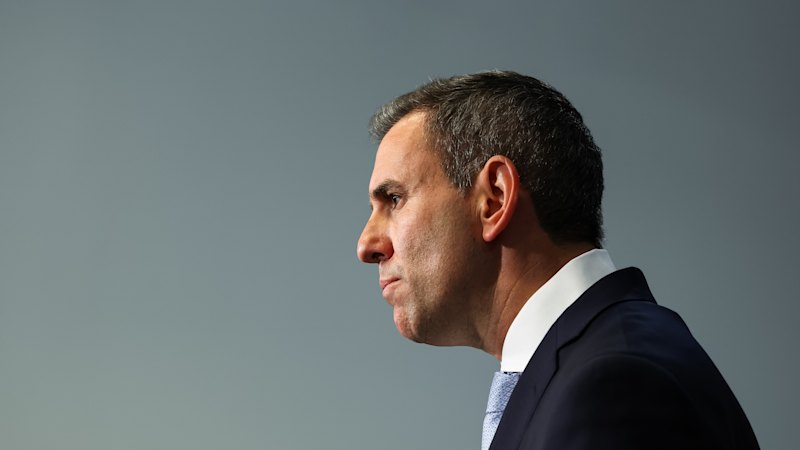
Jim Chalmers warns Labor MPs of possible interest-rate rises ahead of intergenerational report
Topic: finance & marketsRegion: asia pacificUpdated: i1 outletsSources: 1Spectrum: Center Only⏱ 3 min read⚠ 3d+ old
Story Summary
SITUATION
Treasurer Jim Chalmers privately told uneasy Labor MPs that one and possibly two interest-rate rises this year are a prospect. He delivered the warning ahead of Treasury’s first intergenerational report in three years, and he said Australia still has a lower debt burden than every major advanced economy (per smh.com.au).
Coveragetap to expand ▾Spectrum: Center Only🌍Asia: 1
Political Spectrum
Position is inferred from coverage mix.
i1 outlets · Center
Left
Center
Right
Left: 0
Center: 1
Right: 0
Geography Coverage
Distribution of where coverage is coming from.
i1 unique outlets · Dominant: Asia
KEY FACTS
- Treasurer Jim Chalmers held a private briefing with Labor MPs in which he warned one and possibly two interest-rate rises this year are a prospect (per smh.com.au).
- The briefing came ahead of Treasury’s first intergenerational report in three years, which was due for release next week (per smh.com.au).
- Chalmers said Australia had a lower debt burden than 'every major advanced economy' (per smh.com.au).
- Labor’s economic plans have been criticised by employers and pro-growth Labor figures (per smh.com.au).
HISTORICAL CONTEXT
The immediate backdrop is a period of heightened global economic and geopolitical uncertainty: in March 2026 the United States and Israel launched coordinated military strikes on Iranian energy and air‑defence infrastructure, producing renewed energy market volatility and prompting central banks and treasuries worldwide to reassess near‑term policy settings.
Domestically, Australia’s macroeconomic framework remains shaped by the Reserve Bank of Australia’s inflation‑targeting regime (a 2–3% medium‑term target formally adopted in the early 1990s) and the Charter of Budget Honesty Act 1998, which established statutory requirements for Treasury fiscal reporting and periodic long‑term intergenerational analysis.
Brief
Treasurer Jim Chalmers privately warned Labor colleagues that one — and possibly two — interest-rate rises this year are a realistic prospect, a briefing that came as Treasury prepares its first intergenerational report in three years.
Chalmers framed the outlook by stressing Australia’s relatively low debt burden, saying the country has a lower debt load than 'every major advanced economy', even as he cautioned MPs that longer-term economic challenges remain (per smh.com.au).
The timing of the briefing underscores why the intergenerational report matters to the government: Treasury’s analysis, due for release next week, will set out projected budget pressures and demographic trends that Chalmers told MPs could require tougher fiscal choices (per smh.com.au).
Labor backbench unease surfaced in the meeting, with some MPs saying they were 'getting quite worried' about inflation and potential rate rises — concerns amplified by criticism of Labor’s economic plans from employers and pro-growth figures within the party (per smh.com.au).
Chalmers presented the warning as a factual assessment rather than an explicit policy shift; he did not offer a detailed pledge on future Reserve Bank moves, instead flagging the prospect of further monetary tightening should inflationary pressures persist (per smh.com.au).
Employers and internal party critics have used the briefing to argue Labor must reset parts of its economic agenda to reassure voters and markets, while Chalmers has emphasised Australia’s comparatively low public debt as headroom for policy options (per smh.com.au).
What happens next centers on the intergenerational report’s findings and how Treasury and the government translate them into budget choices and messaging.
If the report underscores stronger-than-expected fiscal pressures, Chalmers’ caution about potential rate rises will harden the case for both fiscal restraint and clearer engagement with the Reserve Bank — a political test for a government already fielding criticism from business and pro-growth voices (per smh.com.au).
Why it matters
- Household borrowers in Australia face concrete costs: at least one, possibly two interest-rate rises this year would raise mortgage repayments for Australian homeowners (per smh.com.au).
- Labor MPs bear political costs: unease among backbenchers and criticism from employers and pro-growth figures threatens the government’s ability to defend its economic plans (per smh.com.au).
- The federal budget and future policy choices hinge on Treasury’s intergenerational report: the report’s findings will shape whether the government pursues fiscal restraint or preserves spending priorities (per smh.com.au).
What to watch next
- Whether Treasury publishes the intergenerational report next week as scheduled and what specific fiscal pressures it lists (per smh.com.au).
- Whether Treasurer Jim Chalmers signals any change in fiscal settings or explicit coordination with the Reserve Bank after the report’s release (per smh.com.au).
- Whether Labor backbench criticism crystallises into formal demands or policy revisions ahead of any announced budget decisions (per smh.com.au).
Where sources differ
7 dimensionsFraming differences
?- Only smh.com.au is in this pack; it frames the event as a private warning to uneasy Labor MPs and links it directly to the upcoming intergenerational report (per smh.com.au).
Disputed or unclear
?- No source disputes the core facts, but the scale and timing of any interest-rate rises (one versus two) remain probabilistic and unquantified in the reporting (per smh.com.au).
Omitted context
?- No source in this pack mentions the Reserve Bank’s current monetary policy guidance or its view of inflation drivers, which would clarify how likely rate rises are.
- No source provides quantified estimates of how a rate rise would affect average mortgage payments or the number of households exposed.
- No source cites detailed fiscal projections from the intergenerational report text itself, only that the report is due next week.
Conflicting figures
?- smh.com.au reports 'one and possibly two' interest-rate rises as the prospective figure; no alternative figures are given (per smh.com.au).
Disputed causality
?- smh.com.au presents Chalmers’ warning as linked to the impending intergenerational report and concerns about inflation; no other causal narratives are offered (per smh.com.au).
Attribution disputes
?- smh.com.au attributes the warning and the characterization of Australia’s debt burden directly to Treasurer Jim Chalmers (per smh.com.au).
Sources
1 of 1 linked articles