
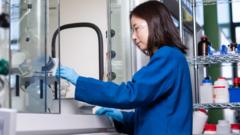
Grace Han Advances Molecular Solar Thermal Energy Storage
Coveragetap to expand ▾Spectrum: Center Only🌍Europe: 1
- Grace Han is a chemistry professor at the University of California, Santa Barbara (per BBC).
- Most systems have the potential to store energy for months or even years (per BBC).
Grace Han, a chemistry professor at the University of California, Santa Barbara, is pioneering a new approach to molecular solar thermal (Most) energy storage, drawing inspiration from an unlikely source: sunburn.
Her research focuses on the photochemistry of DNA molecules, which are damaged by sun exposure, and how this process can inform the development of energy storage systems. The concept of Most energy storage involves molecules that can change shape to store energy and then revert to their original form to release it.
This method holds promise as a potentially cheap and emissions-free way to supply heat. Han's work is particularly influenced by the intense sunlight in California, which provided a natural laboratory for her experiments. Despite previous limited success in the field, Han's insights could lead to significant advancements in energy storage technology.
The ability of Most systems to store energy for extended periods, ranging from months to years, makes them a promising solution for sustainable energy needs. As the world seeks to transition to cleaner energy sources, innovations like Han's could play a crucial role in reducing reliance on fossil fuels and decreasing greenhouse gas emissions.
- Grace Han's research could lead to a reduction in greenhouse gas emissions by providing a sustainable energy storage solution.
- The development of Most systems could decrease reliance on fossil fuels, benefiting the environment and reducing energy costs.
- Communities in sunny regions could particularly benefit from this technology, as it leverages abundant solar energy.
- Whether Grace Han's research leads to a commercially viable Most energy storage system.
- Developments in the application of Most technology in other sunny regions.
- Potential partnerships between the University of California, Santa Barbara, and energy companies to further this research.
- No source mentions the potential economic impact of Most technology on the energy market.
- The specific challenges faced by previous Most technology attempts are not detailed.