
↑Part of: Trump: U.S. must keep AI lead to prevent China dominating Pacific and spying


Shapiro: Trump leaving U.S. exposed as AI outpaces oversight
Topic: technologyRegion: North AmericaUpdated: i2 outletsSources: 5⚠ Bias gap — sources divergeSpectrum: Mostly Center⏱ 2 min read
Story Summary
SITUATION
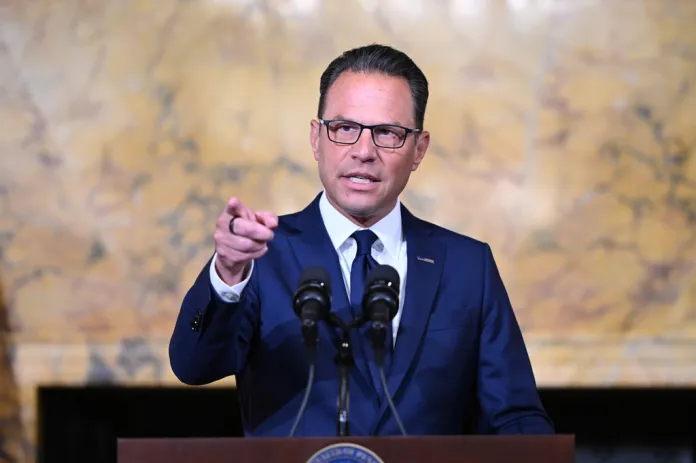
Gov. Josh Shapiro urged federal guardrails for artificial intelligence and called for independent oversight of the most powerful models as AI advances faster than government oversight (per Washington Examiner).
Coveragetap to expand ▾Spectrum: Mostly Center🌍US: 2
Political Spectrum
Position is inferred from coverage mix.
i2 outlets · Center
Left
Center
Right
Left: 0
Center: 1
Right: 1
Geography Coverage
Distribution of where coverage is coming from.
i2 unique outlets · Dominant: US/Canada
KEY FACTS
- Gov. Josh Shapiro called for federal AI guardrails and independent oversight of the most powerful models (per Washington Examiner)
- Shapiro urged international cooperation with China on AI safety (per Washington Examiner)
- Shapiro said President Donald Trump is leaving the United States unprepared as AI advances faster than government oversight (per Washington Examiner)
HISTORICAL CONTEXT
The immediate backdrop is the broader U.S. security environment: in March 2026 the United States and Israel launched coordinated strikes on Iranian power plants, air defenses and military infrastructure after a period of escalating exchanges between Tehran and U.S./Israeli forces.
Domestically, President Donald Trump, inaugurated on January 20, 2025, presides over a federal government that inherited prior AI policy frameworks but has shifted regulatory priorities. Structurally, U.S.
Brief
Gov. Josh Shapiro urged federal guardrails for artificial intelligence, pressing for independent oversight of the most powerful models and for the U.S. to treat AI safety as a diplomatic priority with China (per Washington Examiner).
Shapiro framed his recommendations as a direct response to what he described as rapid AI advances that current U.S. oversight cannot match, and he said President Donald Trump is leaving the country unprepared for that gap (per Washington Examiner).
Shapiro asked that AI safety be on the agenda for Trump’s meeting with Xi Jinping, arguing that international cooperation — including engagement with China — is required to manage risks from advanced models (per Washington Examiner).
The Washington Examiner piece presents Shapiro’s stance as a policy warning from a state governor to the federal executive branch rather than as partisan posturing: it records his specific calls for independent oversight and multilateral engagement without attributing motive beyond his stated concern about speed of development (per Washington Examiner).
Shapiro’s intervention highlights a debate over whether the federal government should create new statutory guardrails and an independent regulator for frontier AI, or rely on industry-led standards and voluntary commitments favored by some in the current administration; the source reports only Shapiro’s prescriptions and critique of the Trump administration’s preparedness (per Washington Examiner).
What happens next is unclear from the single report: Shapiro urged a presidential agenda item and international cooperation, but the article does not document any federal action or response from the White House or from China (per Washington Examiner).
Why it matters
- Residents of the United States bear the concrete regulatory risk Shapiro cites: without federal guardrails the deployment of advanced AI models could outpace oversight mechanisms that protect Americans from harms he warned about (per Washington Examiner).
- Researchers and firms building the most powerful AI models would face new compliance costs if the independent oversight Shapiro proposes is adopted, shifting benefits toward companies that can absorb regulatory compliance (per Washington Examiner).
- U.S.-China coordination on AI safety would materially affect how cross-border model development and data sharing are governed, placing geopolitical leverage in the hands of governments that agree to shared standards (per Washington Examiner).
What to watch next
- Whether President Donald Trump places AI safety on his agenda for the meeting with Xi Jinping as Shapiro urged (per Washington Examiner).
- Whether Congress or the Biden-era successor bodies introduce legislation creating independent oversight or federal guardrails for frontier AI following public calls like Shapiro’s (per Washington Examiner).
- Whether the administration (named as President Donald Trump in the source) responds publicly to Shapiro’s critique or proposes alternative, industry-led oversight measures (per Washington Examiner).
Where sources differ
7 dimensionsBias gap0.50 / 2.0
Left- and right-leaning outlets are covering this story differently — in which facts to emphasize, which context to include, and how to frame causes and consequences.
Center (4)
cnn.comnewsweek.cominquirer.comnotus.org
Right-leaning (1)
washington_examiner+0.70
Gov. Josh Shapiro called for federal AI guardrails and warned that President Donald Trump is leaving the United States unprepared as AI advances faster than government oversight. S…
7 specific areas where coverage diverges — see below.
Framing differences
?- Only the Washington Examiner source is available; it frames Shapiro’s remarks as a warning that Trump is leaving the U.S. unprepared and calls for international cooperation with China (per Washington Examiner).
Disputed or unclear
?- No source disputes Shapiro’s claims; the single-source reporting leaves the existence of any counterclaims or official responses undocumented (per Washington Examiner).
Omitted context
?- No source in this pack mentions existing federal AI initiatives or precise legislative proposals that would implement the independent oversight Shapiro calls for; that prior policy context is omitted (per Washington Examiner).
- The article does not document any response from President Donald Trump, the White House, or Chinese officials to Shapiro’s request to include AI on the U.S.-China agenda (per Washington Examiner).
- The piece omits specific examples of recent AI incidents or harms that might have prompted Shapiro’s urgency, leaving the concrete triggering events unspecified (per Washington Examiner).
Conflicting figures
?- No sources provided differing numerical figures in this reporting (per Washington Examiner).
Disputed causality
?- Shapiro frames his call as triggered by AI advancing faster than government oversight; the Washington Examiner reports that claim but provides no independent evidence of specific triggering incidents (per Washington Examiner).
Attribution disputes
?- The Washington Examiner attributes the call for guardrails and the critique of Trump’s preparedness directly to Gov. Josh Shapiro (per Washington Examiner).
Sources
5 of 5 linked articles
Josh Shapiro wades into AI debate with call for ‘strict guardrails’
cnn.comSep 17Left
↗
Josh Shapiro Says Donald Trump Helped China Gain Edge in AI Race Ahead of Xi Meeting
newsweek.comSep 17Left
↗
Shapiro critical of Mike Johnson and President Trump for their efforts to deal with AI
inquirer.comSep 17Left
↗
Josh Shapiro calls for AI guardrails and claims Trump is leaving US unprepared
washingtonexaminer.comSep 17Center
↗
Josh Shapiro Calls for Federal Government to Place ‘Strict Guardrails’ on AI - washingtonsun.com
notus.orgSep 17Left
↗