
↑Part of: Judge bars ICE from prosecuting critic over email warning officials will 'haunt' them


Judge blocks DHS warning that threatened prosecution of ICE critic
Topic: politicsRegion: north americaUpdated: i2 outletsSources: 3⚠ Bias gap — sources divergeSpectrum: Center Only⏱ 4 min read⚠ 48h+ old
Story Summary
SITUATION
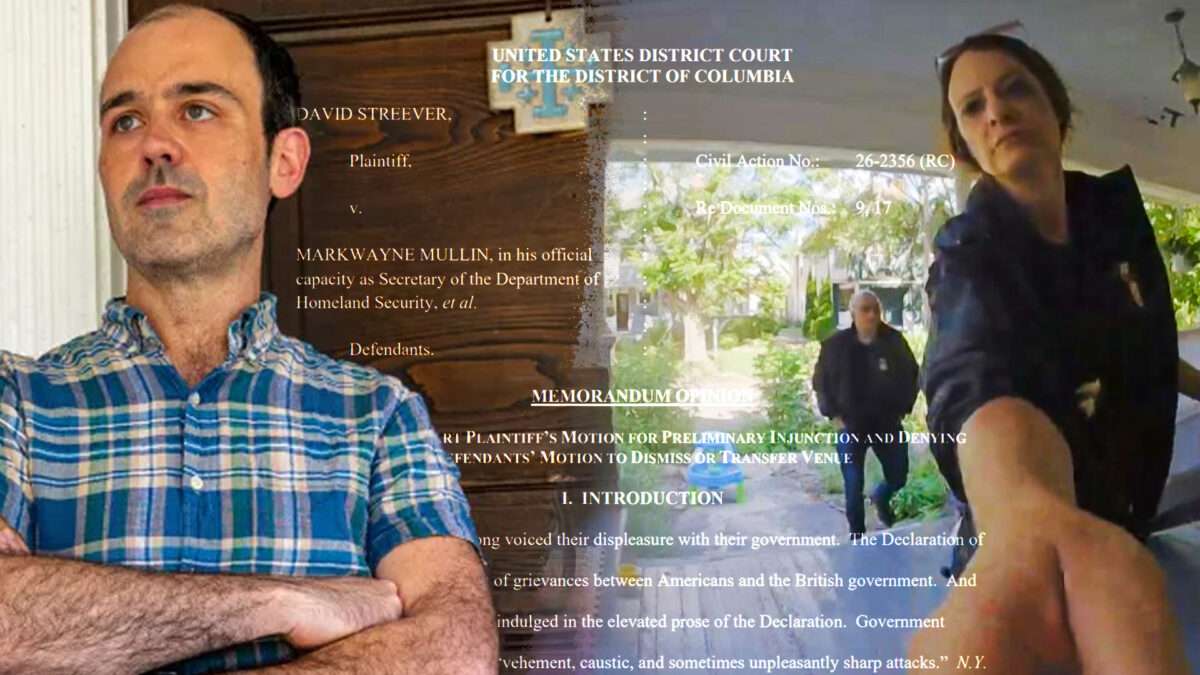
After David Streever emailed ICE acting director Todd Lyons criticizing him, DHS investigators sent Streever a "WARNING NOTICE" that threatened potential prosecution; U.S. District Judge Rudolph Contreras granted a preliminary injunction stopping DHS from acting on that notice.
Coveragetap to expand ▾Spectrum: Center Only🌍US: 2
Political Spectrum
Position is inferred from coverage mix.
i2 outlets · Center
Left
Center
Right
Left: 0
Center: 2
Right: 0
Geography Coverage
Distribution of where coverage is coming from.
i2 unique outlets · Dominant: US/Canada
KEY FACTS
- DHS investigators delivered a "WARNING NOTICE" to David Streever five months after that email that threatened potential prosecution (per reason.com)
- The sequence documented is: Streever emailed Todd Lyons → five months later DHS investigators delivered the WARNING NOTICE (per reason.com)
HISTORICAL CONTEXT
The immediate backdrop is a period of heightened national security focus after the March 2026 coordinated United States and Israeli strikes on Iranian power plants, air defenses and military infrastructure; those strikes, announced by U.S. and Israeli officials as a concerted campaign, produced reciprocal Iranian military actions in 2026 as responses to that campaign.
Domestically, this story occurs under the presidency of Donald J. Trump, inaugurated January 20, 2025, during an administration that has prioritized robust immigration enforcement and strengthened homeland security oversight. Those contemporary developments sit on a set of legal and bureaucratic structures.
Brief
U.S. District Judge Rudolph Contreras blocked Department of Homeland Security investigators from enforcing a "WARNING NOTICE" that threatened prosecution of a private citizen who had emailed Immigration and Customs Enforcement leadership.
According to the court record reported by reason.com, David Streever sent an angry email criticizing ICE acting director Todd Lyons; roughly five months later DHS investigators delivered a notice warning that Streever could face criminal exposure.
Judge Contreras granted a preliminary injunction that prevents DHS from acting on that specific notice and from issuing similar warnings while the case, styled Streever v. Mullin, proceeds (per reason.com).
Streever's attorneys argued the notice chilled protected speech and amounted to punishment for criticizing an agency official; DHS investigators characterized the WARNING NOTICE as a standard investigatory communication, according to the reporting.
The court's injunction preserves the status quo while the litigation tests whether DHS may use investigatory warnings that carry threats of prosecution against critics.
The timing — five months between the emailed criticism and the investigators' warning — is central to the plaintiffs' claim that DHS targeted Streever for his message to Lyons; DHS has not been reported as disputing the sequence in the source text (per reason.com).
The injunction does not resolve the underlying legal questions about investigatory practice or the boundary between protected speech and prosecutable conduct; it only restrains DHS from enforcing or issuing like notices during the litigation (per reason.com). The case now moves into pretrial litigation in Streever v.
Mullin, where the court will consider whether the government's investigatory tools can lawfully be used in contexts that critics say punish dissent; the source frames the ruling primarily as a check on DHS investigatory tactics rather than a broad policy change at the agency (per reason.com).
Expect the parties to litigate quickly because the injunction is temporary and the practical effect — whether DHS will continue similar investigative practices while litigating — is the immediate contested issue (per reason.com).
Why it matters
- Concrete cost: David Streever, a private citizen, faces the direct harm of a threatened prosecution conveyed in a WARNING NOTICE that a federal judge blocked (per reason.com).
- Concrete mechanism: The DHS investigators' WARNING NOTICE allegedly used the prospect of criminal prosecution to deter criticism of ICE leadership, which if permitted would chill political speech by private citizens who contact agency officials (per reason.com).
- Concrete beneficiary: DHS investigators retain investigatory powers but now face judicial limits on using prosecutorial threats against critics while Streever v. Mullin proceeds (per reason.com).
- Concrete institutional stake: U.S. District Judge Rudolph Contreras's injunction temporarily prevents DHS from employing similar warnings, affecting how investigatory communications may be used in future civil-rights and free-speech litigation (per reason.com).
What to watch next
- Whether DHS appeals Judge Rudolph Contreras's preliminary injunction to a federal appeals court and seeks a stay of the order (per reason.com).
- Whether the parties in Streever v. Mullin file dispositive motions or move to resolve the case on constitutional grounds during the preliminary-injunction phase (per reason.com).
- Whether DHS issues any revised investigatory guidance or alternative notices while the injunction remains in effect (per reason.com).
Where sources differ
7 dimensionsBias gap0.50 / 2.0
Left- and right-leaning outlets are covering this story differently — in which facts to emphasize, which context to include, and how to frame causes and consequences.
Center (3)
radaronline.comreason_magsuaragarut.id
7 specific areas where coverage diverges — see below.
Framing differences
?- Only one outlet (reason.com) is in this pack; it frames the injunction as a check on DHS investigatory tactics and emphasizes the sequence from Streever's email to the WARNING NOTICE (per reason.com).
Disputed or unclear
?- No source disputes the sequence or the facts in the provided text; DHS's internal rationale for the WARNING NOTICE beyond being an "investigatory" communication is not detailed (per reason.com).
Omitted context
?- No source text explains DHS's standard procedures for WARNING NOTICES or whether similar notices have been issued to other critics; that procedural context is missing.
- No source text provides the exact contents or legal basis cited in the WARNING NOTICE that threatened prosecution.
- No source text includes statements from DHS leadership or from Todd Lyons responding to the injunction or the underlying warning.
Conflicting figures
?- The only specific timing given is 'five months' between the email and the WARNING NOTICE (per reason.com).
Disputed causality
?- The source documents the sequence: Streever emailed Todd Lyons → five months later DHS investigators delivered the WARNING NOTICE; no source attributes independent prior actions by Streever that triggered the investigation beyond the email (per reason.com).
Attribution disputes
?- Responsibility for delivering the WARNING NOTICE is attributed to DHS investigators; the injunction was granted by U.S. District Judge Rudolph Contreras (per reason.com).
Sources
3 of 3 linked articles
Federal Judge Smacks Down ICE Over Warning to Agency Critic
radaronline.comSep 16Left
↗
A Federal Judge Enjoins DHS From Threatening To Prosecute a Critic for Constitutionally Protected Speech
reason.comSep 16Center
↗
Federal Judge Blocks DHS Threat Against Man Criticizing ICE - suaragarut.id
suaragarut.idSep 16Left
↗