
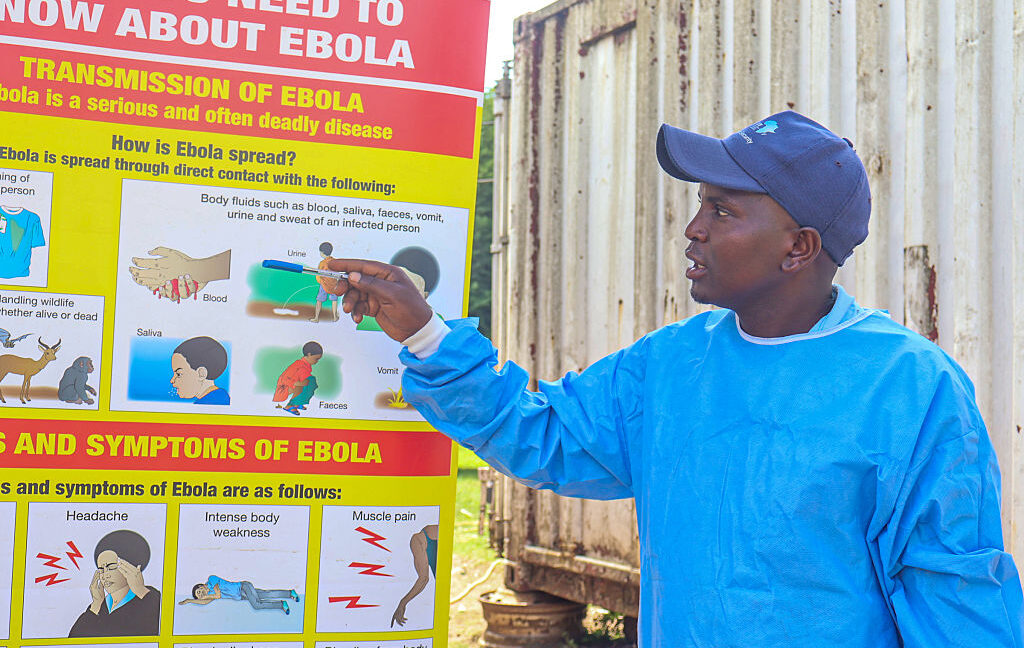
But after a series of events on Thursday and Friday, that plan has now been stalled.
Topic: politicsRegion: north americaUpdated: i2 outletsSources: 5Spectrum: Center Only⏱ 4 min read📡 Wire pickup⚠ 3d+ old
Story Summary
SITUATION
A Kenyan court's ruling has stalled the Trump administration's plan to quarantine Ebola-exposed Americans in Kenya, highlighting the challenges of balancing public health measures with international legal and diplomatic considerations. This decision reflects ongoing tensions in global health policy amid the Ebola crisis.
Coveragetap to expand ▾Spectrum: Center Only🌍US: 3 · Asia: 1 · Other: 1
Political Spectrum
Position is inferred from coverage mix.
i2 outlets · Center
Left
Center
Right
Left: 0
Center: 5
Right: 0
Geography Coverage
Distribution of where coverage is coming from.
i2 unique outlets · Dominant: US/Canada
KEY FACTS
- A Kenyan court has blocked the Trump administration's plan to quarantine Americans exposed to Ebola in Kenya, citing an 'imminent threat to life.'
- The proposed quarantine facility was intended to be located in Laikipia County, approximately 120 miles north of Nairobi.
- The Trump administration's plan included establishing a 50-bed quarantine facility for Ebola-exposed individuals.
- The ruling from the Kenyan court highlights the complexities of international health policies and the administration's handling of the Ebola crisis.
- The Ebola outbreak, which began in West Africa in 2014, resulted in over 11,000 deaths and prompted the U.S. government's proactive response to potential threats.
HISTORICAL CONTEXT
The recent ruling by a Kenyan court to block the Trump administration's plan to quarantine Americans exposed to Ebola in Kenya is situated within a broader context of international health policy and diplomatic relations. The immediate backdrop to this event is the ongoing global response to the Ebola virus, which has seen various outbreaks since its discovery in 1976.
The most significant outbreak occurred in West Africa from 2014 to 2016, resulting in over 11,000 deaths and prompting a reevaluation of international health protocols. In response to the 2014 outbreak, the World Health Organization (WHO) declared the situation a Public Health Emergency of International Concern (PHEIC) on August 8, 2014.
Brief
A Kenyan high court has intervened to block the Trump administration's controversial plan to send Americans exposed to Ebola to a makeshift quarantine facility in Kenya. The court's ruling, which cited an 'imminent threat to life,' comes as the administration has opted not to repatriate these citizens, despite an ongoing Ebola outbreak in the Democratic Republic of the Congo.
The facility was to be located in Laikipia, approximately 120 miles north of Nairobi, and was expected to accommodate up to 50 individuals. However, the court's decision has stalled these plans, prompting U.S. officials to seek alternative countries that might accept the exposed individuals.
The administration's refusal to bring these citizens home for specialized care has drawn significant criticism, raising questions about the adequacy of the proposed quarantine measures. The court will reconvene on June 2 to further examine the case, leaving the fate of these Americans uncertain.
As the situation develops, the administration faces mounting pressure to prioritize the health and safety of its citizens abroad.
Why it matters
- The Kenyan court's decision to block the Trump administration's plan to send Ebola-exposed Americans to Kenya has immediate implications for the health and safety of those individuals, who now face uncertainty about their repatriation and care.
- This ruling not only affects the affected Americans but also complicates the U.S. government's efforts to find alternative locations for quarantine, potentially delaying critical medical responses and increasing the risk of virus transmission.
- As officials scramble for new solutions, the situation underscores the challenges of international cooperation in public health crises and highlights the urgent need for effective domestic protocols to manage such outbreaks.
What to watch next
- The Trump administration is expected to respond to the Kenyan court's ruling within 72 hours, outlining their next steps regarding the repatriation of Americans exposed to Ebola.
- The U.S. State Department may issue a statement clarifying its position on international health protocols and the treatment of citizens abroad in the coming days.
- Congressional leaders are likely to hold discussions next week about potential legislative actions to address the implications of the court's decision on U.S. foreign policy.
- Health officials from the CDC are scheduled to brief Congress on the situation and the risks associated with Ebola exposure, aiming for a meeting before the end of the month.
- Advocacy groups are planning to mobilize public support for the repatriation of affected Americans, with a campaign launch expected within the next week.
Sources
5 of 5 linked articles
Kenyan court blocks Trump admin from dumping Ebola-exposed Americans there
arstechnica.comMay 29Center
↗
Kenya court suspends US plan for Ebola quarantine facility for Americans
apnews.comMay 29Left
↗
Kenyan court blocks US Ebola quarantine facility
theaustralian.com.auMay 29Left
↗
Court Blocks Trump Administration Plan to Treat American Ebola Patients in Kenya
wsj.comMay 29Left
↗
Kenya court blocks US plan to quarantine Americans with Ebola
newsnationnow.comMay 29Left
↗